Amsterdam, Netherlands

Every canal house
hides a story.
Some hide a church.

Urban Tales is a GPS audio guide app that narrates Amsterdam's hidden history, legends and secrets automatically as you walk — at your own pace, with no tour group to follow.


Walk up to a landmark.
The story starts.

No tapping. No searching. Urban Tales detects your GPS position and plays audio automatically the moment you're close enough. Put your phone in your pocket — just walk and listen.

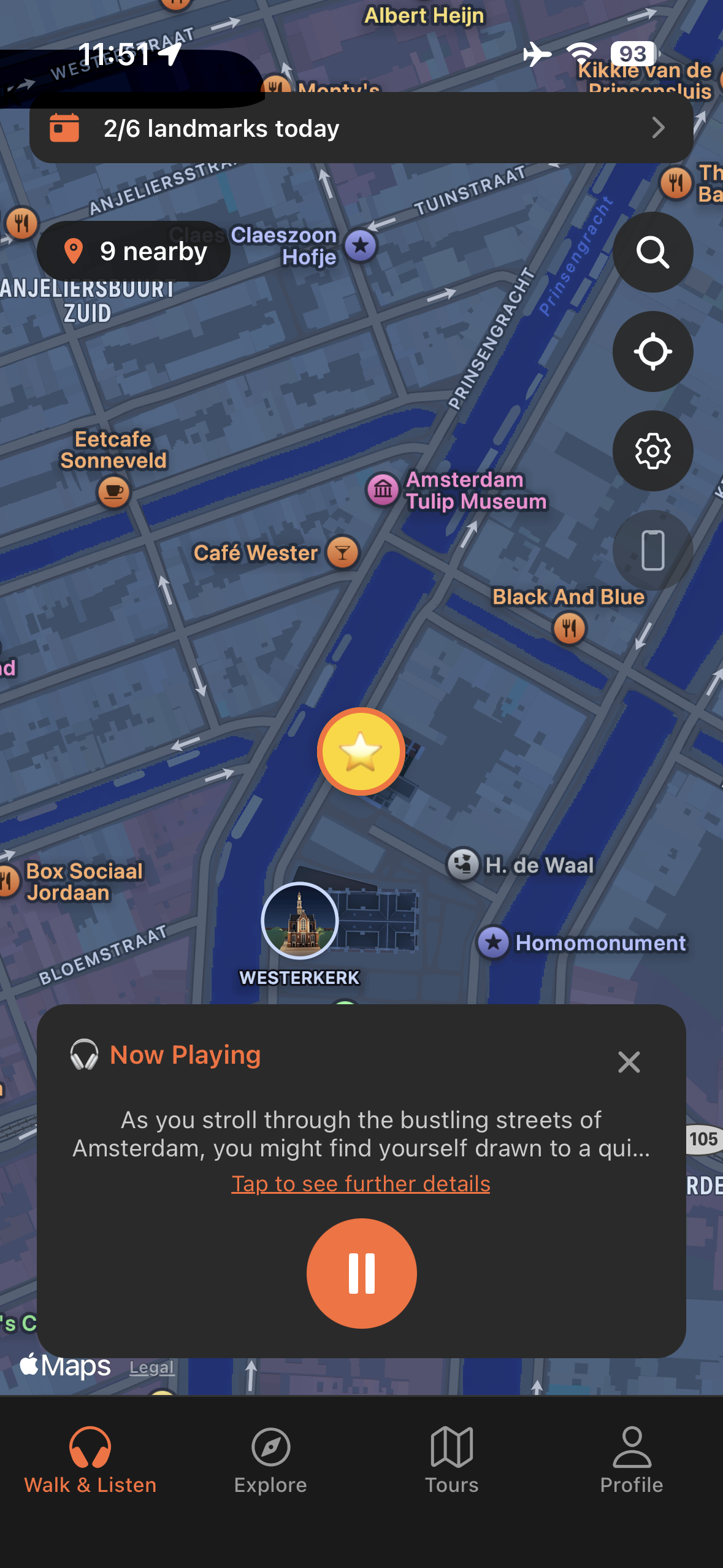
Urban Tales GPS map near the Anne Frank House in Amsterdam with audio story triggered

GPS triggered. Audio starts the moment you arrive at a landmark.

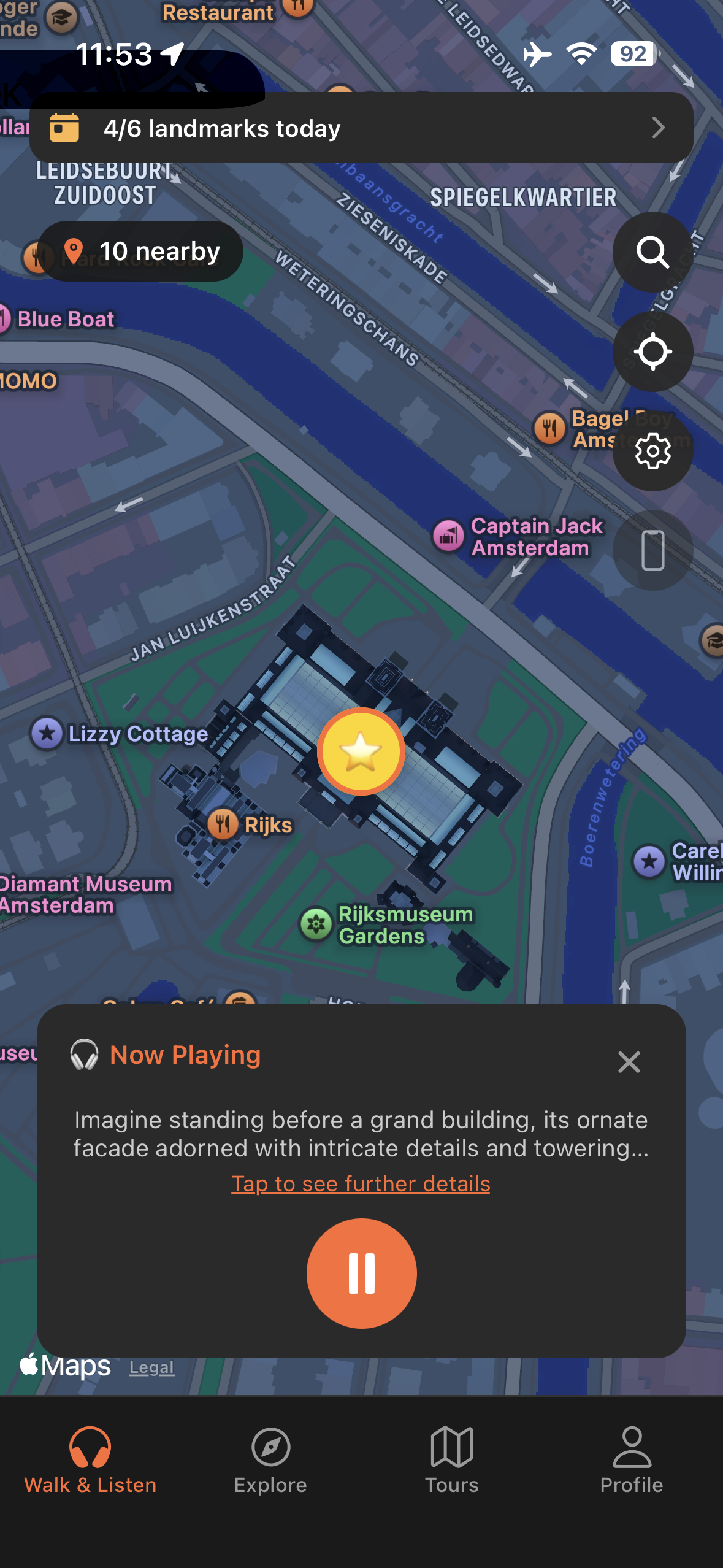
Urban Tales GPS map at the Rijksmuseum in Amsterdam with story triggered

Walk freely. Every landmark around you has a story ready.

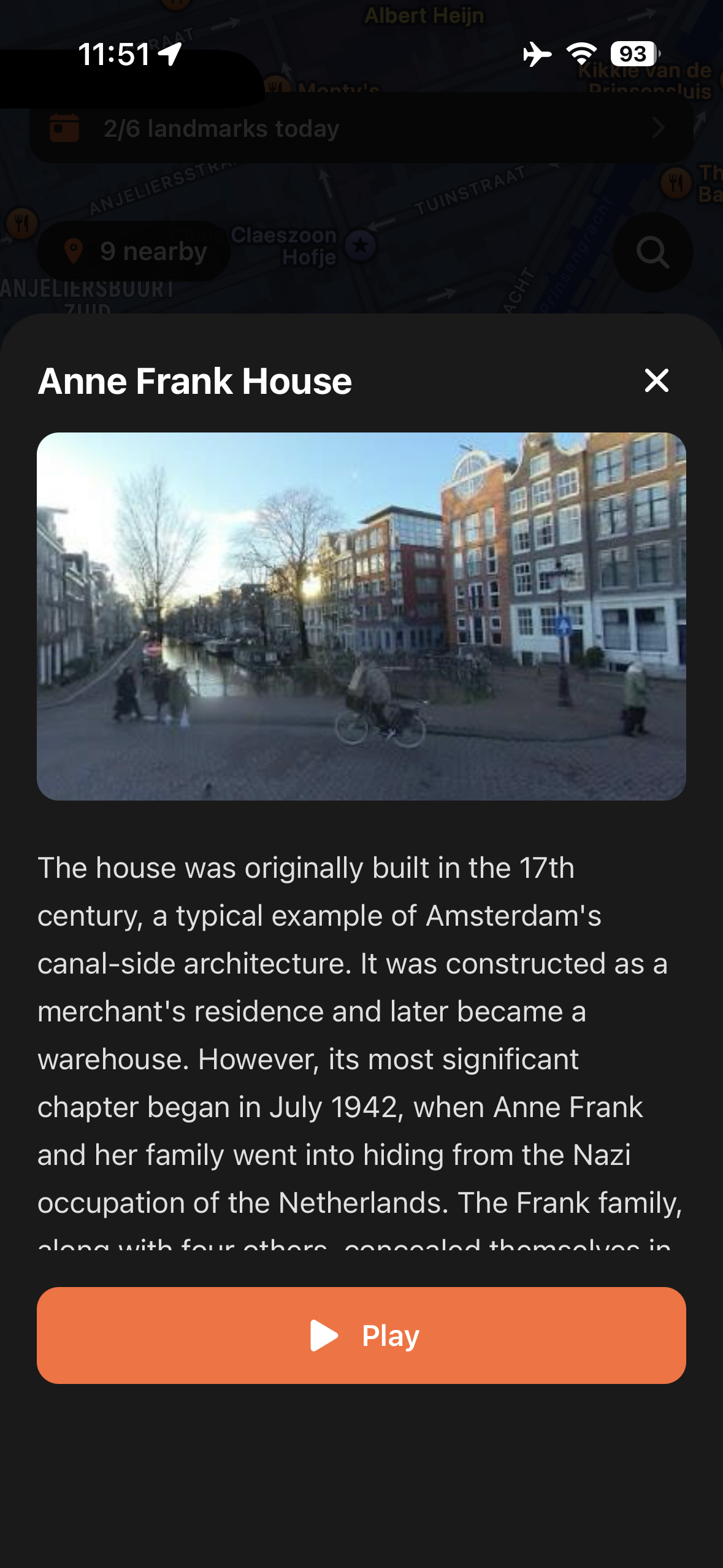
Urban Tales story panel for the Anne Frank House in Amsterdam with canal photo and narration

Rich stories. History, legends and context for every landmark.

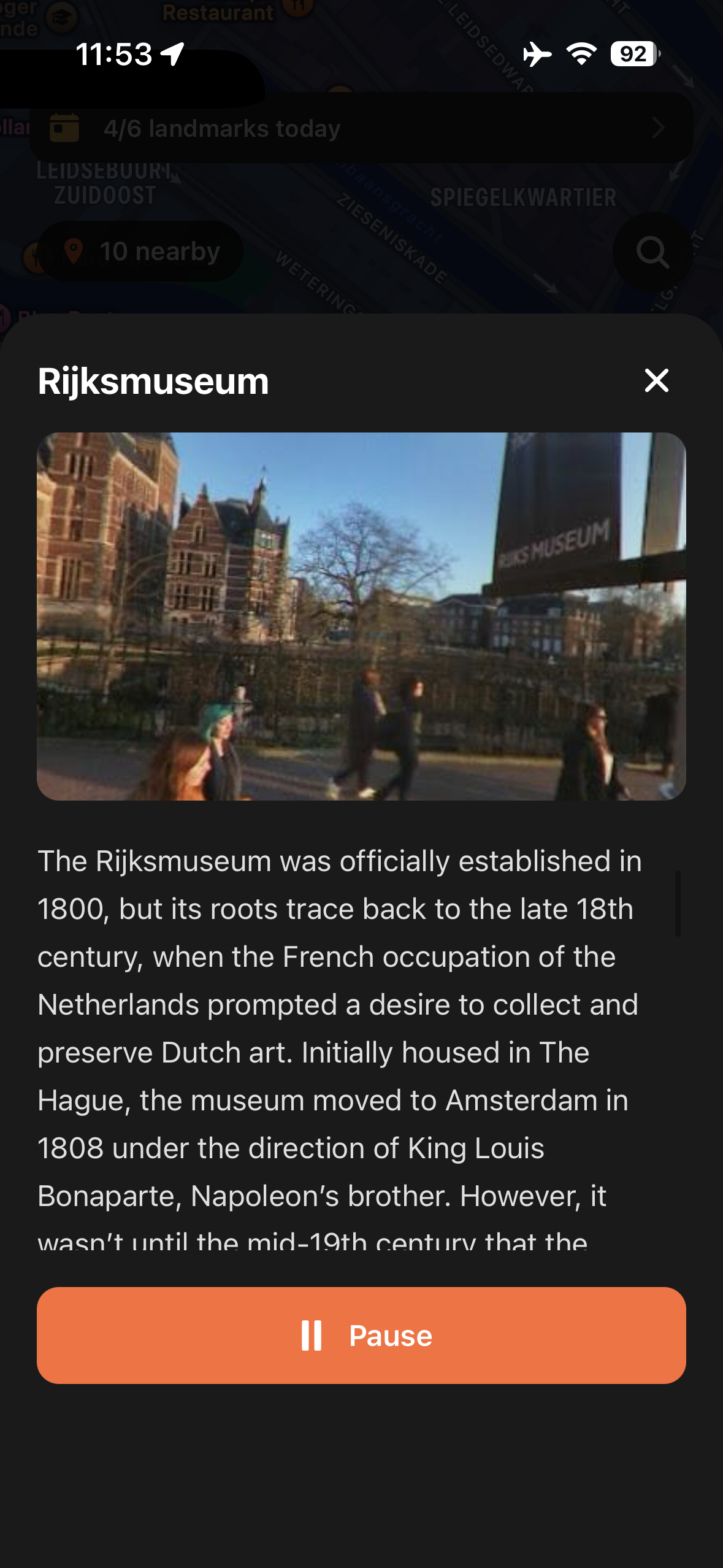
Urban Tales story panel for the Rijksmuseum in Amsterdam with photo and narration

4 storytelling styles. Historical, Legends, Fun Facts and Cinematic.


How it works

Open the app.
Start walking.

No preparation, no pre-booked route, no group to keep up with. Urban Tales works the moment you step outside.

01

Download and open the map

The app shows landmarks around you the moment you open it. Works anywhere in Amsterdam — the app covers the full city.

02

Walk toward anything that catches your eye

As you get close to a landmark, the audio starts automatically. Put your phone in your pocket and just walk and listen.

03

Build a route or explore freely

Create a half-day route, a full-day itinerary, a 7-wonders tour or a custom path. Or ignore all of that and wander — the app keeps up.


What you'll hear

The Amsterdam most visitors
never actually learn.

These are the kinds of stories Urban Tales narrates as you walk. Each one triggers automatically when you're standing in the right place.

History

Anne Frank House · Prinsengracht

Two years in hiding — and a diary that almost wasn't saved

From July 1942 to August 1944, Anne Frank, her family and four others hid in a sealed-off section of a canal house behind a bookcase. After they were betrayed and arrested, Anne's diary was found scattered on the floor by Miep Gies, who kept it. When Otto Frank returned from Auschwitz as the only survivor of the group, Miep gave him the diary. He spent years deciding whether to publish it. The diary has since been translated into 70 languages.

Legend

Our Lord in the Attic · Oudezijds Voorburgwal

A fully functional Catholic church has been hidden in a canal house attic since 1663

During the Protestant Reformation, Catholics in Amsterdam were banned from public worship. In 1663, a wealthy merchant converted the top three floors of his canal house into a hidden church — complete with a nave, gallery, altar and organ. The church operated secretly for over 200 years. It held services for the entire neighbourhood. Today it is the best-preserved 17th-century canal house in Amsterdam and still contains the original church, exactly as it was left.

History

Rijksmuseum · Museumplein

The Dutch Golden Age produced more paintings per capita than any other period in history

In the 17th century, Amsterdam was the wealthiest city in the world and its citizens bought paintings the way modern consumers buy electronics — obsessively. Estimates suggest the Dutch produced between 5 and 10 million paintings in that century alone. Rembrandt, Vermeer, Frans Hals and Jan Steen were all working simultaneously, competing for a market that consumed art at an extraordinary rate. The Rijksmuseum holds the largest collection of Dutch Golden Age painting in existence.

Fun fact

Jordaan · Western Canal Ring

A sailor bar accepted live monkeys as payment — and accidentally created the Amsterdam Zoo

In the Golden Age, sailors returning from VOC voyages would bring exotic animals back to Amsterdam. One bar in the Jordaan — In 't Aepjen, still open today — accepted monkeys as payment when sailors ran out of money. The bar eventually accumulated so many monkeys that the owner created a separate facility to house them, said to be one of the origin stories of Artis, the Amsterdam Zoo, founded in 1838.

History

Dam Square · City Centre

Amsterdam was literally built on a dam — in a river nobody lives near anymore

Amsterdam takes its name from a dam built across the Amstel River in the late 12th century. The city grew on the boggy marshland around it, built on millions of wooden piles driven into the soft ground. The Royal Palace on Dam Square rests on 13,659 wooden piles. Dam Square itself is built on the site of the original dam that gave the city its name.

Cinematic

Waterlooplein · Jewish Quarter

The most vibrant flea market in Europe stands on the site of one of the war's greatest losses

Before World War II, Amsterdam had a Jewish population of around 80,000 — one of the largest in Western Europe, rooted in the city for 400 years. By the end of the war, over 75% had been murdered, the highest proportion of any occupied Western European country. The Dutch Resistance Museum, just steps from Waterlooplein, tells the story of those who hid people like Anne Frank — and those who did not.

Legend

Tiber Island · Isola Tiberina

A snake chose this island as Rome's hospital — and it still is one

When a plague devastated Rome in 293 BC, a sacred serpent escaped a delegation's boat and swam to a small island in the Tiber. Romans took it as a divine sign and built a temple there. The island has been a place of healing ever since — it still houses a working hospital today. The snake wrapped around a rod became the universal symbol of medicine.

Cinematic

Largo di Torre Argentina · Campo Marzio

Julius Caesar was assassinated here. It's now a cat sanctuary.

On the Ides of March, 44 BC, Julius Caesar was stabbed 23 times in the ruins that sit in this open square. Most tourists walk around it without recognising what it is. Today, hundreds of cats live in the sunken ruins under the care of local volunteers. You can visit them for free.


Where to walk

Amsterdam's neighborhoods,
explained through stories.

Urban Tales covers the full city. Here are the areas where the stories are thickest.

Canal Ring & Jordaan

The UNESCO-listed canal network built in the 17th century — 165 canals, 1,500 bridges, warehouses and the hidden almshouse courtyards that give the Jordaan its character.

De Wallen & Old Centre

The oldest part of Amsterdam, including the Red Light District and the hidden Catholic church in an attic. Medieval streets, the oldest bar in the city and Dam Square at the centre of it all.

Museumplein & De Pijp

The Rijksmuseum, Van Gogh Museum and Stedelijk within walking distance of each other. De Pijp next door is where Amsterdam's daily life actually happens — the Albert Cuyp Market and brown cafés.

Jewish Quarter & Plantage

The neighborhood where Amsterdam's 400-year-old Jewish community lived before World War II. The Portuguese Synagogue, the Jewish Historical Museum and the oldest zoo in the Netherlands.

NDSM Wharf & Noord

The former shipyard that built Amsterdam's Golden Age fleet now hosts art studios, markets and one of the city's best street art scenes. A free ferry from Central Station — most tourists never make the crossing.

Spiegelkwartier & Leidseplein

Antique dealers, the Paradiso concert hall, the Melkweg and the Vondelpark — Amsterdam's most layered cultural mile, where the Golden Age meets the counterculture of the 1960s.


Storytelling styles

Choose how Amsterdam
speaks to you.

The same landmark sounds completely different in each mode. Switch styles anytime during your walk.

Historical

Context, dates, politics, empires. What actually happened here and why it mattered. For travelers who want to leave Amsterdam genuinely knowing things.

Legends

Myths, curses, ghosts and ancient superstitions. The stories locals told each other before the history books were written.

Fun Facts

The absurd, the surprising and the genuinely weird. Perfect for keeping energy up on a long walk or exploring with kids.

Cinematic

Films shot here, Vermeer painted here, Rembrandt lived and died here. Amsterdam through the lens of art and cinema.


FAQ

Common questions about
Urban Tales in Amsterdam.

Does Urban Tales cover the Anne Frank House?

Yes. Urban Tales covers the Anne Frank House at Prinsengracht, with stories triggered as you approach. The app tells the history from the outside — entry to the museum requires a separate ticket, which should be booked well in advance.

Is Urban Tales worth it if I have already been to Amsterdam?

Especially then. The hidden church in the attic, the Golden Age painting industry, the wartime history of the Jewish Quarter — Amsterdam rewards deeper exploration. The Fun Facts mode is particularly strong for a city this dense with history.

How does the pricing work for Amsterdam?

You can start exploring for free. A day pass unlocks the full Amsterdam experience for a single day, or you can unlock the city permanently. No subscriptions required.

What languages is the Amsterdam audio guide available in?

Urban Tales supports English, Spanish (LATAM), Brazilian Portuguese, French and German. Select your language when you first open the app.

Can I use Urban Tales for a half-day or full-day visit to Amsterdam?

Yes. Amsterdam is one of the most walkable cities in Europe — the historic centre is compact and almost entirely flat. Walking between canal houses with stories in your ears is exactly what the city was made for.

div>

Amsterdam is waiting.
The stories start the moment you land.

Free to download. No tour group. No fixed schedule.

Download on theApp Store
Get it onGoogle Play

Explore more

Urban Tales works
everywhere you travel.

Lisbon, Amsterdam, Buenos Aires and many more cities available. See the full list and find your next destination.

View all cities →