Bangkok, Thailand

Temples, canals,
street food and chaos.
The city that never stops.

Urban Tales is a GPS audio guide app that narrates Bangkok's hidden history, legends and secrets automatically as you walk — at your own pace, with no tour group to follow.


Walk up to a landmark.
The story starts.

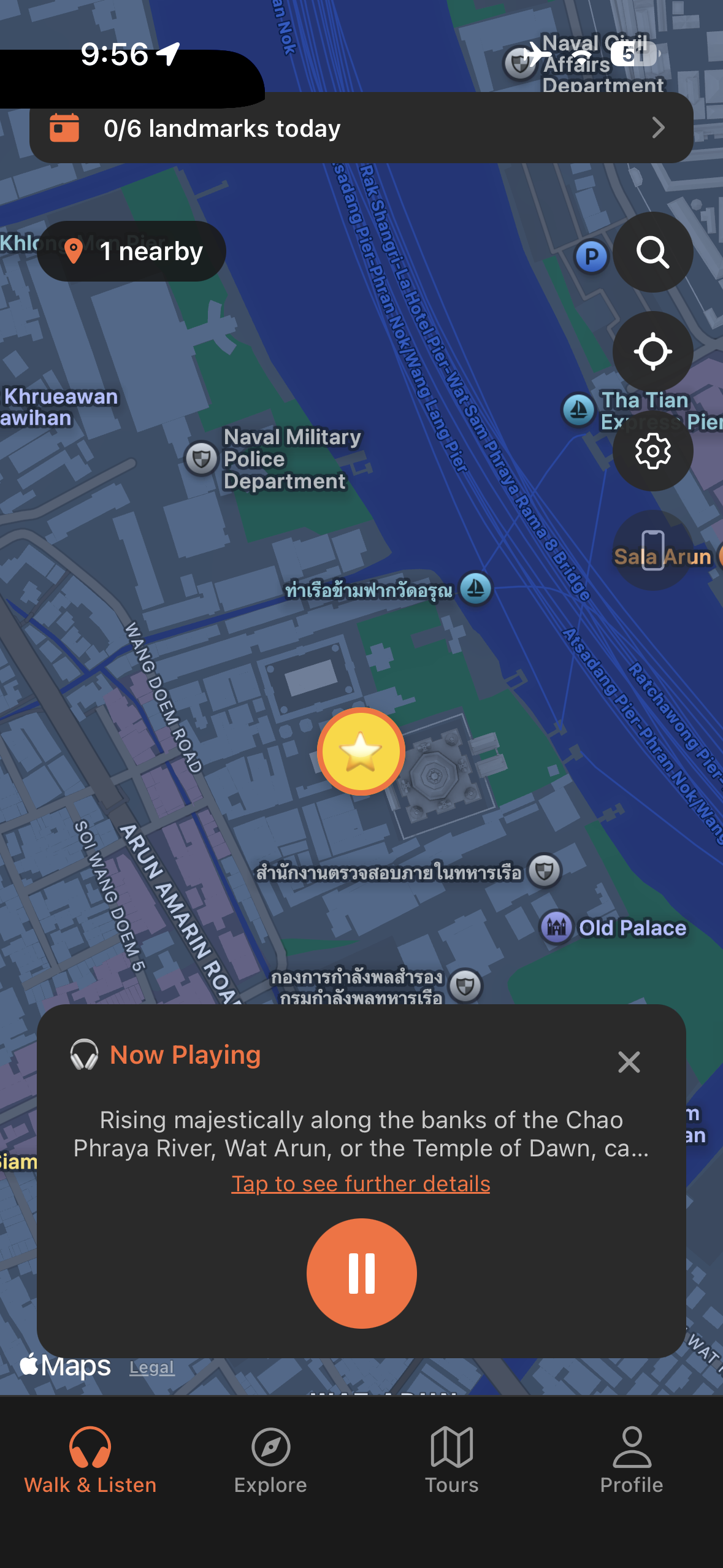
No tapping. No searching. Urban Tales detects your GPS position and plays audio automatically the moment you're close enough. Put your phone in your pocket — just walk and listen.

Urban Tales GPS map in Bangkok with audio story automatically triggered

GPS triggered. Audio starts the moment you arrive at a landmark.

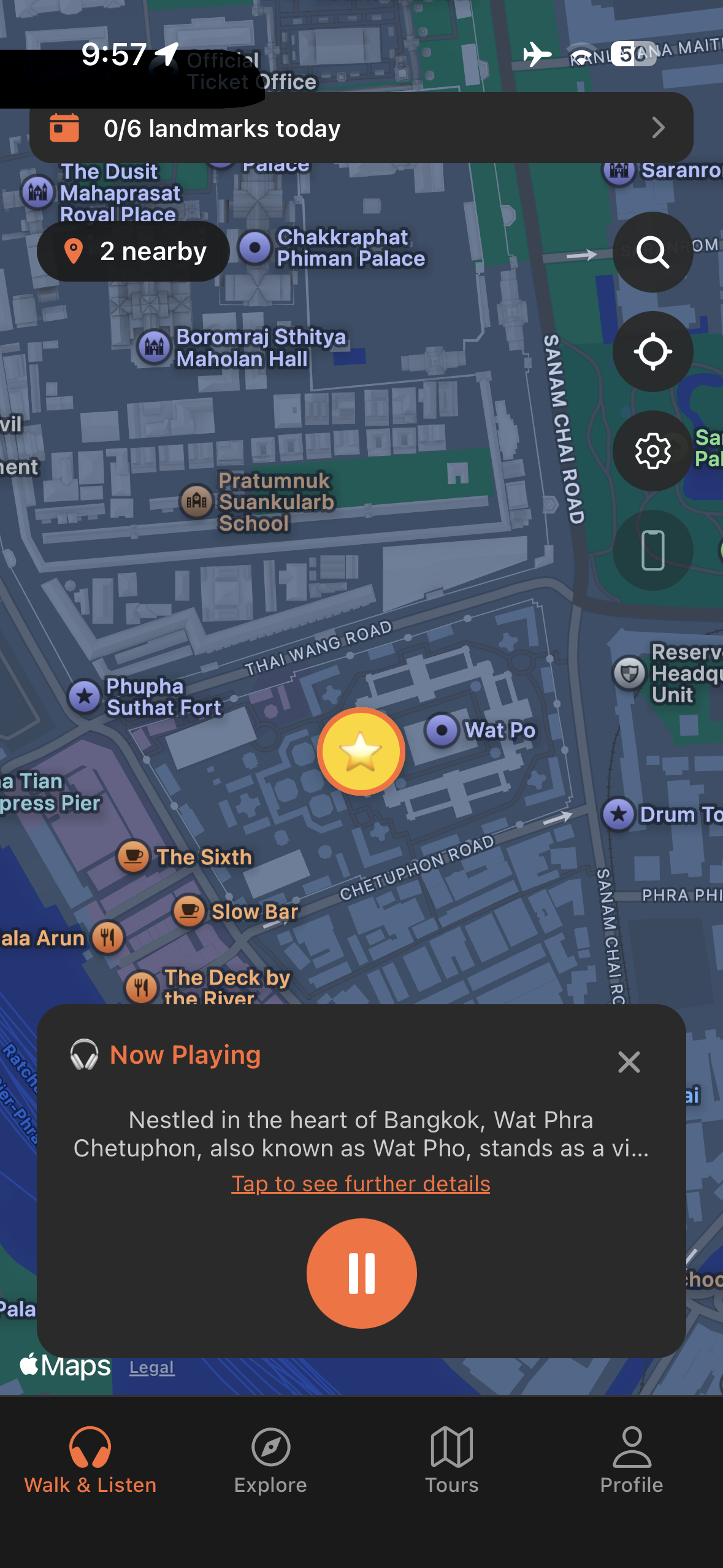
Urban Tales GPS map in Bangkok with story automatically triggered

Walk freely. Every landmark around you has a story ready.

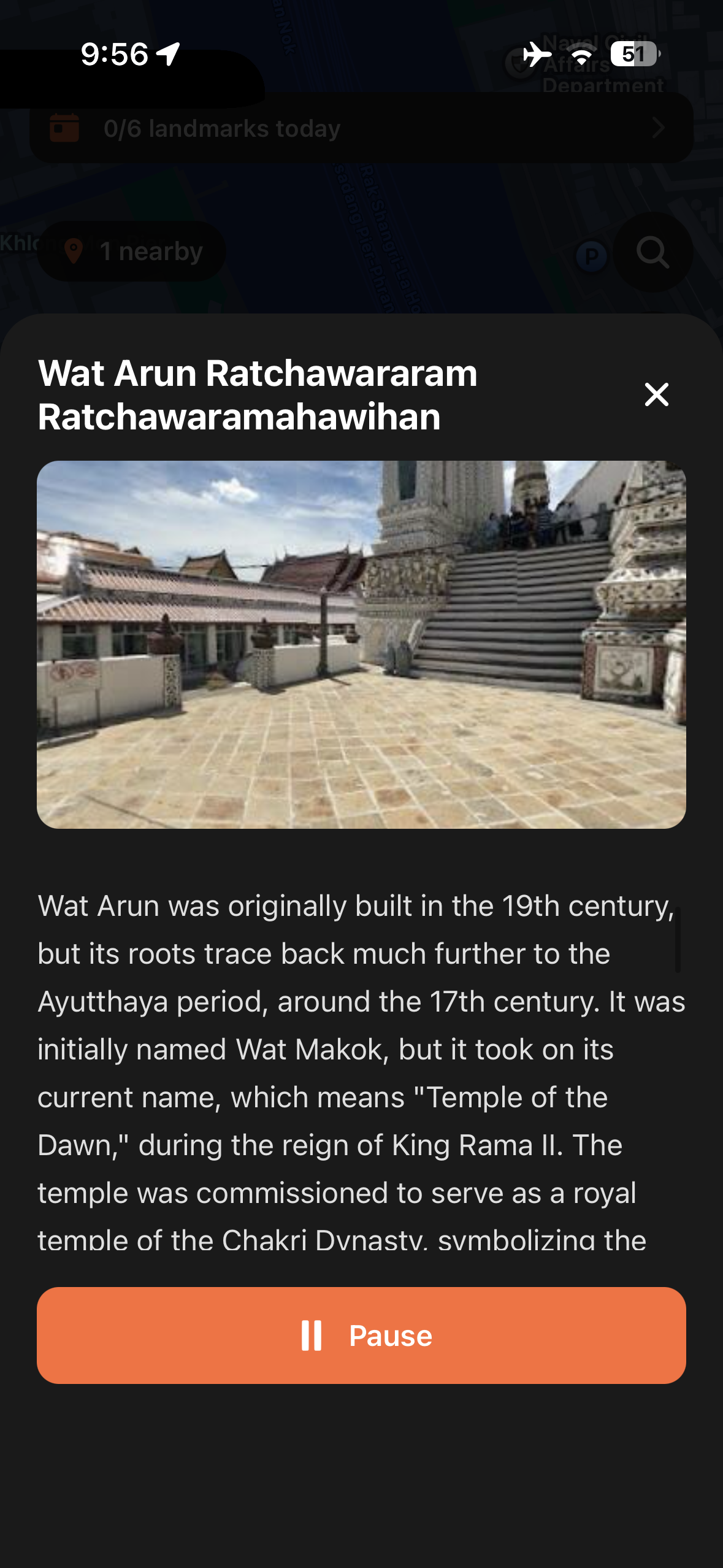
Urban Tales story panel in Bangkok with photo and narration

Rich stories. History, legends and context for every landmark.

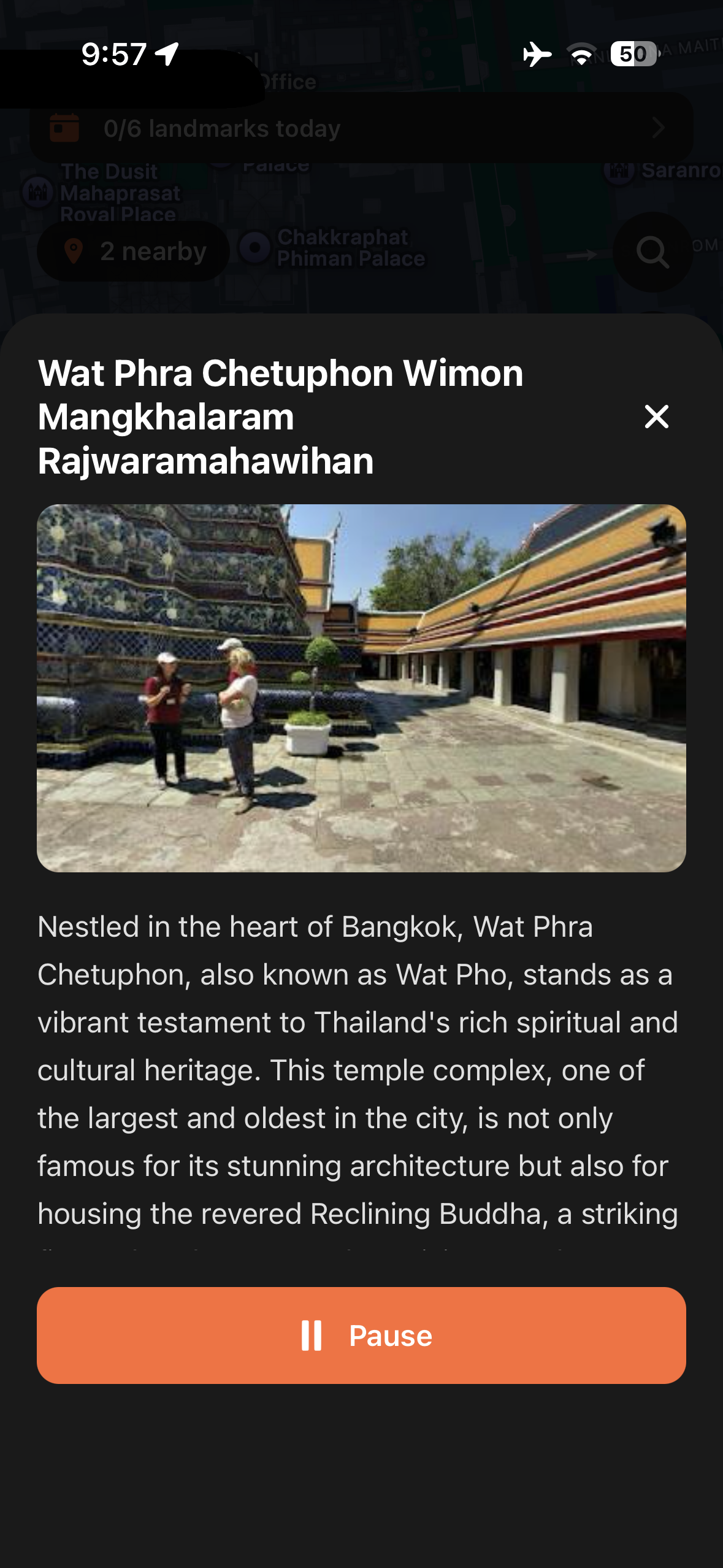
Urban Tales story panel in Bangkok with photo and narration

4 storytelling styles. Historical, Legends, Fun Facts and Cinematic.


How it works

Open the app.
Start walking.

No preparation, no pre-booked route, no group to keep up with. Urban Tales works the moment you step outside.

01

Download and open the map

The app shows landmarks around you the moment you open it. Works anywhere in Bangkok — the app covers the full city.

02

Walk toward anything that catches your eye

As you get close to a landmark, the audio starts automatically. Put your phone in your pocket and just walk and listen.

03

Build a route or explore freely

Create a half-day route, a full-day itinerary, a 7-wonders tour or a custom path. Or ignore all of that and wander — the app keeps up.


What you'll hear

The Bangkok most visitors
never actually learn.

These are the kinds of stories Urban Tales narrates as you walk. Each one triggers automatically when you're standing in the right place.

History

Wat Arun · Thonburi

The Temple of Dawn is covered in millions of fragments of Chinese porcelain — from ballast thrown off trade ships

Wat Arun's iconic spire, rising 70 metres above the Chao Phraya River, is decorated with millions of pieces of Chinese porcelain — plates, bowls and cups shattered deliberately and pressed into the plaster in intricate patterns. The porcelain came from Chinese trading ships that used ceramic dishes as ballast; when they arrived in Bangkok, the dishes were no longer needed. Rather than discard them, temple craftsmen turned them into the most distinctive exterior in Thailand. The work continues — craftspeople still repair the porcelain mosaic by hand today.

History

Wat Pho · Rattanakosin

Thailand's oldest public university hid its knowledge in stone — carved into the temple walls to survive any future burning of books

Wat Pho, built in the 16th century and expanded under King Rama III in the 1830s, was designed as Thailand's first public university. The king ordered the walls decorated with inscriptions covering medicine, astrology, history and literature — essentially encoding the kingdom's entire body of knowledge into the stone and ceramic of the temple complex. His reasoning: books could be burned and libraries destroyed, but it was harder to erase knowledge from the walls of a royal temple. Wat Pho is also the birthplace of Thai massage, which is still taught there today.

Fun fact

Grand Palace · Rattanakosin

Bangkok's full ceremonial name is the longest place name in the world — and most Thais know it by heart

Bangkok's ceremonial name is Krungthepmahanakhon Amonrattanakosin Mahintharayutthaya Mahadilokphop Noppharatratchathaniburirom Udomratchaniwetmahasathan Amonphimanawatansathit Sakkathattiyawitsanukamprasit — 168 characters, officially recognised by Guinness World Records as the longest place name on Earth. Thai schoolchildren learn it as a song. It translates roughly to "City of Angels, Great City of Immortals, Magnificent City of the Nine Gems..." Bangkok itself is a foreign nickname. Thais call their capital Krung Thep — City of Angels.

Legend

Erawan Shrine · Ratchaprasong

A four-faced Hindu deity shrine at the heart of Bangkok was built to appease spirits — and became one of Asia's most visited religious sites

The Erawan Shrine was built in 1956 after a series of accidents and deaths during the construction of the Erawan Hotel (now the Grand Hyatt). A Brahmin priest advised that a shrine to Brahma be erected to appease the spirits of the land. The accidents stopped. The shrine grew. It now sits at one of Bangkok's busiest intersections, and thousands of people visit daily to make offerings — flowers, incense, wooden elephants and commissioned traditional dances. It was bombed in 2015 but rebuilt and reopened within weeks.

Cinematic

Khao San Road · Banglamphu

A single street became the backpacker capital of the world — and Alex Garland wrote The Beach about the travellers he met here

Khao San Road, a few hundred metres long in the Banglamphu district, became the centre of Southeast Asian backpacker culture in the 1980s and 90s. The British novelist Alex Garland stayed in guesthouses nearby while travelling Thailand in the early 1990s. His 1996 novel The Beach — about a traveller searching for a utopian hidden beach — was inspired partly by the travellers he encountered on Khao San Road and the culture of destination-seeking that defined the era. The film adaptation starred Leonardo DiCaprio and was shot on Koh Phi Phi.

History

Chao Phraya River · City-wide

Bangkok was called the "Venice of the East" — and its canals were deliberately filled in to build roads

In the 19th century, Bangkok was a city built on canals — klongs — that served as roads, markets and water supplies. Homes, temples and markets were built on the water. European visitors called it the Venice of the East. In the late 19th and early 20th centuries, as the Thai government modernised, the canals were progressively filled in to create roads. Most of the canal network is gone. What remains in Thonburi, on the west bank of the Chao Phraya, preserves a glimpse of the canal city that once covered the entire Bangkok plain.


Where to walk

Bangkok's neighborhoods,
explained through stories.

Urban Tales covers the full city. Here are the areas where the stories are thickest.

Rattanakosin (Old City)

The artificial island where Bangkok's royal city was founded in 1782. The Grand Palace, Wat Pho, Wat Arun across the river — the oldest and most densely sacred part of the city.

Thonburi & Canals

The west bank of the Chao Phraya, where the canal city that once covered all of Bangkok still exists in fragments. Wat Arun's porcelain spire, floating markets and klongs lined with wooden houses.

Chinatown (Yaowarat)

One of the oldest and densest Chinatowns in the world. The street food here — crab omelette, roast duck, mango sticky rice — is eaten standing at the side of the road, at midnight, as it has been for 200 years.

Silom & Sathorn

Bangkok's financial district during the day, its most international nightlife after dark. The Sri Mariamman Temple sits between glass towers. Lumpini Park provides the only escape from the heat in the entire district.

Sukhumvit

The street that runs for 50 kilometres through eastern Bangkok and contains more different versions of the city than any other single road — from luxury malls to street markets, Japanese restaurants to rooftop bars.

Banglamphu & Khao San

The neighborhood where Alex Garland stayed before writing The Beach, where backpacker culture was invented and where the oldest parts of Bangkok survive in narrow lanes behind the main road.


Storytelling styles

Choose how Bangkok
speaks to you.

The same landmark sounds completely different in each mode. Switch styles anytime during your walk.

Historical

Context, dates, politics, empires. What actually happened here and why it mattered. For travelers who want to leave Bangkok genuinely knowing things.

Legends

Myths, curses, ghosts and ancient superstitions. The stories locals told each other before the history books were written.

Fun Facts

The absurd, the surprising and the genuinely weird. Perfect for keeping energy up on a long walk or exploring with kids.

Cinematic

The Hangover II was filmed here, Alex Garland set The Beach nearby. Bangkok through the lens of cinema and literature.


FAQ

Common questions about
Urban Tales in Bangkok.

Does Urban Tales cover the Grand Palace, Wat Pho and Wat Arun?

Yes. Urban Tales covers all three — with stories triggered as you approach each temple and palace. Entry to the Grand Palace and temple interiors requires separate tickets, which should be purchased on arrival.

Is Urban Tales worth it if I have already been to Bangkok?

Especially then. The porcelain on Wat Arun, the knowledge encoded into Wat Pho's walls, Bangkok's full ceremonial name — these are the layers that most visitors never reach. The city rewards depth every time.

How does the pricing work for Bangkok?

You can start exploring for free. A day pass unlocks the full Bangkok experience for a single day, or you can unlock the city permanently. No subscriptions required.

What languages is the Bangkok audio guide available in?

Urban Tales supports English, Spanish (LATAM), Brazilian Portuguese, French and German. Select your language when you first open the app.

Can I use Urban Tales for a half-day or full-day visit to Bangkok?

Yes. The old city around Rattanakosin is compact and walkable. A half-day covers the Grand Palace, Wat Pho and a river crossing to Wat Arun. A full day lets you explore Chinatown, the canal neighborhoods of Thonburi and the neighborhoods further east.

Bangkok is waiting.
The stories start the moment you land.

Free to download. No tour group. No fixed schedule.

Download on theApp Store
Get it onGoogle Play

Explore more

Urban Tales works
everywhere you travel.

Explore our full collection of cities at urbantales.net/cities.html See the full list and find your next destination.

View all cities →