Barcelona, Spain

Gaudí built the
skyline. The city
hides the rest.

Urban Tales is a GPS audio guide app that narrates Barcelona's hidden history, legends and secrets automatically as you walk — at your own pace, with no tour group to follow.


Walk up to a landmark.
The story starts.

No tapping. No searching. Urban Tales detects your GPS position and plays audio automatically the moment you're close enough. Put your phone in your pocket — just walk and listen.

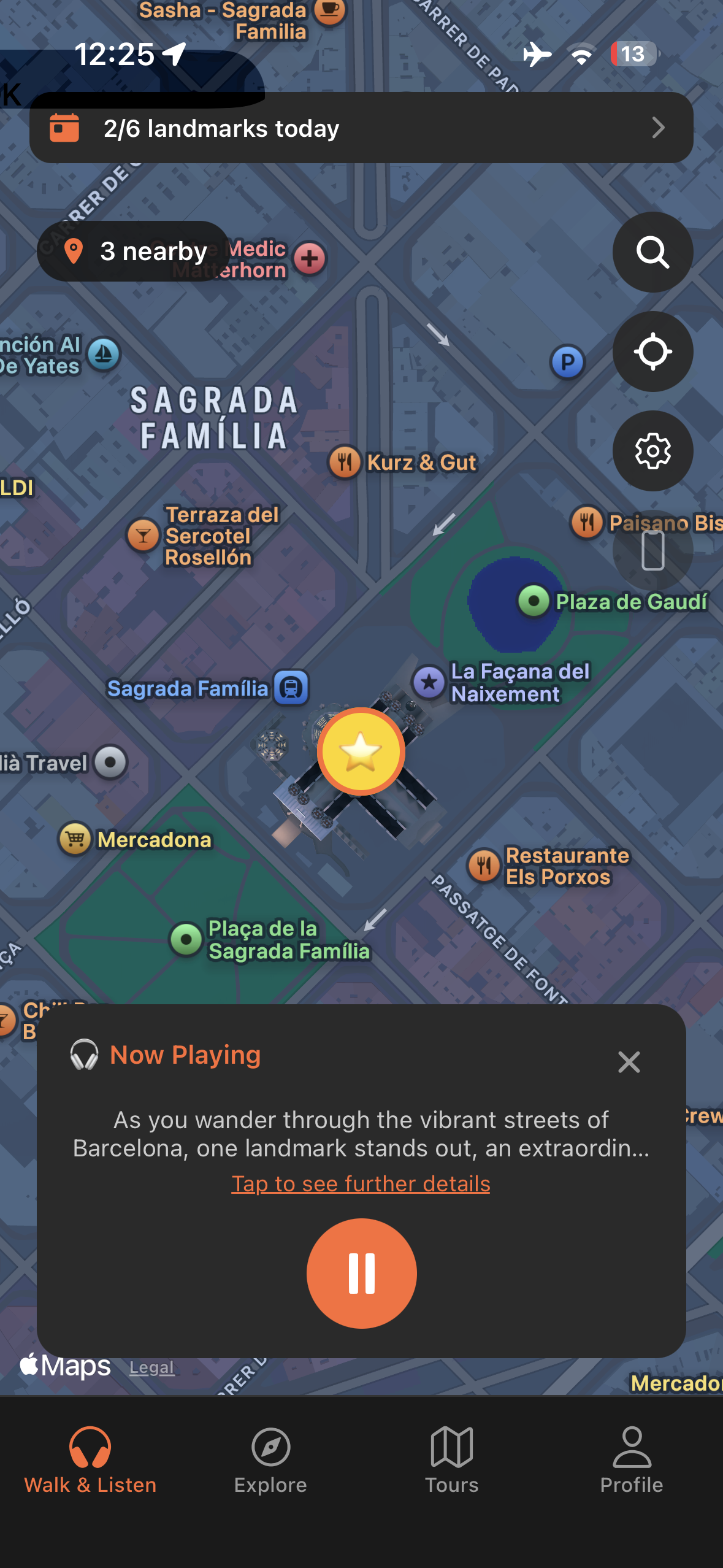
Urban Tales GPS map near the Sagrada Família in Barcelona with audio story automatically triggered

GPS triggered. Audio starts the moment you arrive at a landmark.

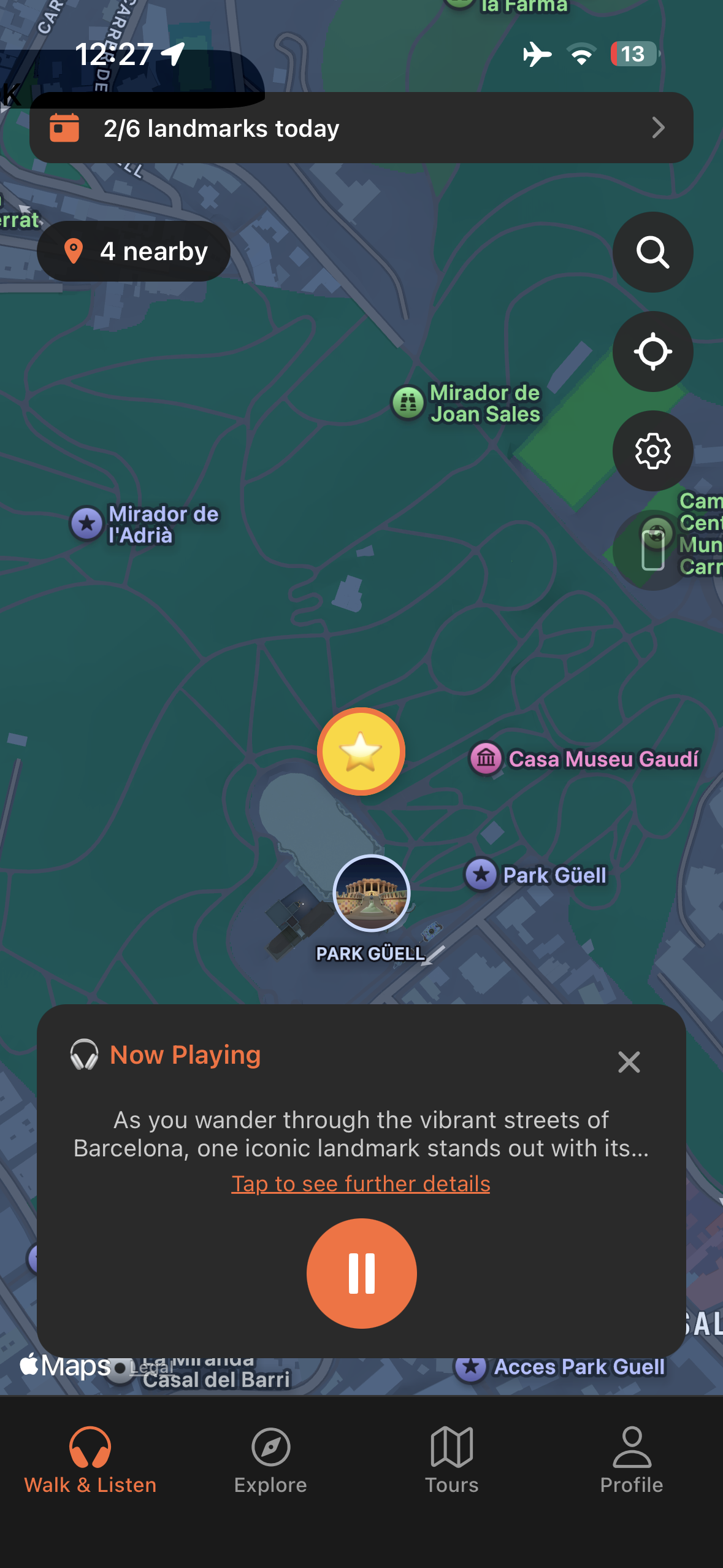
Urban Tales GPS map at Park Güell in Barcelona with story automatically triggered

Walk freely. Every landmark around you has a story ready.

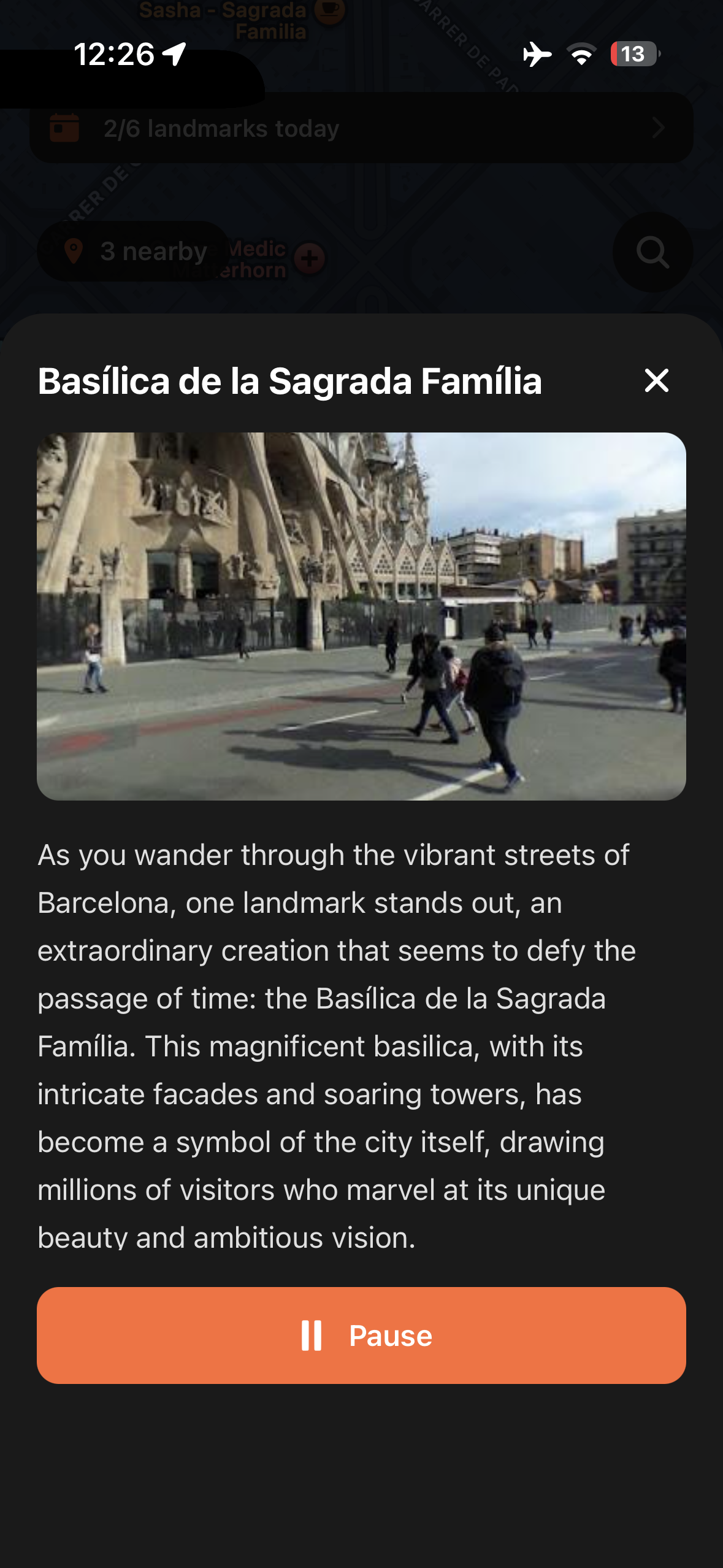
Urban Tales story panel for the Sagrada Família in Barcelona with narration text and photo

Rich stories. History, legends and context for every landmark.

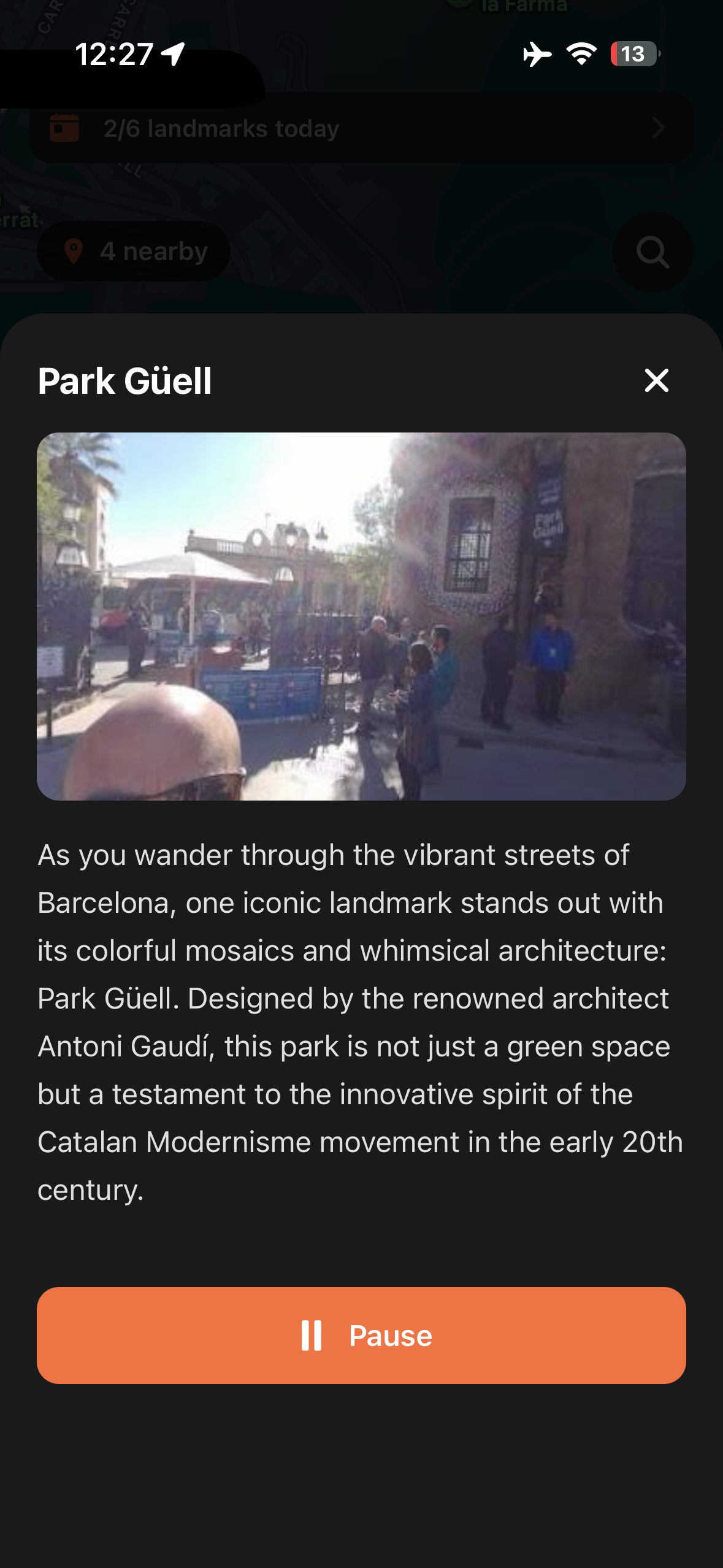
Urban Tales story panel for Park Güell in Barcelona with photo and narration text

4 storytelling styles. Historical, Legends, Fun Facts and Cinematic.


How it works

Open the app.
Start walking.

No preparation, no pre-booked route, no group to keep up with. Urban Tales works the moment you step outside.

01

Download and open the map

The app shows landmarks around you the moment you open it. Works anywhere in Barcelona — from the Sagrada Família to a quiet street in Gràcia.

02

Walk toward anything that catches your eye

As you get close to a landmark, the audio starts automatically. Put your phone in your pocket and just walk and listen.

03

Build a route or explore freely

Create a half-day route, a full-day itinerary, a 7-wonders tour or a custom path. Or ignore all of that and wander — the app keeps up.


What you'll hear

The Barcelona most visitors
never actually learn.

These are the kinds of stories Urban Tales narrates as you walk. Each one triggers automatically when you're standing in the right place.

History

Sagrada Família · Eixample

The most visited building in Spain has been under construction for over 140 years — and was started by a man who knew he'd never see it finished

Antoni Gaudí took over the Sagrada Família in 1883 and immediately knew the project would outlast him. He spent the last 16 years of his life living in the crypt, working exclusively on it. When he was struck by a tram in 1926, he was so simply dressed that passersby assumed he was a beggar. He died three days later. Construction is expected to finish in 2026 — 144 years after it began.

Legend

Pont del Bisbe · Gothic Quarter

A neo-Gothic bridge with a skull and a sword — and a legend that will end the city

The ornate bridge connecting the Palau de la Generalitat to the Casa dels Canonges was built in 1928 and immediately controversial — it was constructed without permission. But the legend that grew around it is darker: a stone skull with a dagger is carved into its arch. According to local tradition, if the dagger is ever removed, the city of Barcelona will collapse. Locals still half-believe it.

Fun fact

Park Güell · Gràcia

Gaudí's masterpiece was a complete commercial failure — it only sold two of its planned 60 plots

Eusebi Güell commissioned Park Güell in 1900 as a luxury housing estate for the Barcelona bourgeoisie. Gaudí designed winding paths, elaborate mosaic terraces and a market hall — then almost nobody bought a house. By 1914 the project was abandoned as a housing development. The city eventually bought it and opened it as a public park. One of the only two houses ever sold there was Gaudí's own home, now a museum.

History

Plaça de Sant Felip Neri · Gothic Quarter

The bullet holes in the church walls are from a massacre — not the war you might assume

This quiet, tucked-away square in the Gothic Quarter feels timeless. But look closely at the church walls and you'll see dozens of pockmarks. In January 1938, during the Spanish Civil War, a Nationalist bomb killed 42 people sheltering there — many of them children. The shrapnel damage was never repaired. The square remains one of the most charged and least visited spots in the city.

Cinematic

Las Ramblas · Ciutat Vella

Hemingway, Picasso and Orwell all walked this street — and wrote about it very differently

Las Ramblas has attracted writers for over a century. Hemingway drank at the bars. Picasso grew up in the streets around it. George Orwell was shot through the throat on a nearby rooftop during the Civil War and wrote about recovering in the cafes below in Homage to Catalonia. He described Las Ramblas as the only street in the world where he wished the night would last forever.

Legend

Temple of Augustus · Gothic Quarter

Four 2,000-year-old Roman columns are hidden inside a medieval courtyard — most people walk past the door

At Carrer del Paradís 10, four enormous columns from the Roman Temple of Augustus stand in a dim medieval courtyard — 9 metres high, perfectly preserved, and almost completely unknown to visitors. The temple was built in the 1st century BC when Barcelona was the Roman city of Barcino. The columns were incorporated into medieval walls for centuries before being rediscovered. Entry is free.


Where to walk

Barcelona's neighborhoods,
explained through stories.

Urban Tales covers the full city. Here are the areas where the stories are thickest.

Gothic Quarter

The oldest part of Barcelona, built over Roman ruins. Medieval streets that haven't changed their layout in 2,000 years, hidden squares and the ghostly traces of the Spanish Civil War still visible in the walls.

El Born & Sant Pere

Narrow medieval streets, the 14th-century Santa Maria del Mar basilica built by the people of the Ribera neighborhood, and El Born Centre — a covered market built over the ruins of the 1714 siege of Barcelona.

Eixample

The 19th-century grid district where Modernisme exploded. The Sagrada Família, Casa Batlló, Casa Milà and dozens of other extraordinary buildings within walking distance of each other.

Gràcia

A former independent village absorbed into Barcelona in 1897. Its residents have been asserting their identity ever since. Park Güell, intimate plazas and the most local feeling of any neighborhood in the city.

Barceloneta & Port

Built in the 18th century to house fishermen displaced by the construction of the Citadel fortress. The grid of tight streets hides a history of displacement, resistance and the smell of the sea.

Montjuïc

The hill that has watched over the city for centuries. A castle used as a military prison, the 1929 World Exhibition pavilions, a cemetery and a fortress — and one of the best views of the Mediterranean anywhere.


Storytelling styles

Choose how Barcelona
speaks to you.

The same landmark sounds completely different in each mode. Switch styles anytime during your walk.

Historical

Context, dates, politics, empires. What actually happened here and why it mattered. For travelers who want to leave Barcelona genuinely knowing things.

Legends

Myths, curses, ghosts and ancient superstitions. The stories Catalans told each other before the history books were written.

Fun Facts

The absurd, the surprising and the genuinely weird. Perfect for keeping energy up on a long walk or exploring with kids.

Cinematic

Films shot here, scenes set here, Almodóvar and Woody Allen both fell for these streets. Barcelona through the lens of cinema.


FAQ

Common questions about
Urban Tales in Barcelona.

Does Urban Tales cover Gaudí's buildings — Sagrada Família, Casa Batlló, Casa Milà?

Yes. Urban Tales covers all of Gaudí's major works in Barcelona, with stories triggered as you approach each building. The app covers the exterior and surrounding areas — entry tickets for the interiors are separate.

Is Urban Tales worth it if I've already been to Barcelona before?

Especially then. The city reveals entirely different layers on return visits — the Roman history beneath the Gothic Quarter, the Civil War traces in Plaça de Sant Felip Neri, the failed housing estate behind Park Güell. The Legends mode transforms places you thought you already knew.

How does the pricing work for Barcelona?

You can start exploring for free. A day pass unlocks the full Barcelona experience for a single day, or you can unlock the city permanently. No subscriptions required.

What languages is the Barcelona audio guide available in?

Urban Tales supports English, Spanish (LATAM), Brazilian Portuguese, French and German. Select your language when you first open the app.

Can I use Urban Tales for a half-day or full-day visit to Barcelona?

Yes. The app supports quick stops, half-day explorations, full-day routes and custom tours. Use the tour generator to plan around your available time — Barcelona is compact enough to cover a lot on foot in a single day.

Barcelona is waiting.
The stories start the moment you land.

Free to download. No tour group. No fixed schedule.

Download on theApp Store
Get it onGoogle Play

Explore more

Urban Tales works
everywhere you travel.

Barcelona, London, New York and many more cities available. See the full list and find your next destination.

View all cities →