Berlin, Germany

Divided for 28 years.
Reunited for 35.
Still figuring it out.

Urban Tales is a GPS audio guide app that narrates Berlin's hidden history, legends and secrets automatically as you walk — at your own pace, with no tour group to follow.


Walk up to a landmark.
The story starts.

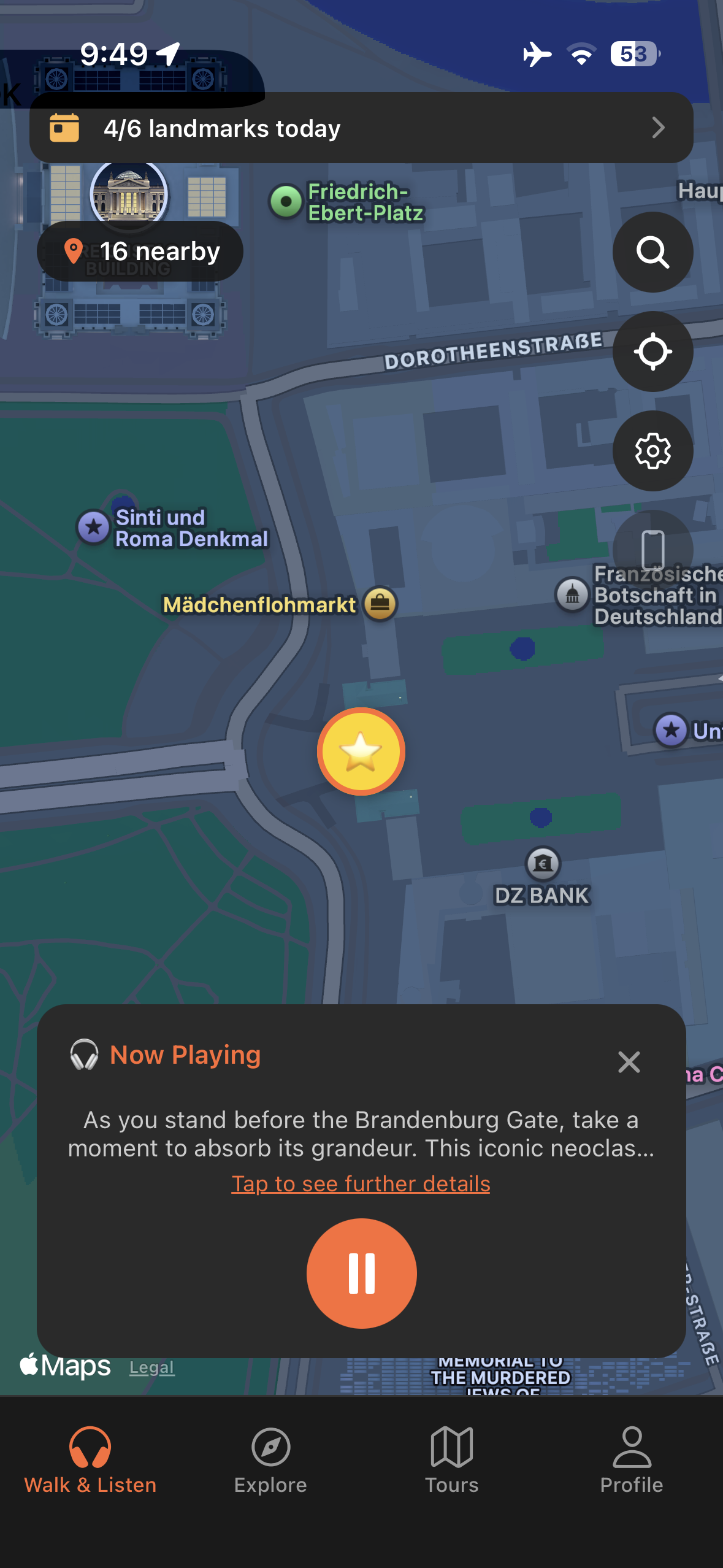
No tapping. No searching. Urban Tales detects your GPS position and plays audio automatically the moment you're close enough. Put your phone in your pocket — just walk and listen.

Urban Tales GPS map in Berlin with audio story automatically triggered

GPS triggered. Audio starts the moment you arrive at a landmark.

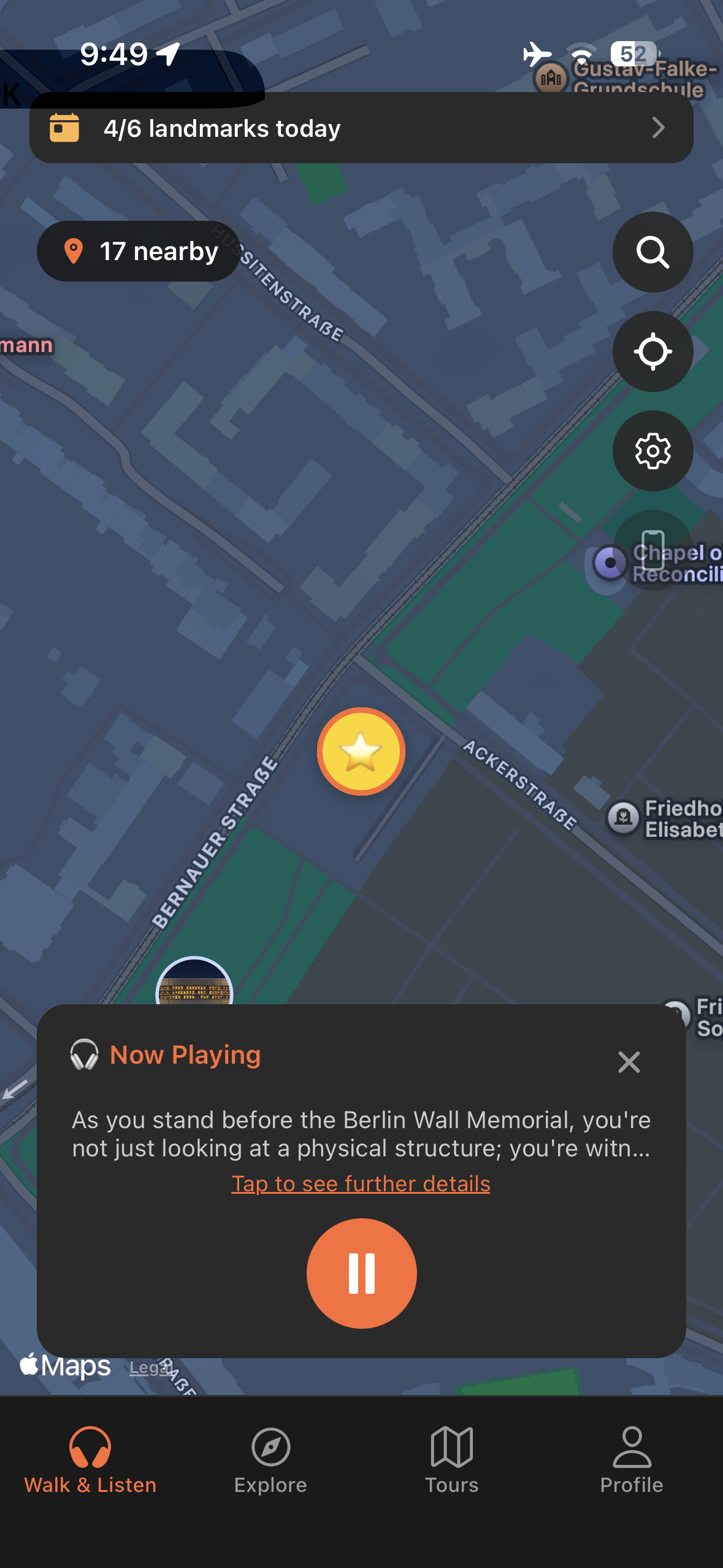
Urban Tales GPS map in Berlin with story automatically triggered

Walk freely. Every landmark around you has a story ready.

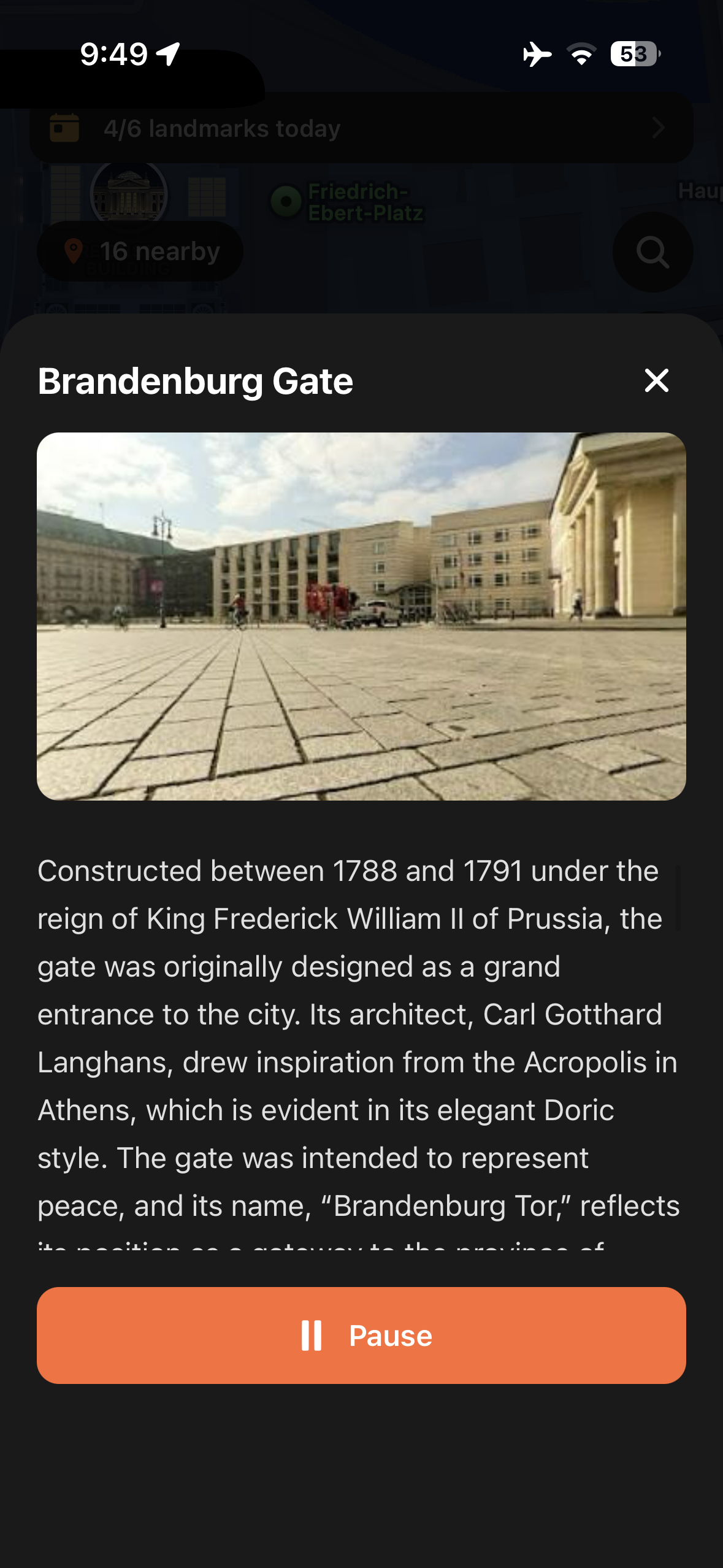
Urban Tales story panel in Berlin with photo and narration

Rich stories. History, legends and context for every landmark.

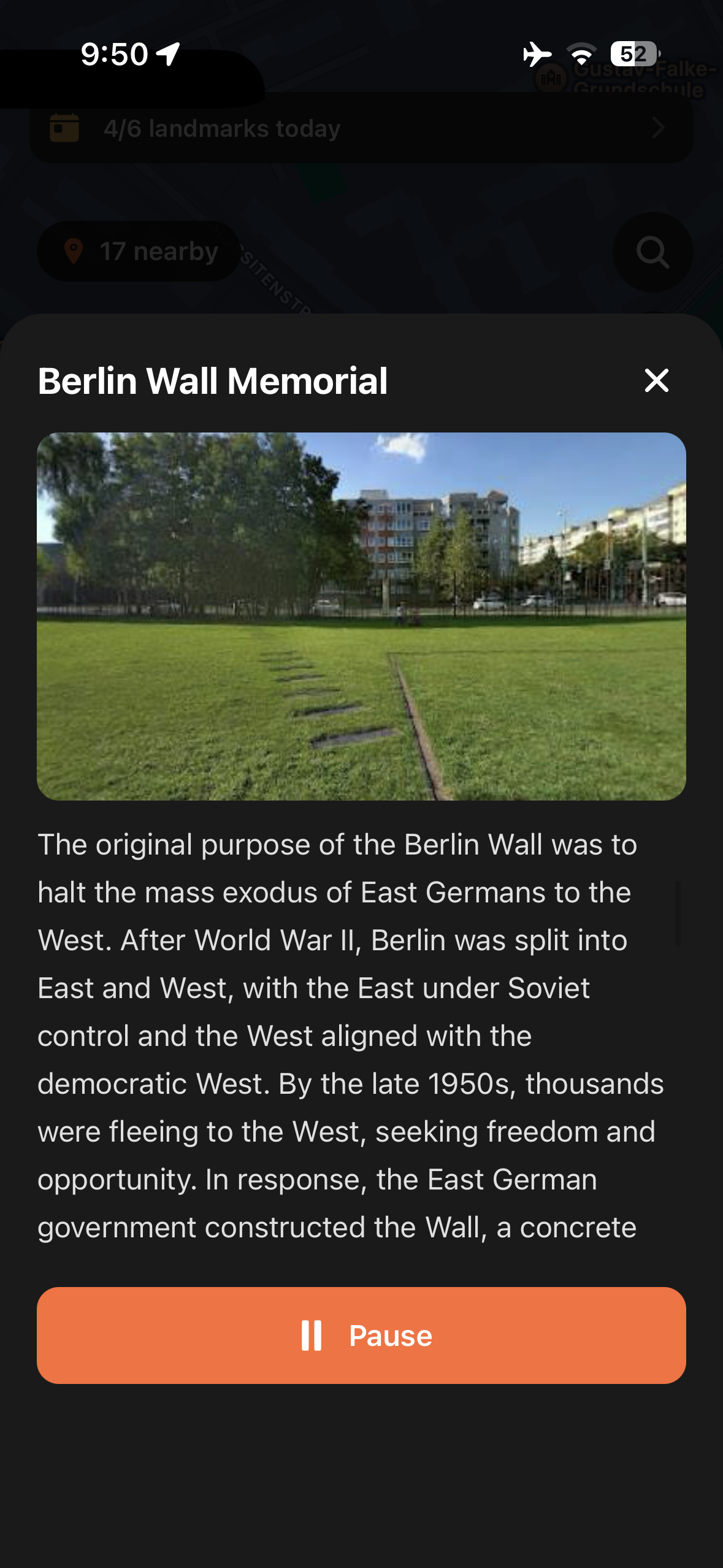
Urban Tales story panel in Berlin with photo and narration

4 storytelling styles. Historical, Legends, Fun Facts and Cinematic.


How it works

Open the app.
Start walking.

No preparation, no pre-booked route, no group to keep up with. Urban Tales works the moment you step outside.

01

Download and open the map

The app shows landmarks around you the moment you open it. Works anywhere in Berlin — the app covers the full city.

02

Walk toward anything that catches your eye

As you get close to a landmark, the audio starts automatically. Put your phone in your pocket and just walk and listen.

03

Build a route or explore freely

Create a half-day route, a full-day itinerary, a 7-wonders tour or a custom path. Or ignore all of that and wander — the app keeps up.


What you'll hear

The Berlin most visitors
never actually learn.

These are the kinds of stories Urban Tales narrates as you walk. Each one triggers automatically when you're standing in the right place.

History

Brandenburg Gate · Mitte

The most famous gate in the world was built as a symbol of peace — and spent most of its existence as a symbol of division

The Brandenburg Gate was completed in 1791, designed as a triumphal arch representing peace. For nearly three decades during the Cold War, it stood in the no-man's-land between East and West Berlin, inaccessible to both sides. When the Wall fell on 9 November 1989, crowds surged to the Gate and began chipping at the Wall with hammers. The first official East-West crossing at the Gate happened on 22 December 1989. Ronald Reagan's 1987 speech — "Mr. Gorbachev, tear down this wall" — was delivered 800 metres to the west.

History

Berlin Wall Memorial · Bernauer Strasse

The Wall went up overnight — and families were separated before they even knew it was happening

On the night of 12–13 August 1961, East German soldiers began stringing barbed wire across Berlin. Berliners woke up to find their city divided. Families who had gone to sleep in one part of Berlin could not reach relatives in another. People living on Bernauer Strasse found that their apartment buildings were in the East while the pavement outside was in the West. Some jumped from upper floors to reach the West. At least 140 people died attempting to cross the Wall over the following 28 years. The last person was shot in February 1989, nine months before it fell.

Cinematic

Hansa Studios · Tiergarten

David Bowie moved to West Berlin in 1976 and recorded three albums that changed music — while looking at the Wall from his studio window

David Bowie arrived in West Berlin in 1976, fleeing drug addiction and celebrity. He moved into an apartment in Schöneberg and worked at Hansa Studios — a recording studio so close to the Wall that musicians could see East German guard towers from the window. In two years, he recorded Heroes, Low and Lodger — the Berlin Trilogy. The lyrics to Heroes were partly inspired by watching two lovers kissing against the Wall from the studio window. Bowie called his time in Berlin the happiest years of his life.

Fun fact

Ampelmännchen · City-wide

East Germany's traffic light man became so beloved after reunification that he replaced the West German version

The Ampelmännchen — the little hat-wearing man on East German pedestrian traffic lights, designed in 1961 — was scheduled to be phased out after reunification and replaced with the West German standard. A campaign by East Berliners saved him. Not only did he survive, he spread: the Ampelmännchen now appears on traffic lights across united Berlin and has become one of the city's most recognisable symbols. There are souvenir shops dedicated entirely to him. He is one of very few East German cultural exports that outlasted the country that created him.

History

Memorial to the Murdered Jews of Europe · Mitte

The memorial has no entrance, no exit and no explanation — and that is the point

The Holocaust Memorial, designed by architect Peter Eisenman and opened in 2005, consists of 2,711 concrete slabs of varying heights on an undulating ground plane in the heart of Berlin. There are no names, no dates, no explanations on the slabs themselves. Visitors enter from any direction, walk among the columns, and find their own way through. As you go deeper, the columns grow taller and the ground dips lower. The designer said he wanted visitors to feel disorientated, isolated and discomfited — not to understand, but to feel something that resists understanding.

Legend

Tempelhof Field · Neukölln

The world's largest airport became a park — and Berliners voted to keep it empty rather than build on it

Tempelhof Airport, built by the Nazis as a monument to the Third Reich and used in the 1948 Berlin Airlift to supply the besieged city, closed in 2008. The city proposed building housing on the enormous field. In a 2014 referendum, Berliners voted against it by 64%. The 386-hectare field — larger than Central Park — remains entirely open: grass, former runways, community gardens and kite flyers. It is the most distinctive public space in Europe, and the city chose it over housing in one of Europe's fastest-growing real estate markets.


Where to walk

Berlin's neighborhoods,
explained through stories.

Urban Tales covers the full city. Here are the areas where the stories are thickest.

Mitte

The historic centre rebuilt, divided, partially destroyed and rebuilt again. The Brandenburg Gate, the Holocaust Memorial, Museum Island and the traces of the Wall all within a few kilometres of each other.

Prenzlauer Berg & Friedrichshain

The East Berlin neighborhoods that escaped the worst of wartime bombing and became the creative engine of reunified Berlin. The East Side Gallery — the longest remaining section of the Wall — runs through Friedrichshain.

Kreuzberg & Neukölln

The West Berlin neighborhoods that pressed against the Wall, became home to Turkish immigrants, squatters and artists, and emerged as the most culturally influential part of the city. Techno was invented in Kreuzberg.

Schöneberg & Charlottenburg

David Bowie's Berlin. The neighborhood where he lived, the studios where he recorded the Berlin Trilogy, and the street where the Ampelmännchen was saved by popular vote after reunification.

Museum Island

A UNESCO-listed island in the Spree containing five world-class museums within walking distance of each other, including the Pergamon Museum and the Neues Museum housing Nefertiti's bust.

Tempelhof & Steglitz

The former Nazi airport-turned-public-park that Berliners voted to keep empty. Surrounded by neighborhoods that tell the story of Berlin's postwar immigration, urban transformation and refusal to conform.


Storytelling styles

Choose how Berlin
speaks to you.

The same landmark sounds completely different in each mode. Switch styles anytime during your walk.

Historical

Context, dates, politics, empires. What actually happened here and why it mattered. For travelers who want to leave Berlin genuinely knowing things.

Legends

Myths, curses, ghosts and ancient superstitions. The stories locals told each other before the history books were written.

Fun Facts

The absurd, the surprising and the genuinely weird. Perfect for keeping energy up on a long walk or exploring with kids.

Cinematic

Bowie recorded here, Wenders filmed it, the club scene rewrote nightlife history. Berlin through the lens of music and cinema.


FAQ

Common questions about
Urban Tales in Berlin.

Does Urban Tales cover the Berlin Wall and the Brandenburg Gate?

Yes. Urban Tales covers both fully — the Brandenburg Gate, the Berlin Wall Memorial at Bernauer Strasse, the East Side Gallery and the Checkpoint Charlie area — with stories triggered as you walk through each site.

Is Urban Tales worth it if I have already been to Berlin?

Especially then. Berlin rewards deeper exploration more than almost any city. The Ampelmännchen survival story, Bowie in Hansa Studios, the Wall going up overnight — these are the stories that transform what you see into something you remember.

How does the pricing work for Berlin?

You can start exploring for free. A day pass unlocks the full Berlin experience for a single day, or you can unlock the city permanently. No subscriptions required.

What languages is the Berlin audio guide available in?

Urban Tales supports English, Spanish (LATAM), Brazilian Portuguese, French and German. The German narration for Berlin is particularly immersive — the city's stories told in the language of both the division and the reunification.

Can I use Urban Tales for a half-day or full-day visit to Berlin?

Yes. Berlin is large but its key sites are concentrated enough for a focused half-day route. A full day lets you explore Mitte, Kreuzberg and the neighborhoods east of the former Wall. The city is best explored on foot or by bike — Urban Tales works for both.

Berlin is waiting.
The stories start the moment you land.

Free to download. No tour group. No fixed schedule.

Download on theApp Store
Get it onGoogle Play

Explore more

Urban Tales works
everywhere you travel.

Explore our full collection of cities at urbantales.net/cities.html See the full list and find your next destination.

View all cities →