Buenos Aires, Argentina

Paris of the South.
Capital of tango.
City of ghosts.

Urban Tales is a GPS audio guide app that narrates Buenos Aires's hidden history, legends and secrets automatically as you walk — at your own pace, with no tour group to follow.


Walk up to a landmark.
The story starts.

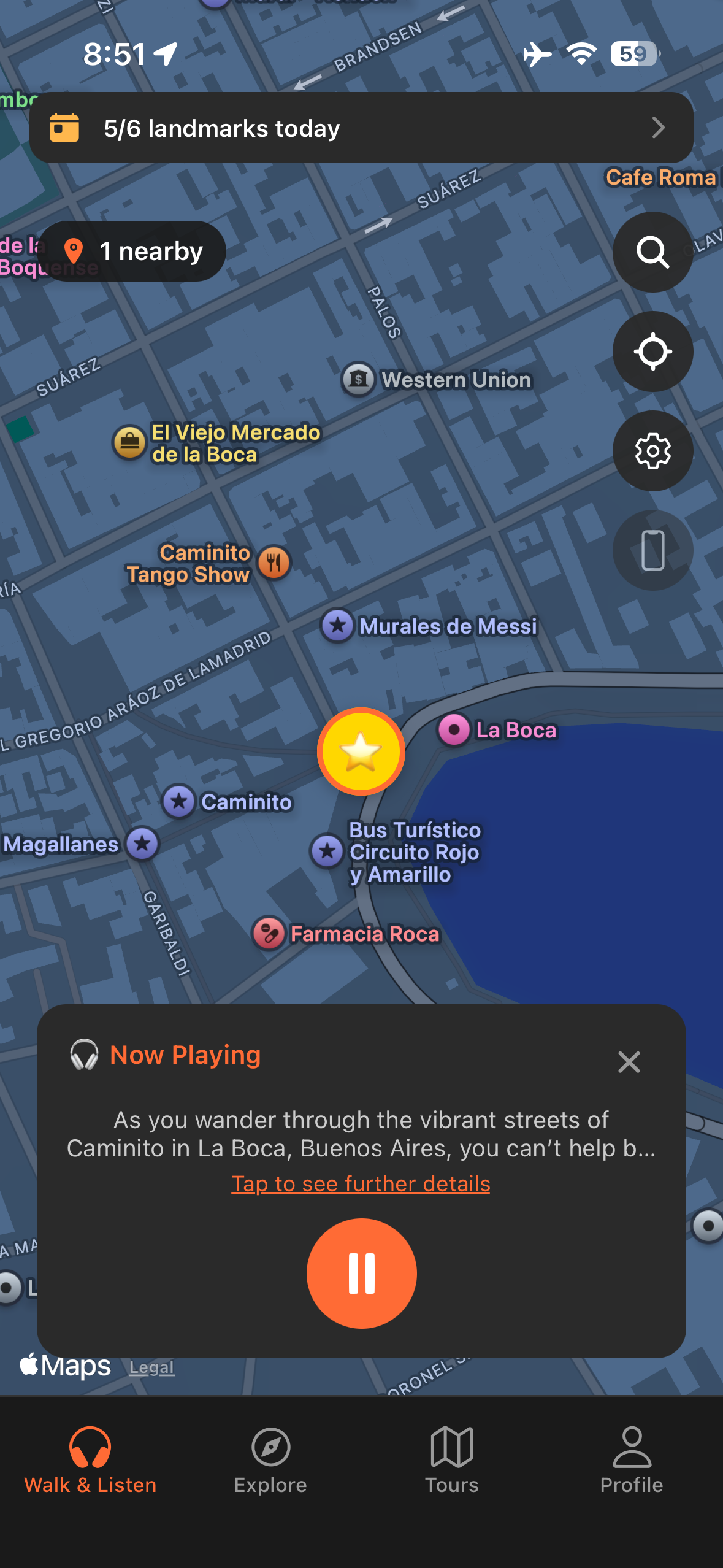
No tapping. No searching. Urban Tales detects your GPS position and plays audio automatically the moment you're close enough. Put your phone in your pocket — just walk and listen.

Urban Tales GPS map at Caminito in La Boca Buenos Aires with audio story triggered

GPS triggered. Audio starts the moment you arrive at a landmark.

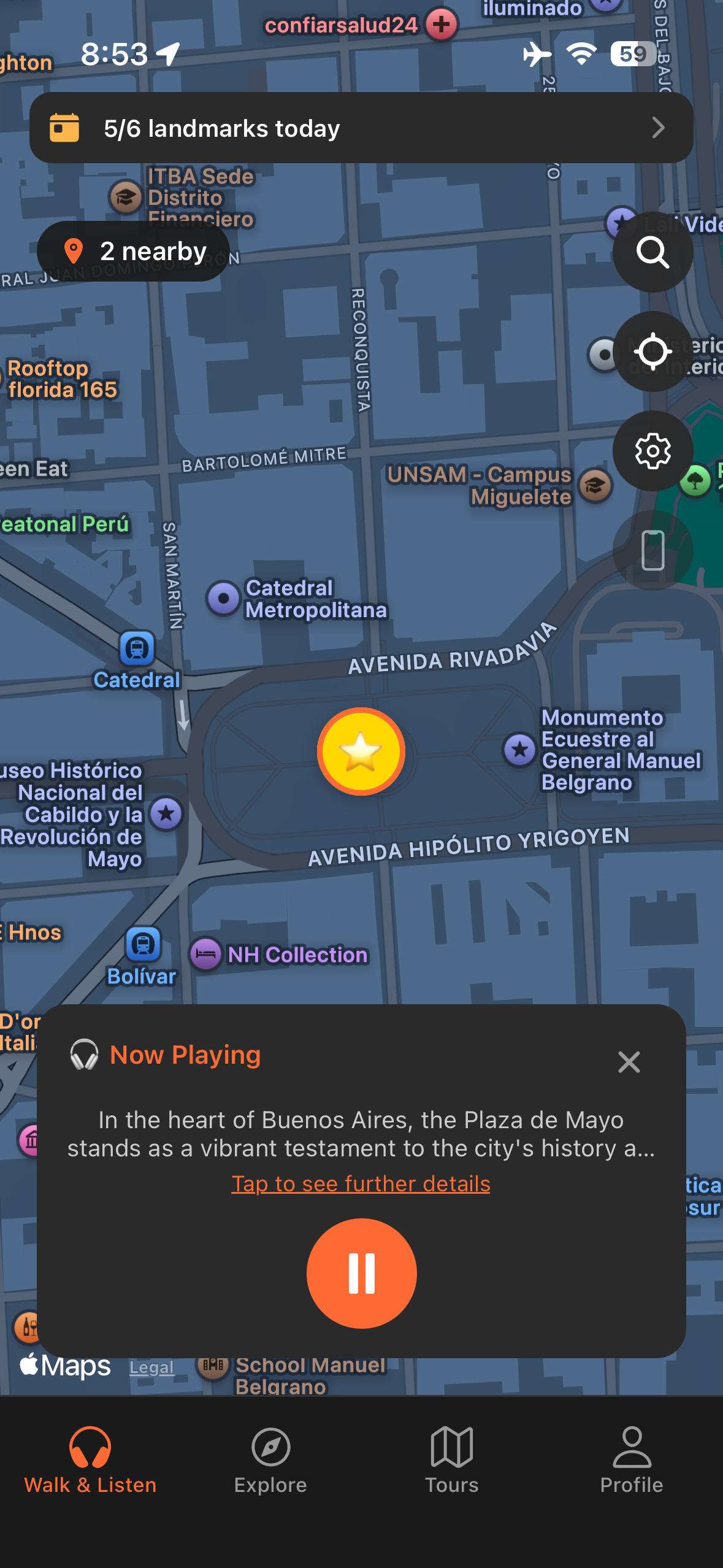
Urban Tales GPS map at Plaza de Mayo in Buenos Aires with story triggered

Walk freely. Every landmark around you has a story ready.

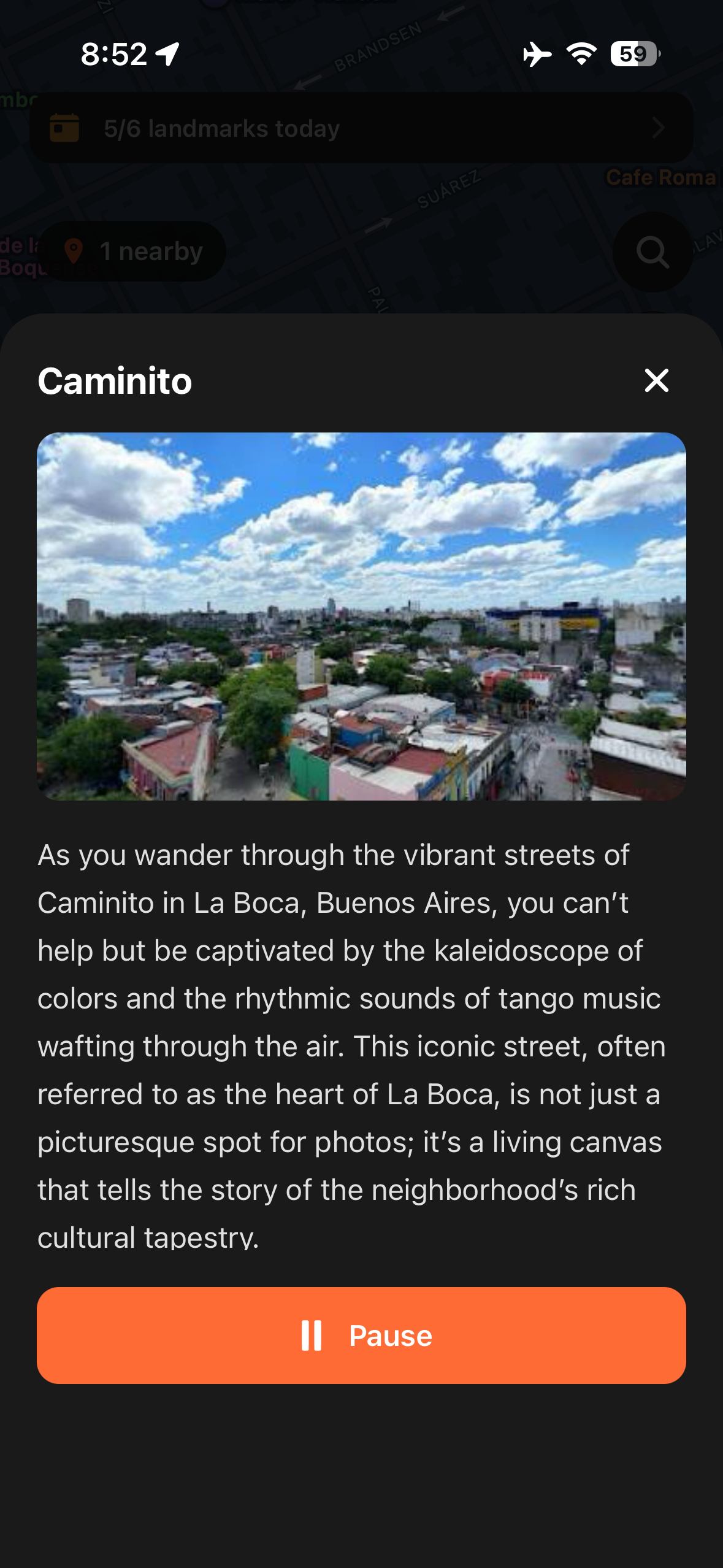
Urban Tales story panel for Caminito in Buenos Aires with aerial photo and narration

Rich stories. History, legends and context for every landmark.

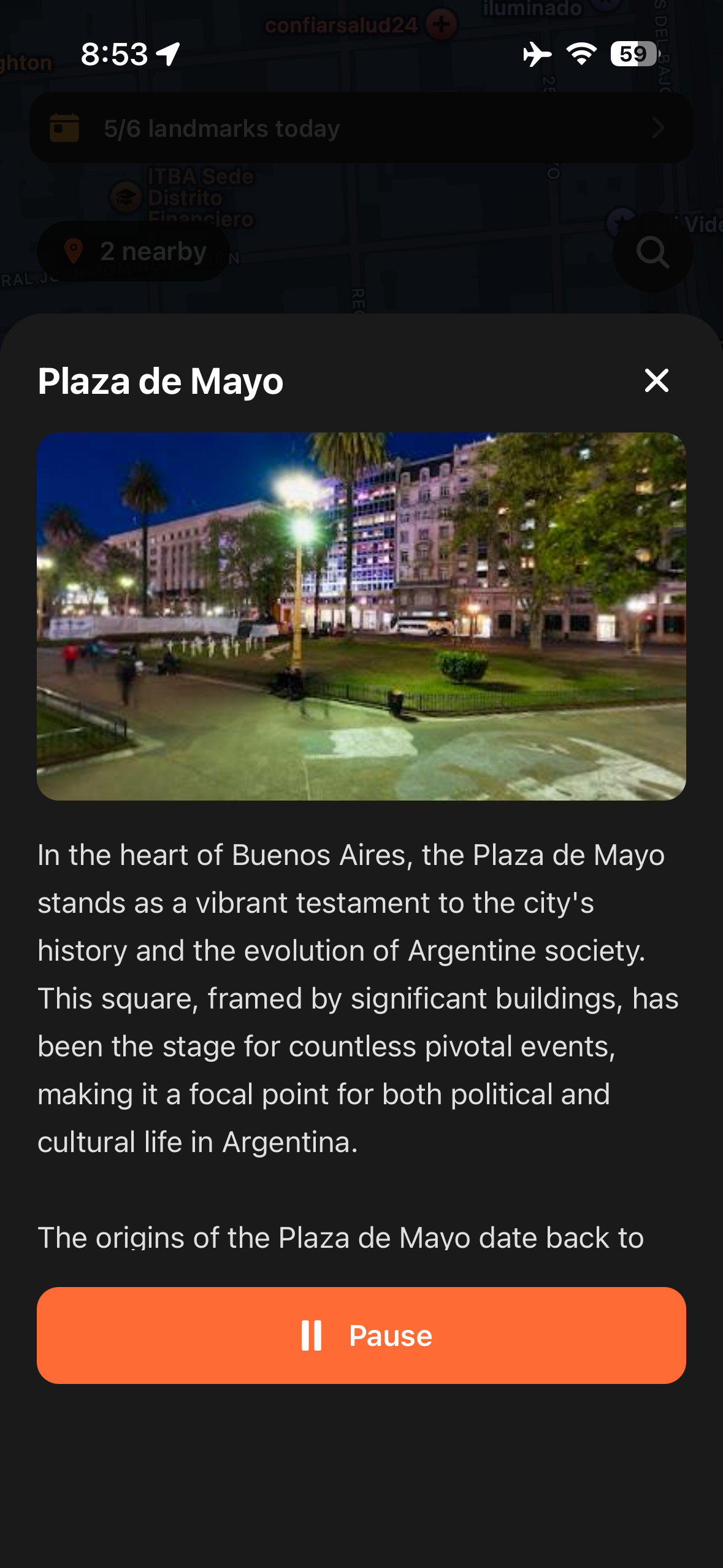
Urban Tales story panel for Plaza de Mayo in Buenos Aires with night photo and narration

4 storytelling styles. Historical, Legends, Fun Facts and Cinematic.


How it works

Open the app.
Start walking.

No preparation, no pre-booked route, no group to keep up with. Urban Tales works the moment you step outside.

01

Download and open the map

The app shows landmarks around you the moment you open it. Works anywhere in Buenos Aires — the app covers the full city.

02

Walk toward anything that catches your eye

As you get close to a landmark, the audio starts automatically. Put your phone in your pocket and just walk and listen.

03

Build a route or explore freely

Create a half-day route, a full-day itinerary, a 7-wonders tour or a custom path. Or ignore all of that and wander — the app keeps up.


What you'll hear

The Buenos Aires most visitors
never actually learn.

These are the kinds of stories Urban Tales narrates as you walk. Each one triggers automatically when you're standing in the right place.

History

Plaza de Mayo · Microcentro

Every major crisis in Argentine history has played out in this square — and the mothers who walked it changed it forever

Plaza de Mayo has been the stage for Argentine history since 1810: the May Revolution, Perón's rise, military coups, the Falklands War, the 2001 economic collapse. Its most enduring image is the Madres de Plaza de Mayo — mothers of people who disappeared during the 1976–83 military dictatorship — who began circling the square in silent protest in 1977 when public gatherings were banned. They wore white headscarves and carried photographs of their missing children. They still walk every Thursday.

Legend

Recoleta Cemetery · Recoleta

A young socialite was reportedly buried alive — and her ghost still wanders the alleys

Recoleta Cemetery holds Argentine presidents, Nobel Prize winners and Evita Perón. But the most persistent legend belongs to Rufina Cambaceres, a 19-year-old buried in 1902 after what appeared to be a heart attack. When her coffin was later opened, evidence suggested she had been alive when interred. The legend of La Dama de Blanco — the Lady in White — a figure seen wandering the cemetery at night in a white dress — is said to be her ghost.

Cinematic

Caminito · La Boca

The most photographed street in Buenos Aires was created by a tango singer who painted it himself

Caminito was a disused railway siding until the 1950s, when tango singer and painter Benito Quinquela Martín decided to transform it. He painted the abandoned houses himself in vivid colours and installed sculptures. The neighbourhood had been built by Genoese immigrants who painted their houses with leftover boat paint — whatever colour was available — which is why no two houses match. Caminito is now the most visited street in Argentina.

Fun fact

Palacio Barolo · Avenida de Mayo

A skyscraper was designed as a three-dimensional version of Dante's Divine Comedy

Completed in 1923, the Palacio Barolo was the tallest building in South America, designed by Italian architect Mario Palanti as a monument to Dante's Divine Comedy. The 22 floors represent the cantos of Hell, Purgatory and Heaven. The height of 100 metres corresponds to Dante's 100 cantos. On the summer solstice, the Southern Cross constellation is visible directly above its dome. The building is aligned specifically for this effect.

History

San Telmo · Southern Buenos Aires

Tango was born in the tenements of immigrants who had nowhere else to dance

Tango emerged in the late 19th century in the conventillos — overcrowded tenement courtyards — of San Telmo and La Boca, where Genoese, Spanish, African and Argentine cultures collided. The upper classes considered it immoral and banned it from polite society. It spread to Paris instead, where it became fashionable, and only then was accepted back into Argentine culture. The dance was literally too scandalous for Argentina until Europeans approved it first.

Legend

Casa Rosada · Plaza de Mayo

The pink presidential palace got its colour from ox blood — and Evita's balcony is exactly where you think it is

The Casa Rosada's distinctive pink colour is said to originate from the 19th-century practice of mixing ox blood with lime paint to help it resist humidity. The balcony from which Eva Perón addressed the descamisados — the shirtless ones — still exists, facing Plaza de Mayo. The real and fictional versions of this moment, immortalised in the musical Evita, made it one of the most recognised images in Latin American political history.

Legend

Tiber Island · Isola Tiberina

A snake chose this island as Rome's hospital — and it still is one

When a plague devastated Rome in 293 BC, a sacred serpent escaped a delegation's boat and swam to a small island in the Tiber. Romans took it as a divine sign and built a temple there. The island has been a place of healing ever since — it still houses a working hospital today. The snake wrapped around a rod became the universal symbol of medicine.

Cinematic

Largo di Torre Argentina · Campo Marzio

Julius Caesar was assassinated here. It's now a cat sanctuary.

On the Ides of March, 44 BC, Julius Caesar was stabbed 23 times in the ruins that sit in this open square. Most tourists walk around it without recognising what it is. Today, hundreds of cats live in the sunken ruins under the care of local volunteers. You can visit them for free.


Where to walk

Buenos Aires's neighborhoods,
explained through stories.

Urban Tales covers the full city. Here are the areas where the stories are thickest.

Microcentro & Plaza de Mayo

The political and commercial heart of Buenos Aires. Every major moment in Argentine history — from the 1810 revolution to the 2001 crisis — has played out within a few blocks of here.

San Telmo

The oldest neighbourhood in Buenos Aires, where tango was born in the tenement courtyards of 19th-century immigrants. Cobblestone streets, antique markets, milongas and the city at its most atmospheric.

La Boca

The Genoese immigrant neighbourhood where tango spread and where Caminito was painted into existence. Home to the Boca Juniors stadium — a religious site for Argentine football.

Recoleta

Paris transplanted to South America. Grand boulevards, the cemetery where Evita is buried, and neoclassical architecture that made Buenos Aires the wealthiest city in Latin America.

Palermo

The largest neighbourhood in Buenos Aires — parks, boutiques, the best restaurants in the city and the literary ghost of Jorge Luis Borges, who lived and wrote here for most of his life.

Puerto Madero

The reclaimed waterfront built on old port docks in the 1990s. The contrast between gleaming modern towers and abandoned warehouses tells the story of Argentina's extraordinary economic reversals.


Storytelling styles

Choose how Buenos Aires
speaks to you.

The same landmark sounds completely different in each mode. Switch styles anytime during your walk.

Historical

Context, dates, politics, empires. What actually happened here and why it mattered. For travelers who want to leave Buenos Aires genuinely knowing things.

Legends

Myths, curses, ghosts and ancient superstitions. The stories locals told each other before the history books were written.

Fun Facts

The absurd, the surprising and the genuinely weird. Perfect for keeping energy up on a long walk or exploring with kids.

Cinematic

Films shot here, tango danced here, Borges wrote these streets into his fiction. Buenos Aires through the lens of cinema and literature.


FAQ

Common questions about
Urban Tales in Buenos Aires.

Does Urban Tales cover Recoleta Cemetery and the tomb of Eva Perón?

Yes. Urban Tales covers Recoleta Cemetery and the surrounding neighborhood, with stories triggered as you approach and walk through. The cemetery is free to enter and Urban Tales tells the stories of those buried there — including Evita.

Is Urban Tales worth it if I have already been to Buenos Aires?

Especially then. The ghost of Recoleta, the Divine Comedy in the Palacio Barolo, the Madres de Plaza de Mayo — every return visit finds something new. The Legends mode transforms the city.

How does the pricing work for Buenos Aires?

You can start exploring for free. A day pass unlocks the full Buenos Aires experience for a single day, or you can unlock the city permanently. No subscriptions required.

What languages is the Buenos Aires audio guide available in?

Urban Tales supports English, Spanish (LATAM), Brazilian Portuguese, French and German. The Spanish narration for Buenos Aires is particularly immersive — porteño stories told in the language they belong to.

Can I use Urban Tales for a half-day or full-day visit to Buenos Aires?

Yes. Buenos Aires is enormous but its best neighborhoods are walkable once you are in them. Use the tour generator to plan a route — the city rewards wandering in almost any direction.

div>

Buenos Aires is waiting.
The stories start the moment you land.

Free to download. No tour group. No fixed schedule.

Download on theApp Store
Get it onGoogle Play

Explore more

Urban Tales works
everywhere you travel.

Lisbon, Amsterdam, Buenos Aires and many more cities available. See the full list and find your next destination.

View all cities →