Chicago, USA

Burned down in 1871.
Rebuilt as the world's
first modern city.

Urban Tales is a GPS audio guide app that narrates Chicago's hidden history, legends and secrets automatically as you walk — at your own pace, with no tour group to follow.


Walk up to a landmark.
The story starts.

No tapping. No searching. Urban Tales detects your GPS position and plays audio automatically the moment you're close enough. Put your phone in your pocket — just walk and listen.

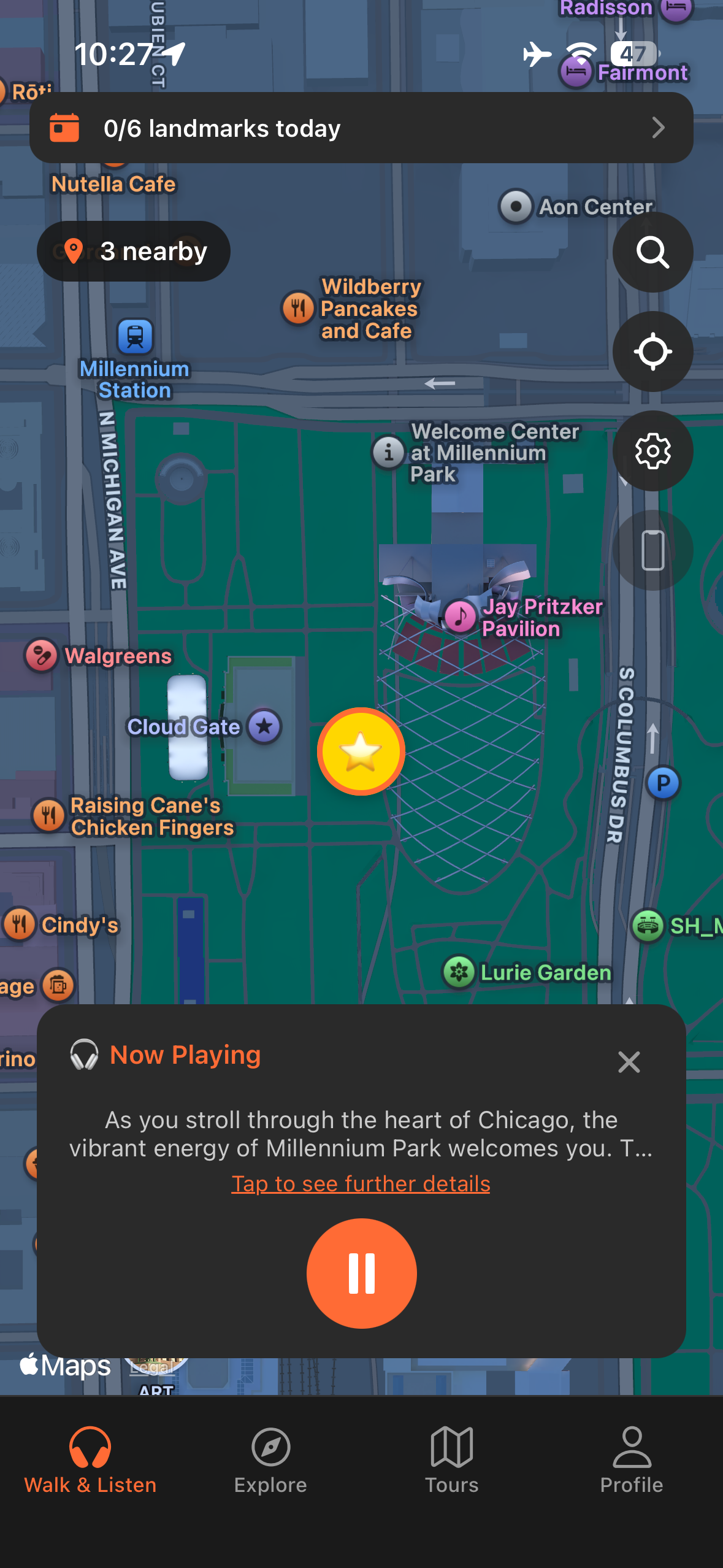
Urban Tales GPS map in Chicago with audio story automatically triggered

GPS triggered. Audio starts the moment you arrive at a landmark.

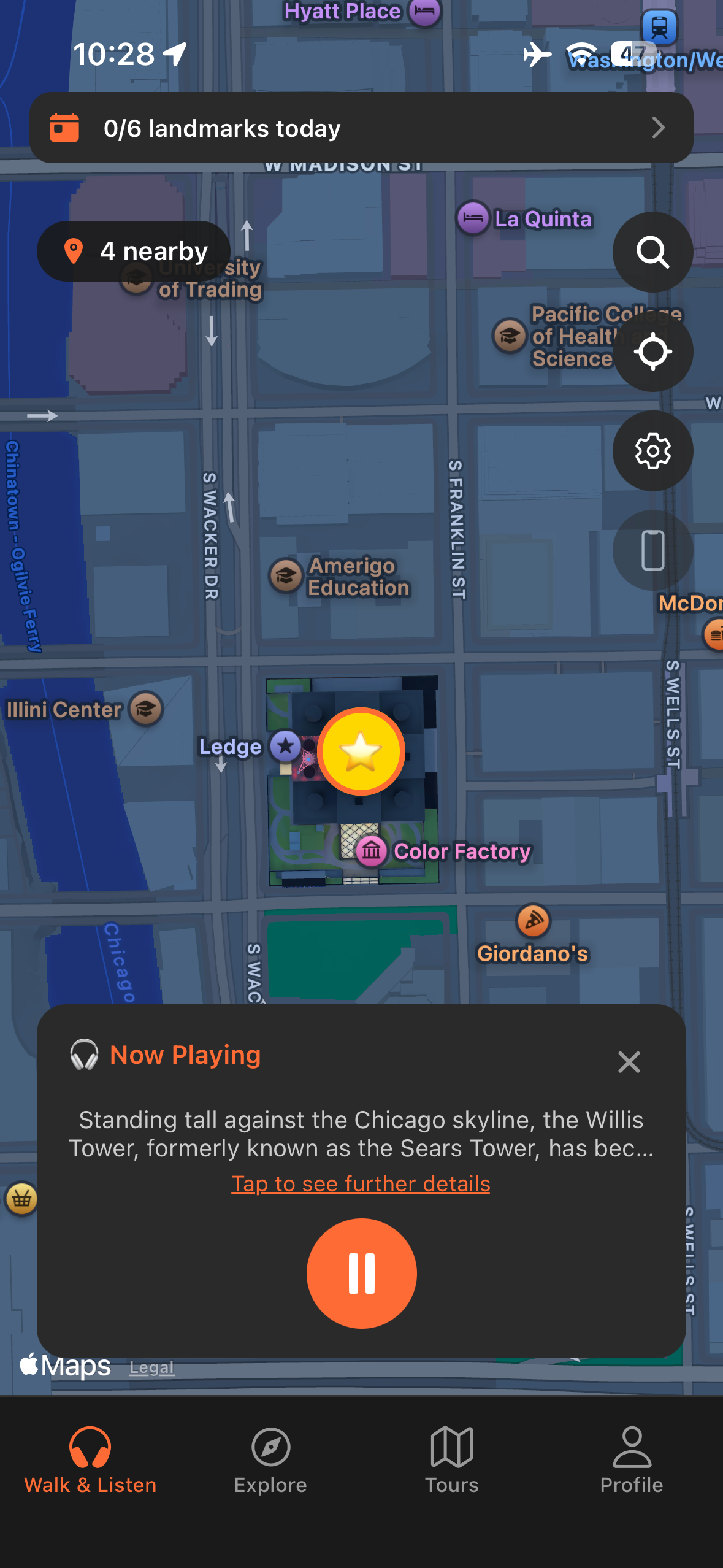
Urban Tales GPS map in Chicago with story automatically triggered

Walk freely. Every landmark around you has a story ready.

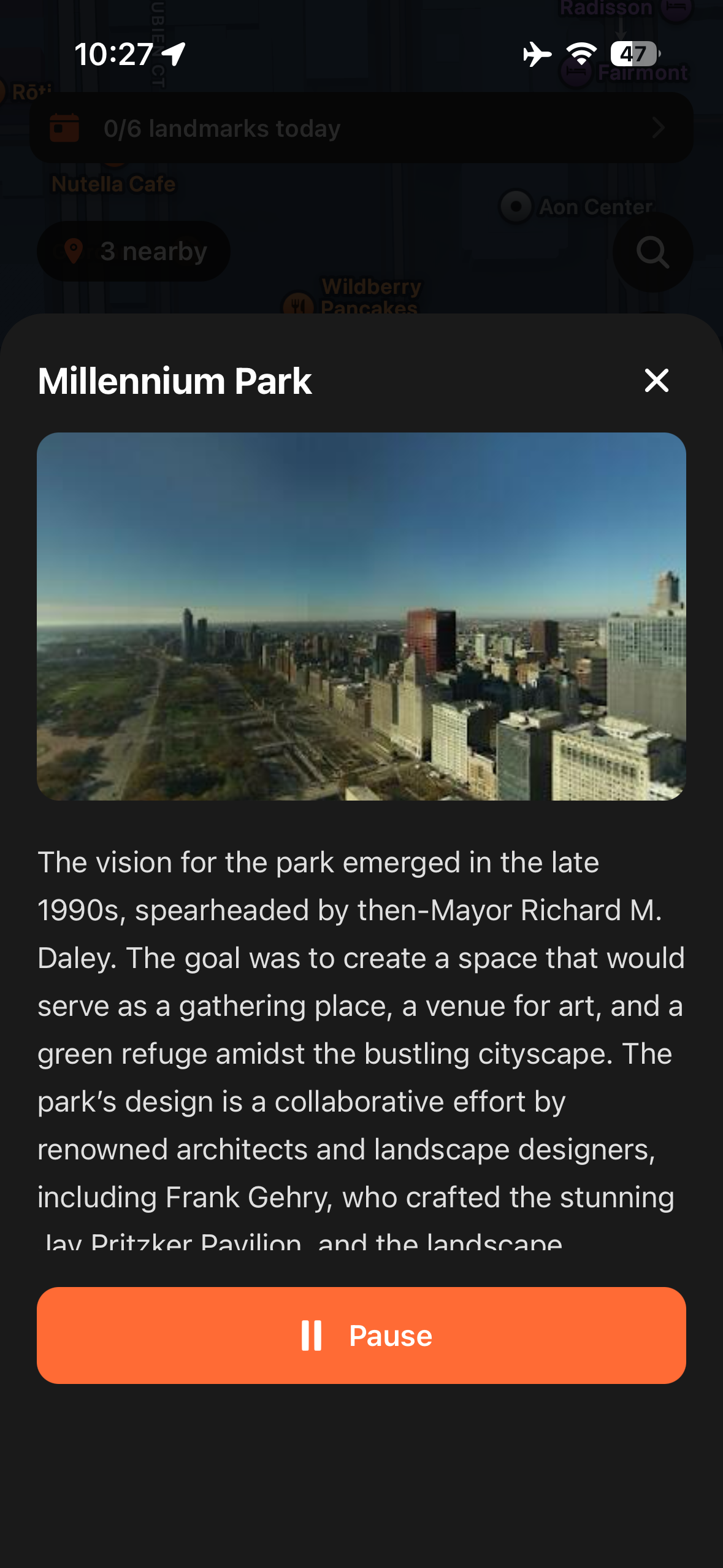
Urban Tales story panel in Chicago with photo and narration

Rich stories. History, legends and context for every landmark.

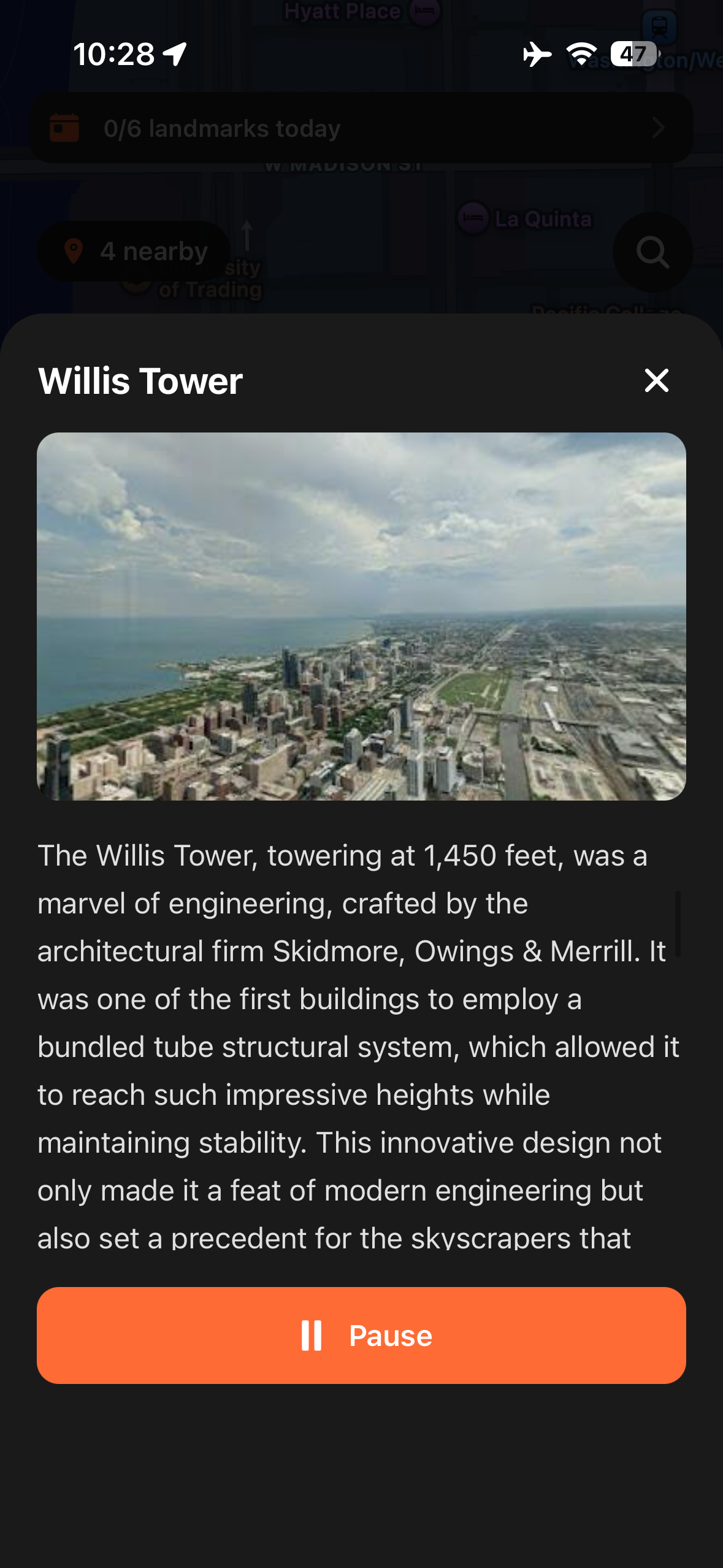
Urban Tales story panel in Chicago with photo and narration

4 storytelling styles. Historical, Legends, Fun Facts and Cinematic.


How it works

Open the app.
Start walking.

No preparation, no pre-booked route, no group to keep up with. Urban Tales works the moment you step outside.

01

Download and open the map

The app shows landmarks around you the moment you open it. Works anywhere in Chicago — the app covers the full city.

02

Walk toward anything that catches your eye

As you get close to a landmark, the audio starts automatically. Put your phone in your pocket and just walk and listen.

03

Build a route or explore freely

Create a half-day route, a full-day itinerary, a 7-wonders tour or a custom path. Or ignore all of that and wander — the app keeps up.


What you'll hear

The Chicago most visitors
never actually learn.

These are the kinds of stories Urban Tales narrates as you walk. Each one triggers automatically when you're standing in the right place.

History

The Loop & Chicago River

Chicago burned down in 1871 — and the city that rose from the ashes invented the modern skyscraper

The Great Chicago Fire of 1871 destroyed 17,000 buildings and left 100,000 people homeless. Reconstruction brought architects from across the world, and the combination of available land, ambitious clients and new steel construction technology produced the first true skyscrapers — buildings whose weight was carried by an internal steel frame rather than the walls. The Home Insurance Building, completed in 1885 and now demolished, is considered the world's first. Chicago was essentially the laboratory in which modern urban architecture was invented.

Fun fact

Chicago River · Downtown

Chicago reversed the flow of its river — using gravity and engineering to send sewage away from the lake instead of into it

The Chicago River originally flowed into Lake Michigan — the city's drinking water supply. By the late 19th century, the river had become so polluted by sewage that typhoid and cholera epidemics were killing thousands. Chicago's solution was audacious: they reversed the river's flow. By deepening a canal connecting to the Illinois River and using a series of locks, engineers made the river flow away from the lake. The project, completed in 1900, was one of the greatest engineering achievements of its era. The river still flows backwards today.

History

Willis Tower (Sears Tower) · The Loop

The world's tallest building for 25 years was designed by calculating exactly how many desks Sears needed

The Willis Tower was built between 1970 and 1973 for Sears, Roebuck and Co., which needed to house 7,000 employees. The architect Bruce Graham and engineer Fazlur Khan designed the bundled tube structure — nine square tubes of different heights — specifically to provide the exact floor area Sears required while reaching a height that would make the building the tallest in the world. It held that record until 1998. Sears vacated the building in 1992. The building was renamed Willis Tower in 2009 after a British insurance company bought the naming rights.

Cinematic

Millennium Park & The Bean

Cloud Gate was designed to be impossible to manufacture — and its builder figured it out anyway

Anish Kapoor's Cloud Gate, universally known as "The Bean," consists of 168 stainless steel plates welded together with no visible seams, forming a surface so smooth it reflects the Chicago skyline like a perfect mirror. When Kapoor submitted the design in 1999, no one knew how to build it. A specialist fabricator spent years developing new techniques. The finished sculpture weighs 110 tonnes and is cleaned twice a day to maintain its reflective quality. Kapoor trademarked "Vantablack" — the blackest material ever made — in 2016, preventing other artists from using it. The Bean remains the opposite: the most reflective public sculpture in the world.

History

Pullman Historic District · Far South Side

An industrialist built a perfect company town — and his workers went on the strike that created Labor Day

In 1880, industrialist George Pullman built a planned town south of Chicago to house workers from his railcar factory — complete housing, a church, a library, shops and parks, all owned by the company and rented to workers. It was considered a model of industrial philanthropy. In 1894, after Pullman cut wages while keeping rents unchanged, workers went on strike. The Pullman Strike became a national crisis, involving 250,000 workers across 27 states. President Cleveland sent federal troops to break it. Congress created Labor Day as a national holiday within days — reportedly to appease the labor movement after the violent suppression.

Legend

Wrigley Field · Wrigleyville

The Cubs went 108 years without a World Series title — and a goat was blamed for most of it

In 1945, Billy Sianis brought his pet goat to a World Series game at Wrigley Field. When the goat's smell disturbed other fans and Sianis was asked to leave, he allegedly cursed the Cubs: "The Cubs, they ain't gonna win no more." The team lost the series. They didn't win another World Series for 71 years, until 2016. The "Curse of the Billy Goat" became one of the most enduring legends in American sports. Wrigley Field itself, built in 1914, is the second-oldest ballpark in Major League Baseball and still has its original hand-turned scoreboard.


Where to walk

Chicago's neighborhoods,
explained through stories.

Urban Tales covers the full city. Here are the areas where the stories are thickest.

The Loop

Chicago's downtown grid, where the Great Fire of 1871 left a blank canvas that produced the world's first skyscrapers. The Willis Tower, Millennium Park, the Chicago Riverwalk and the elevated train that gives the Loop its name.

River North & Magnificent Mile

Michigan Avenue north of the Chicago River — one of the most photographed streets in America, lined with landmarks from the Tribune Tower to the Water Tower, one of the few buildings that survived the Great Fire.

Wicker Park & Bucktown

The neighborhood where Chicago's creative class landed after leaving the downtown. Victorian architecture, independent music venues, vintage stores and the streets that inspired the city's literary scene from Nelson Algren to Saul Bellow.

Hyde Park

The neighborhood on the South Side where the University of Chicago sits, Barack Obama lived and the first controlled nuclear reaction in history took place — under the bleachers of a demolished football stadium in 1942.

Pilsen & Little Village

Chicago's Mexican-American neighborhoods, home to the city's most vibrant mural tradition, the National Museum of Mexican Art and the food that most Chicagoans will tell you is the best in the city.

Wrigleyville & Lincoln Park

The North Side neighborhoods built around baseball, lake access and the zoo that has been free to visit since 1868. Wrigley Field's hand-turned scoreboard is still operated by humans sitting in the manual boards.


Storytelling styles

Choose how Chicago
speaks to you.

The same landmark sounds completely different in each mode. Switch styles anytime during your walk.

Historical

Context, dates, politics, empires. What actually happened here and why it mattered. For travelers who want to leave Chicago genuinely knowing things.

Legends

Myths, curses, ghosts and ancient superstitions. The stories locals told each other before the history books were written.

Fun Facts

The absurd, the surprising and the genuinely weird. Perfect for keeping energy up on a long walk or exploring with kids.

Cinematic

The Blues Brothers, Ferris Bueller, The Dark Knight — Chicago has been the backdrop for more films than almost any other American city. The city through the lens of cinema.


FAQ

Common questions about
Urban Tales in Chicago.

Does Urban Tales cover Cloud Gate (The Bean) and Millennium Park?

Yes. Urban Tales covers Millennium Park fully, with stories triggered as you approach Cloud Gate, the Jay Pritzker Pavilion and the surrounding area. The park is free to visit and Urban Tales works throughout it.

Is Urban Tales worth it if I have already been to Chicago?

Especially then. The reversed river, the company town that created Labor Day, the nuclear reaction under a football stadium — Chicago's stories reward deeper exploration every time. The History mode is particularly strong for a city this dense with consequence.

How does the pricing work for Chicago?

You can start exploring for free. A day pass unlocks the full Chicago experience for a single day, or you can unlock the city permanently. No subscriptions required.

What languages is the Chicago audio guide available in?

Urban Tales supports English, Spanish (LATAM), Brazilian Portuguese, French and German. Select your language when you first open the app.

Can I use Urban Tales for a half-day or full-day visit to Chicago?

Yes. The Loop and lakefront are walkable and make a natural half-day route. A full day lets you explore the neighborhoods north and south of downtown. Chicago also rewards exploration by elevated train — Urban Tales works wherever you go.

Chicago is waiting.
The stories start the moment you land.

Free to download. No tour group. No fixed schedule.

Download on theApp Store
Get it onGoogle Play

Explore more

Urban Tales works
everywhere you travel.

Explore our full collection of cities at urbantales.net/cities.html See the full list and find your next destination.

View all cities →