Florence, Italy

The Renaissance
began here.
The secrets stayed.

Urban Tales is a GPS audio guide app that narrates Florence's hidden history, legends and secrets automatically as you walk — at your own pace, with no tour group to follow.


Walk up to a landmark.
The story starts.

No tapping. No searching. Urban Tales detects your GPS position and plays audio automatically the moment you're close enough. Put your phone in your pocket — just walk and listen.

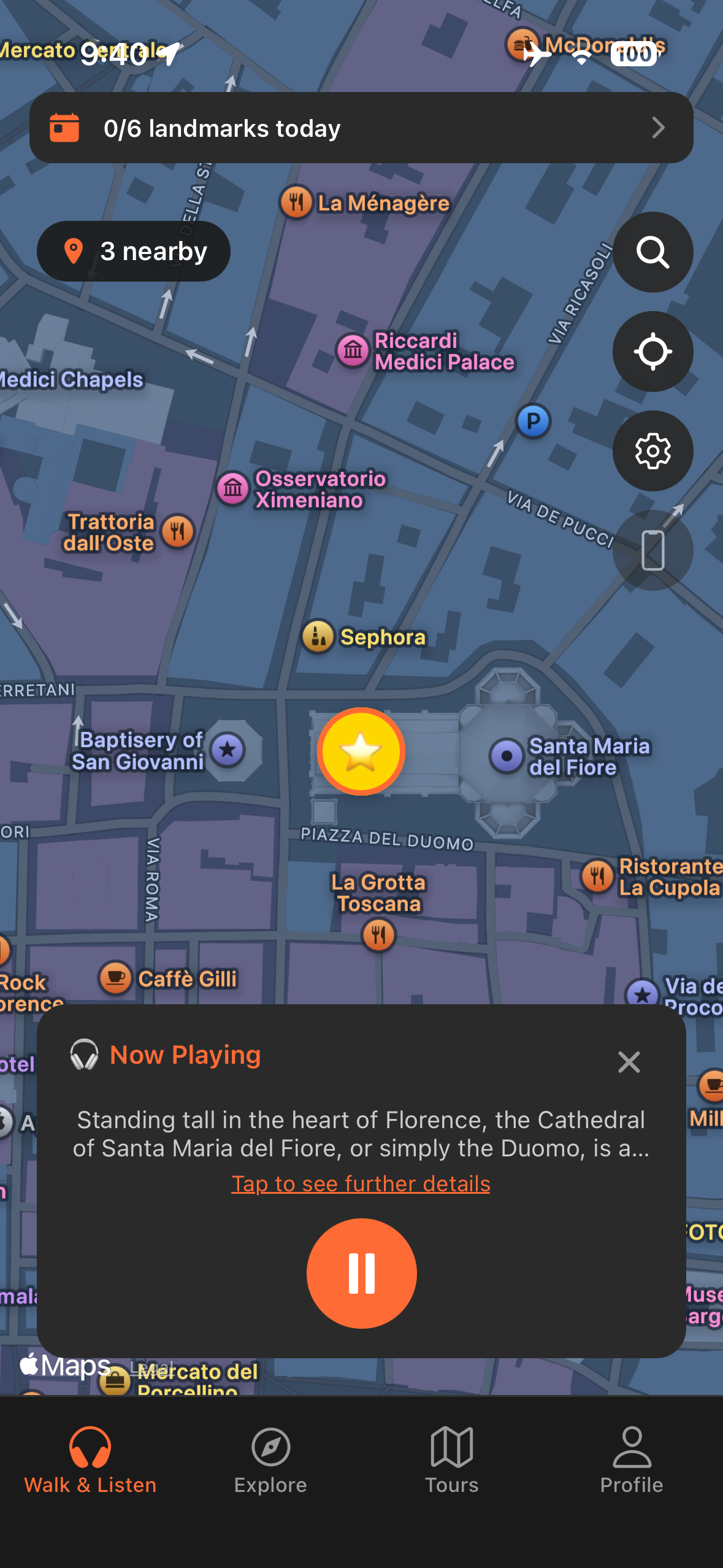
Urban Tales GPS map at the Duomo in Florence with audio story automatically triggered

GPS triggered. Audio starts the moment you arrive at a landmark.

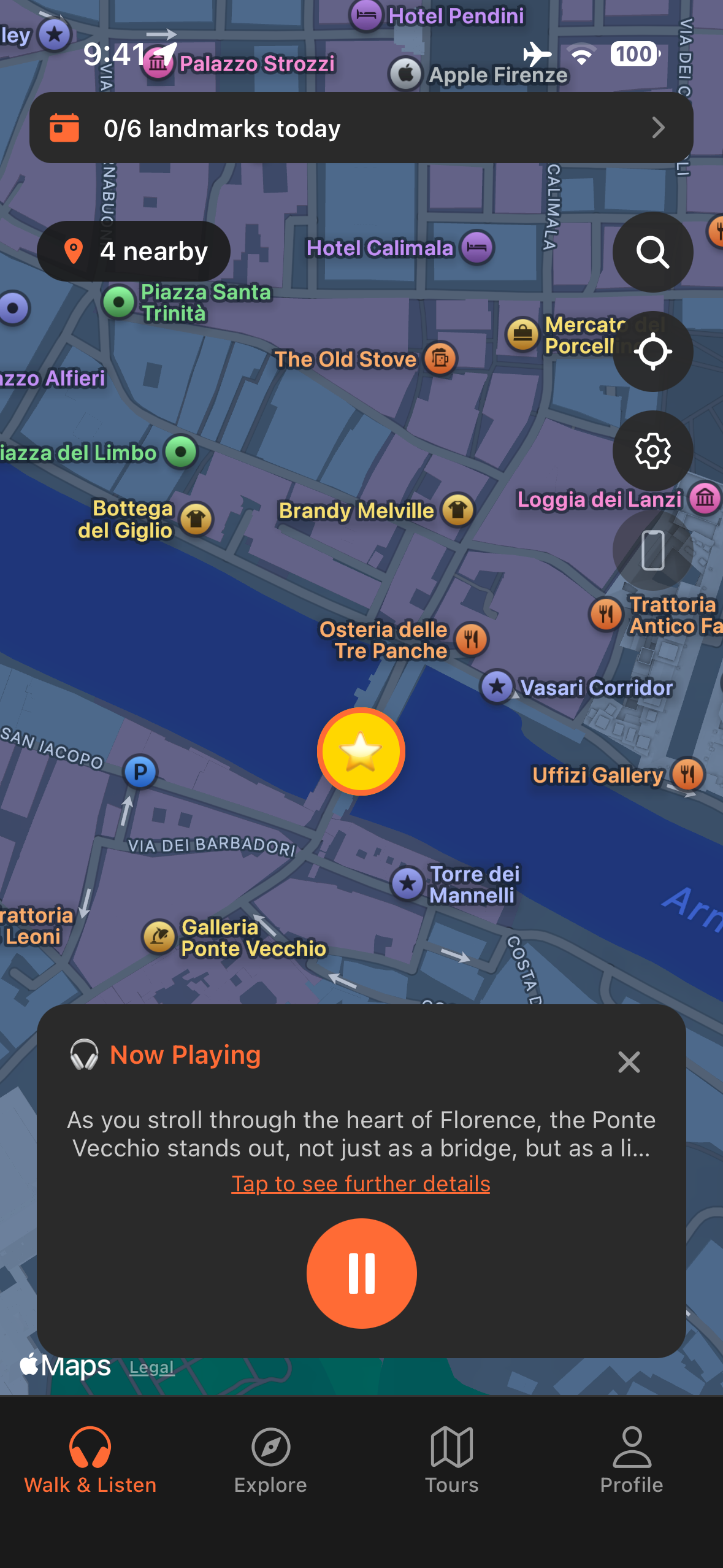
Urban Tales GPS map at Ponte Vecchio in Florence with story automatically triggered

Walk freely. Every landmark around you has a story ready.

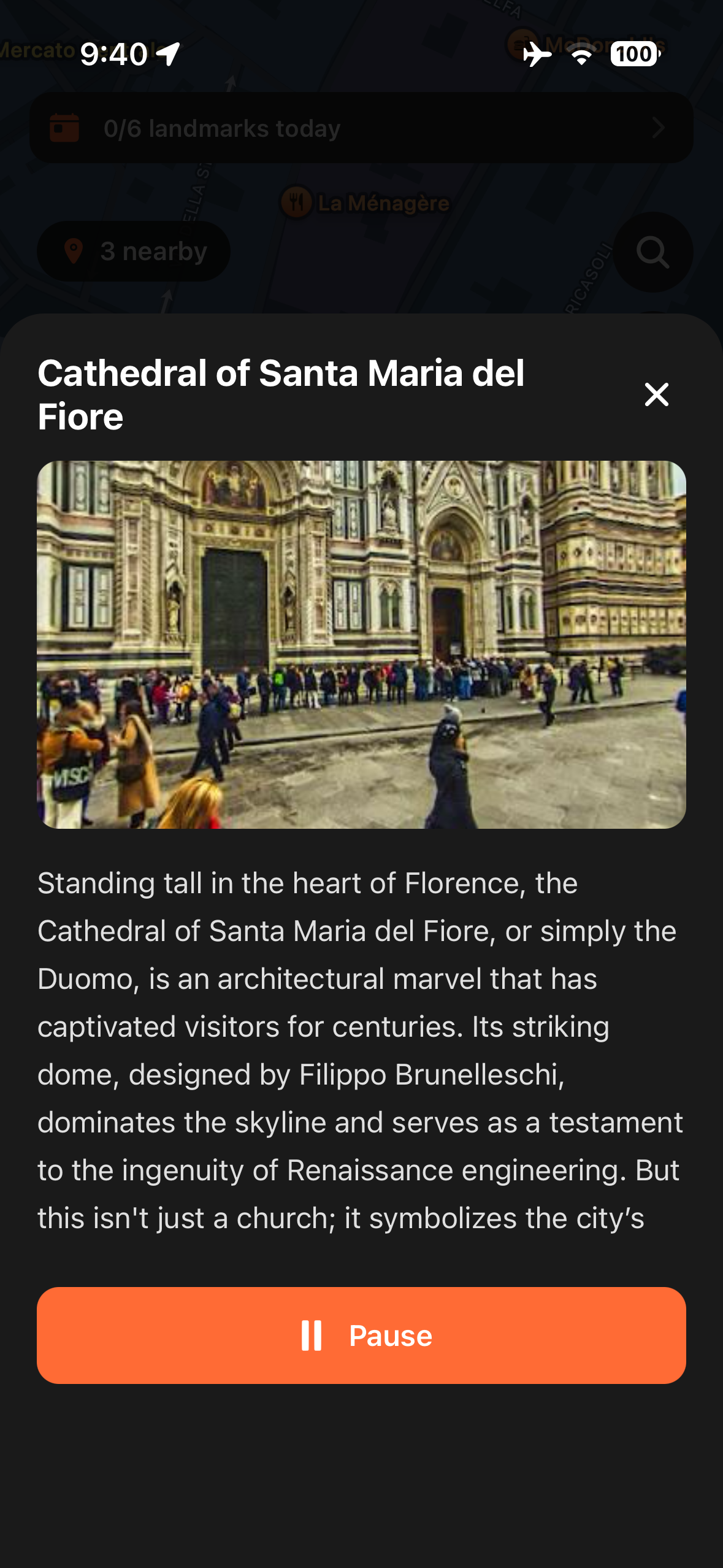
Urban Tales story panel for the Duomo in Florence with narration text and facade photo

Rich stories. History, legends and context for every landmark.

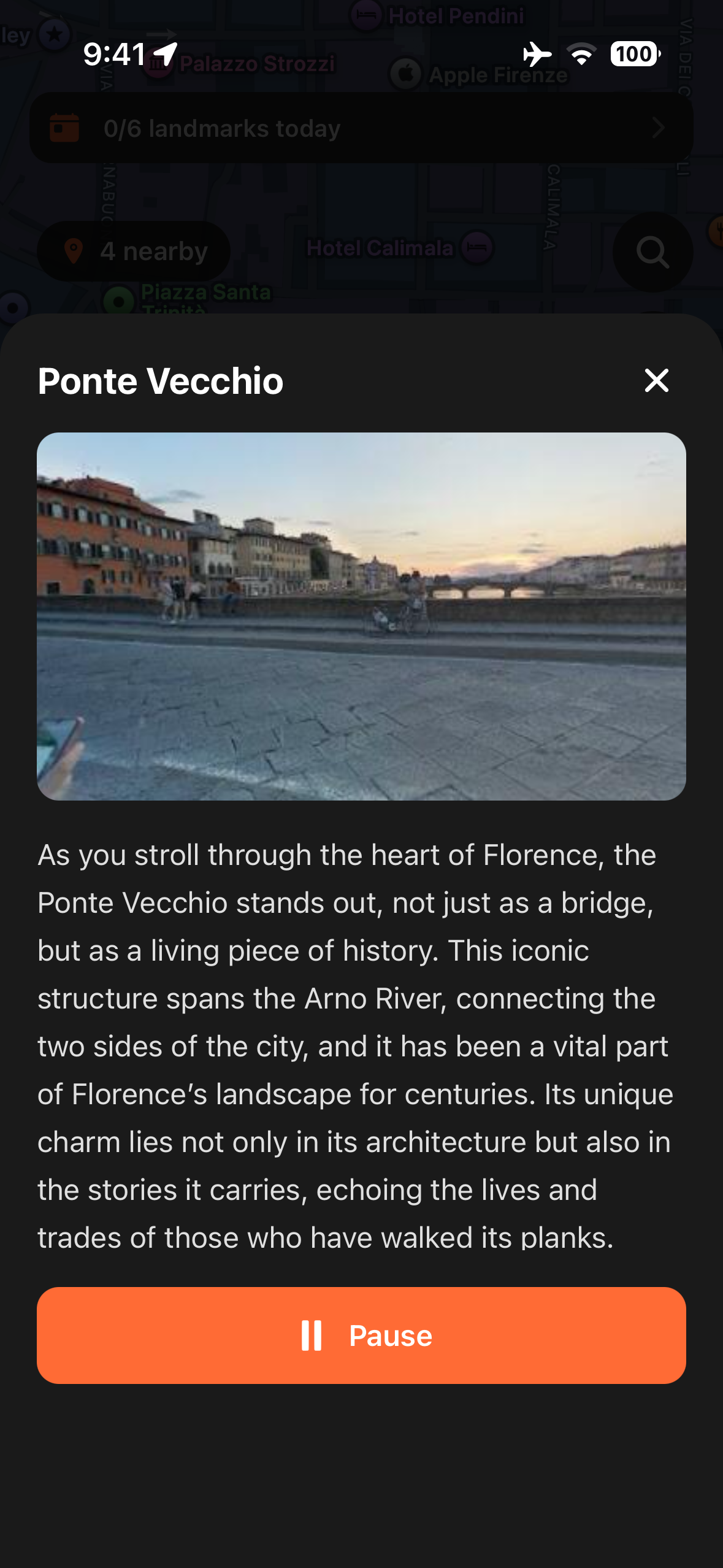
Urban Tales story panel for Ponte Vecchio in Florence with Arno River photo and narration

4 storytelling styles. Historical, Legends, Fun Facts and Cinematic.


How it works

Open the app.
Start walking.

No preparation, no pre-booked route, no group to keep up with. Urban Tales works the moment you step outside.

01

Download and open the map

The app shows landmarks around you the moment you open it. Works anywhere in Florence — from the Duomo to a quiet street in the Oltrarno.

02

Walk toward anything that catches your eye

As you get close to a landmark, the audio starts automatically. Put your phone in your pocket and just walk and listen.

03

Build a route or explore freely

Create a half-day route, a full-day itinerary, a 7-wonders tour or a custom path. Or ignore all of that and wander — the app keeps up.


What you'll hear

The Florence most visitors
never actually learn.

These are the kinds of stories Urban Tales narrates as you walk. Each one triggers automatically when you're standing in the right place.

History

Duomo · Piazza del Duomo

Brunelleschi built the world's largest dome without scaffolding — and kept his method secret

When Filippo Brunelleschi won the commission to dome Florence's cathedral in 1418, the hole in the roof had been open for 50 years because nobody knew how to close it. Brunelleschi invented new machines, new bricklaying patterns and a herringbone technique so revolutionary he refused to explain it to anyone — fearing his competitors would steal it. He died before seeing it completed. The dome remains the largest masonry dome ever built. Modern engineers still debate exactly how he did it.

Legend

Duomo · Porta della Mandorla

There's a bull's head carved on the cathedral — put there as revenge by a wronged husband

Look closely at the Porta della Mandorla on the north side of the Duomo and you'll spot an ox head carved into the stonework. The official explanation is that it honours the animals that hauled building materials. The local legend is darker: a foreman having an affair with a baker's wife was reported to the Ecclesiastical Court when the husband found out. In revenge, the foreman placed the bull's head facing the baker's shop — pointing horns directly at the man he had cuckolded, visible from his window every single day.

History

Ponte Vecchio · Arno River

Hitler personally ordered this bridge to be spared — and the butchers were evicted so jewellers could move in

Ponte Vecchio is the only bridge in Florence that survived World War II — all the others were destroyed by retreating German forces. Historians believe Hitler, who had visited Florence in 1938 and been moved by its beauty, issued a direct order to spare it. The bridge originally housed butchers and fishmongers. In 1593, Ferdinando I de' Medici evicted them all — disgusted by the smell — and replaced them with goldsmiths and jewellers, which is why it looks the way it does today.

Legend

Palazzo Vecchio · Piazza della Signoria

A ghost wanders the halls — and Michelangelo hid a self-portrait on the wall

In 1441, a military captain named Baldaccio was falsely accused of treason, murdered, and thrown from a window in the Sala dei Gigli. His ghost is said to wander the palace at night, heard as footsteps and closing doors. Less supernatural but equally hidden: Michelangelo carved a small portrait into the stone wall of the entrance, visible only if you know where to look. Art historians have debated for centuries whether it's actually his face.

Fun fact

Vasari Corridor · Uffizi to Pitti Palace

The Medici built a secret elevated passageway across the city so they could move without being seen

In 1565, Cosimo I de' Medici commissioned Giorgio Vasari to build a private elevated corridor connecting the Uffizi to the Palazzo Pitti across the Arno — 1 kilometre of enclosed walkway above the rooftops, through the walls of buildings and over the top of the Ponte Vecchio. The Medici could travel between their offices and home without descending to street level. During World War II, the corridor was used to hide artworks from Nazi seizure. It opened for limited public visits after decades of restoration.

Cinematic

Piazza della Signoria · Historic Centre

The most important square in Renaissance history is also where Savonarola burned books — and was then burned himself

Piazza della Signoria was the political heart of Florence for centuries. In 1497 and 1498, the radical friar Girolamo Savonarola held "Bonfires of the Vanities" here — piling up mirrors, books, art and luxury goods and setting them alight. The following year, the citizens turned on him. Savonarola was hanged and then burned in the same square. A small marble disk marks the exact spot. Most visitors walk over it without noticing.


Where to walk

Florence's neighborhoods,
explained through stories.

Urban Tales covers the full city. Here are the areas where the stories are thickest.

Duomo & Historic Centre

The Baptistery, the Campanile, the cathedral and the surrounding medieval streets. Florence's most concentrated layer of Renaissance history, public art and hidden detail — all within a 10-minute walk.

Piazza della Signoria & Uffizi

The political and artistic heart of the Renaissance. The square where Savonarola burned books and was later burned himself. The Uffizi Gallery above it holds the world's greatest concentration of Renaissance painting.

Oltrarno

The "other side of the Arno" — quieter, more artisan, less photographed. The Pitti Palace, the Boboli Gardens, craft workshops and the neighborhood where Florentines who aren't working in tourism actually live.

Santa Croce

The Franciscan basilica where Michelangelo, Galileo, Machiavelli and Dante's empty tomb are all found within 100 metres of each other. The most storied church floor in the world.

San Lorenzo & San Marco

The Medici parish. The family chapels, the Laurentian Library Michelangelo designed, and Fra Angelico's frescoed monastery — all in the neighborhood where the Medici built their power base.

San Miniato & Piazzale Michelangelo

The hill above the city. San Miniato al Monte is one of Italy's finest Romanesque churches, built in 1018 and containing a medieval zodiac floor. The views from Piazzale Michelangelo are the ones on every postcard — but Urban Tales tells you what you're actually looking at.


Storytelling styles

Choose how Florence
speaks to you.

The same landmark sounds completely different in each mode. Switch styles anytime during your walk.

Historical

Context, dates, politics, empires. What actually happened here and why it mattered. For travelers who want to leave Florence genuinely knowing things.

Legends

Myths, curses, ghosts and ancient superstitions. The stories Florentines told each other before the history books were written.

Fun Facts

The absurd, the surprising and the genuinely weird. Perfect for keeping energy up on a long walk or exploring with kids.

Cinematic

Hannibal Lecter curated its museums. Dan Brown hid codes in its churches. Florence through the lens of cinema.


FAQ

Common questions about
Urban Tales in Florence.

Does Urban Tales cover the Uffizi Gallery and other museums?

Urban Tales covers the exterior areas, piazzas and surrounding streets of Florence's major museums and galleries. For stories about works inside the Uffizi or Accademia, you'll need a separate entry ticket — but the history Urban Tales tells around these buildings is often more surprising than what's inside.

Is Urban Tales worth it if I've already been to Florence before?

Especially then. Florence rewards deeper attention more than almost any city. The Legends mode covers the stories that standard tours skip — the bull's head on the Duomo, the ghost in Palazzo Vecchio, the marble disk in the piazza where a friar was burned alive. Every return visit finds something new.

How does the pricing work for Florence?

You can start exploring for free. A day pass unlocks the full Florence experience for a single day, or you can unlock the city permanently. No subscriptions required.

What languages is the Florence audio guide available in?

Urban Tales supports English, Spanish (LATAM), Brazilian Portuguese, French and German. Select your language when you first open the app.

Can I use Urban Tales for a half-day or full-day visit to Florence?

Yes. Florence is compact and extremely walkable — most of the historic centre can be covered on foot in a day. The tour generator builds routes around your available time. For a first visit, a 7 Wonders route covers the essentials; returning visitors often do the Oltrarno and the hills.

Florence is waiting.
The stories start the moment you land.

Free to download. No tour group. No fixed schedule.

Download on theApp Store
Get it onGoogle Play

Explore more

Urban Tales works
everywhere you travel.

Tokyo, Florence, Barcelona, London, New York and many more cities available. See the full list and find your next destination.

View all cities →