Lisbon, Portugal

Seven hills,
one river,
a vanished empire.

Urban Tales is a GPS audio guide app that narrates Lisbon's hidden history, legends and secrets automatically as you walk — at your own pace, with no tour group to follow.


Walk up to a landmark.
The story starts.

No tapping. No searching. Urban Tales detects your GPS position and plays audio automatically the moment you're close enough. Put your phone in your pocket — just walk and listen.

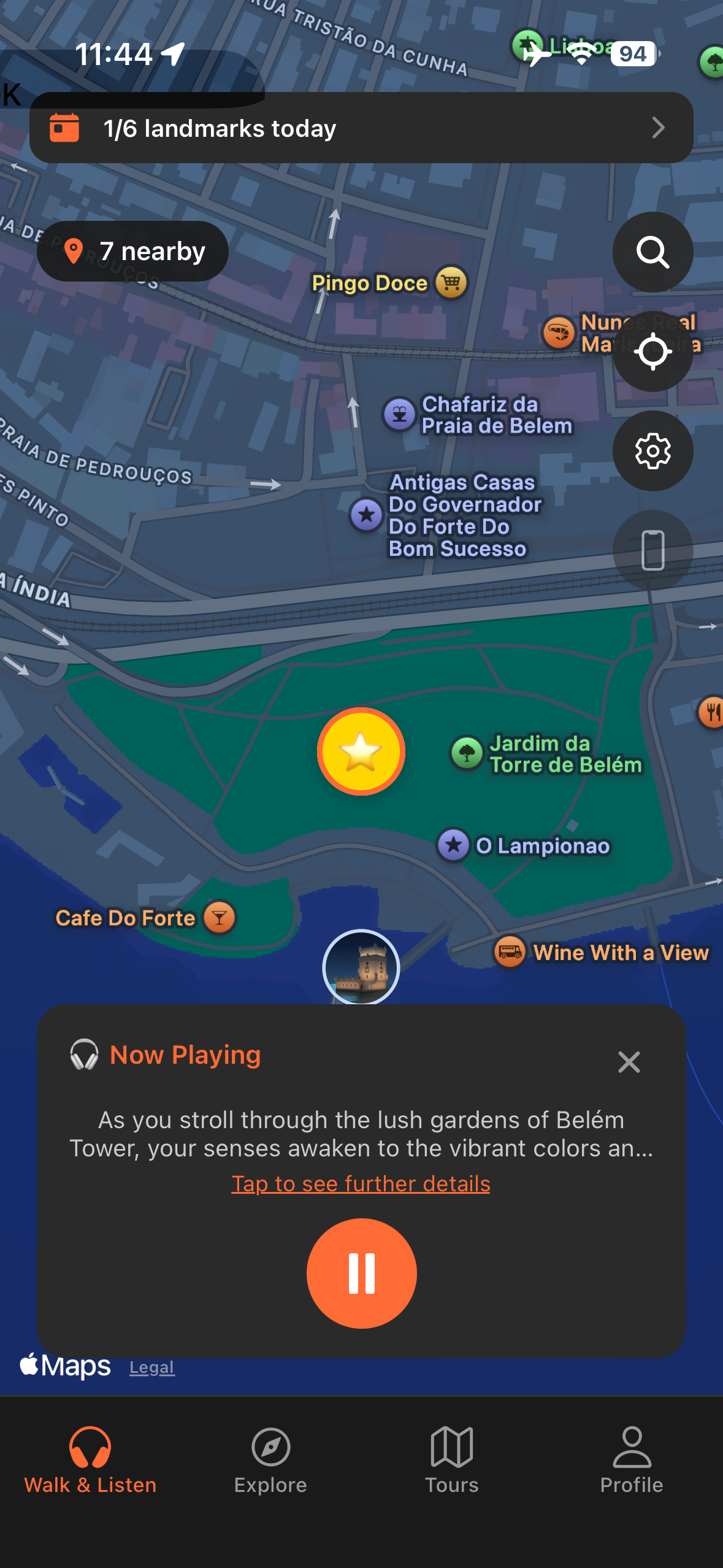
Urban Tales GPS map at Belém Tower in Lisbon with audio story automatically triggered

GPS triggered. Audio starts the moment you arrive at a landmark.

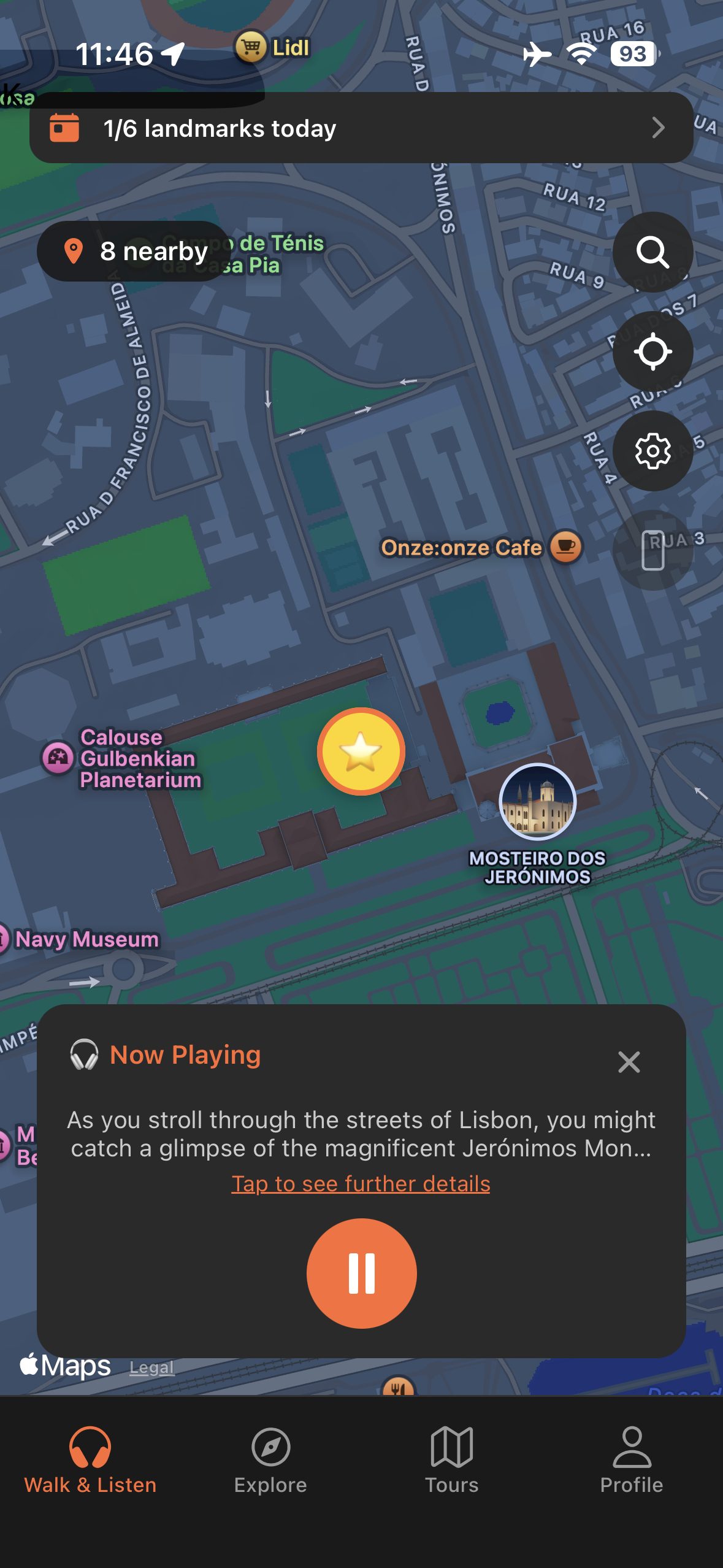
Urban Tales GPS map at Jerónimos Monastery in Lisbon with story triggered

Walk freely. Every landmark around you has a story ready.

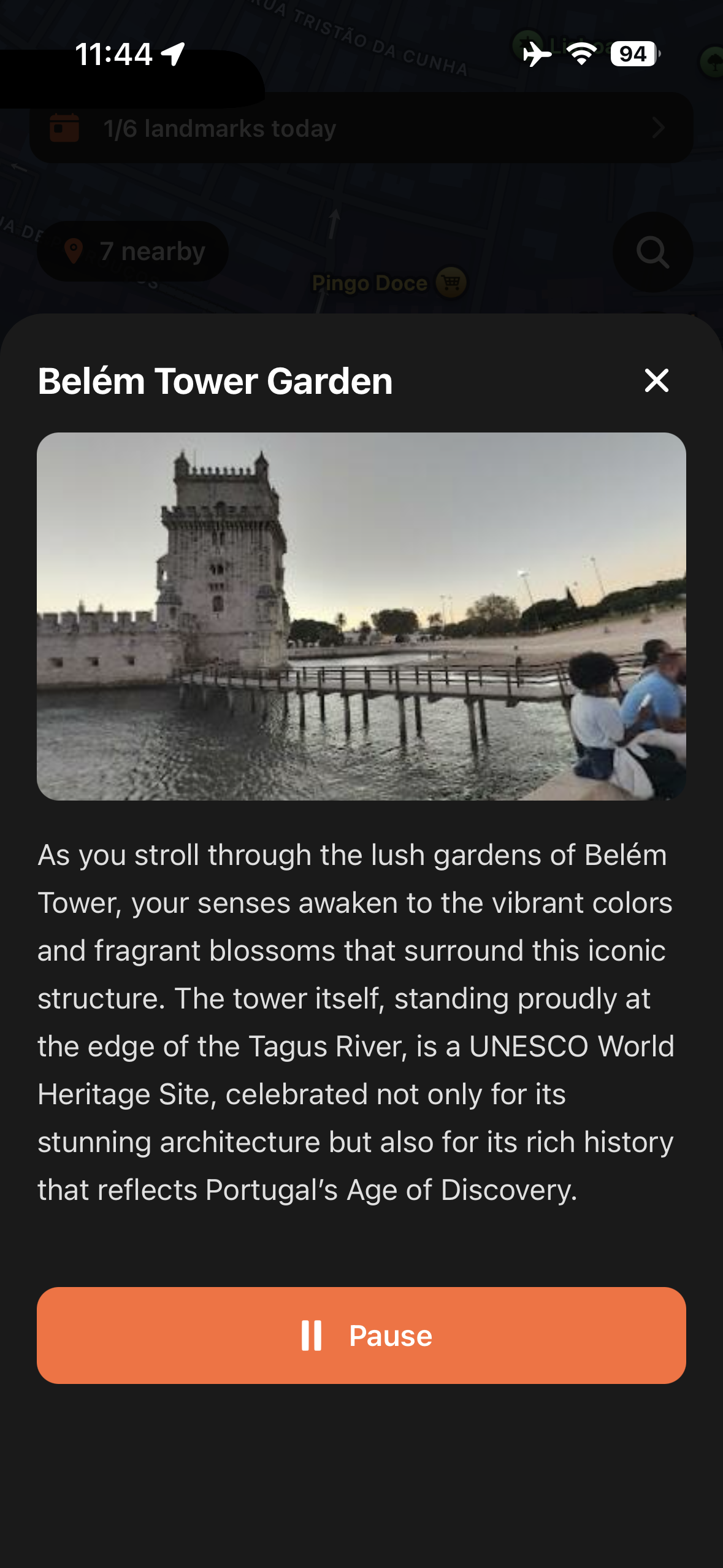
Urban Tales story panel for Belém Tower in Lisbon with photo and narration

Rich stories. History, legends and context for every landmark.

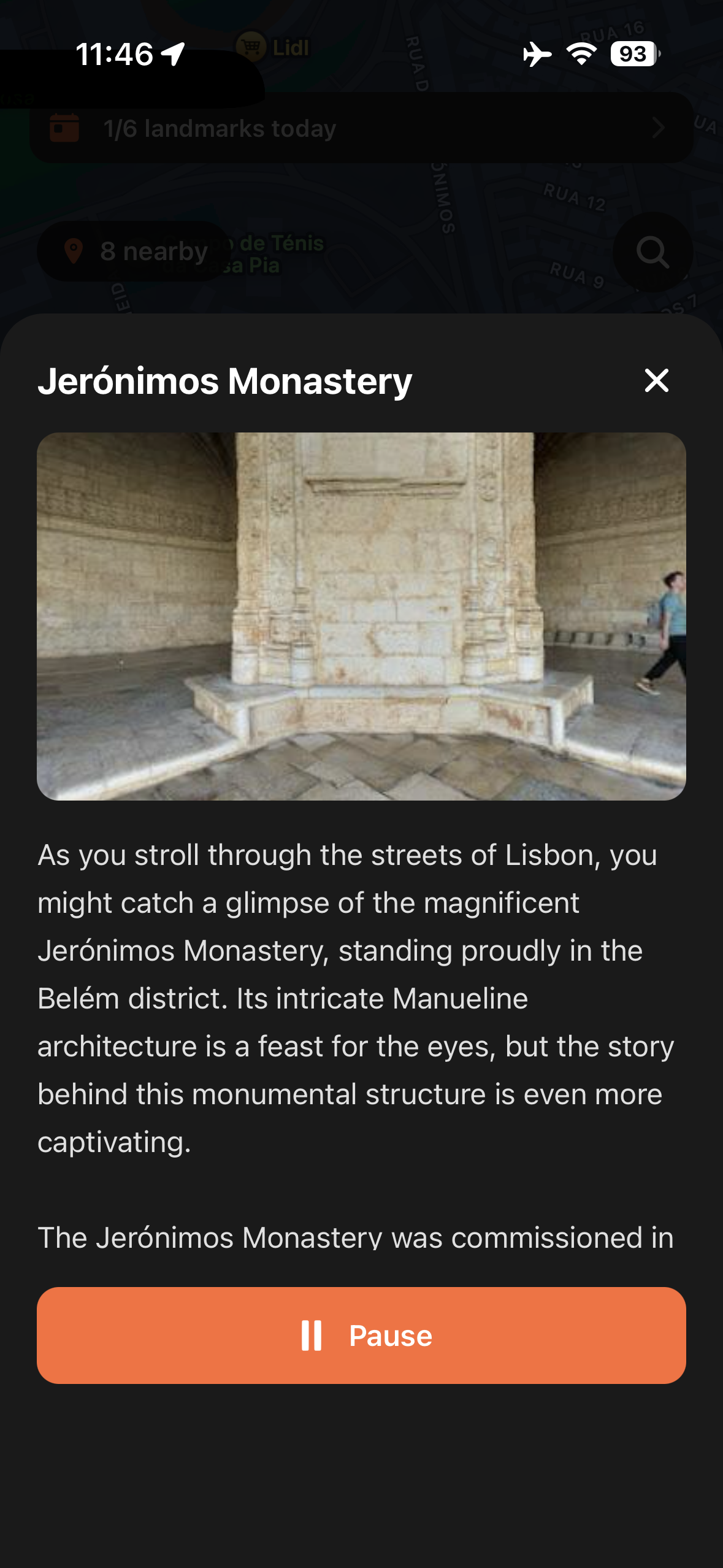
Urban Tales story panel for Jerónimos Monastery in Lisbon with photo and narration

4 storytelling styles. Historical, Legends, Fun Facts and Cinematic.


How it works

Open the app.
Start walking.

No preparation, no pre-booked route, no group to keep up with. Urban Tales works the moment you step outside.

01

Download and open the map

The app shows landmarks around you the moment you open it. Works anywhere in Lisbon — the app covers the full city.

02

Walk toward anything that catches your eye

As you get close to a landmark, the audio starts automatically. Put your phone in your pocket and just walk and listen.

03

Build a route or explore freely

Create a half-day route, a full-day itinerary, a 7-wonders tour or a custom path. Or ignore all of that and wander — the app keeps up.


What you'll hear

The Lisbon most visitors
never actually learn.

These are the kinds of stories Urban Tales narrates as you walk. Each one triggers automatically when you're standing in the right place.

History

Jerónimos Monastery · Belém

Built with the profits of the spice trade — and Vasco da Gama is buried inside

The Jerónimos Monastery was commissioned in 1501 by King Manuel I to celebrate Vasco da Gama's return from India. It was funded almost entirely by the pepper tax — a 5% levy on all spices brought from the East. The doorway is a masterpiece of the Manueline style: ropes, armillary spheres and coral carved in stone. Inside, da Gama himself is buried in a marble sarcophagus. The monastery survived the 1755 earthquake — one of the few buildings in Lisbon that did.

Legend

Lisbon Cathedral · Alfama

The city's coat of arms shows two ravens — because they guarded a saint's remains on a boat

Lisbon's patron saint is São Vicente. According to legend, his remains were transported by boat from Valencia to Lisbon in 1173, accompanied by two ravens who perched on the bow and never moved throughout the entire journey. The ravens appear on the city's official coat of arms today. The cathedral itself was built immediately after the Christian conquest of the city in 1147, on the site of a mosque — which was itself built on a Visigothic church.

History

Praça do Comércio · Baixa

The 1755 earthquake killed 30,000 people in minutes — and this square rose from the ruins

On the morning of All Saints Day, 1755, an earthquake measuring an estimated magnitude 8.5 struck Lisbon. The shaking lasted ten minutes. The fires that followed burned for five days. The tsunami came next. Up to 40,000 people died. The Marquis of Pombal rebuilt the entire city centre from scratch in a rationalist grid — the first planned city rebuilt after an earthquake in European history. Praça do Comércio stands on the site of the old royal palace, which collapsed in the disaster.

Fun fact

Aqueduct of Free Waters · Northern Lisbon

The most beautiful engineering feat in Lisbon was also used by a serial killer

The Aqueduto das Águas Livres stretches 58 kilometres and was completed in 1748 to bring fresh water to Lisbon. A century after its completion, the 19th-century serial killer Diogo Alves used the isolated arches to ambush and murder travellers, throwing the bodies into the valley below. He killed at least 70 people. His preserved head is still stored at the Faculty of Medicine of Lisbon.

Legend

Belém Tower · Tagus Estuary

The tower stood in the middle of the river — until an earthquake shifted the shoreline

Belém Tower was built between 1516 and 1521 as a fortress in the middle of the Tagus River, accessible only by boat. The 1755 earthquake gradually deposited enough sediment to connect it to the shore. It now appears to sit on the riverbank, but was designed as a water fortress. The rhinoceros carved above the entrance is one of the first realistic European sculptures of the animal — inspired by a rhino gifted to King Manuel I in 1515.

Cinematic

Alfama · Eastern Lisbon

Fado was born in these streets — and nobody agrees exactly how or why

Fado — the melancholy Portuguese music of longing, loss and fate — is said to have originated in the Alfama neighbourhood in the early 19th century. The theories of its origin are disputed: African rhythms from Brazil, Arabic music from the Moorish occupation, or the songs of sailors mourning the dead. Alfama itself survived the 1755 earthquake almost intact because its Moorish foundations were built on bedrock, not the soft riverside silt that destroyed the rest of the city.

Legend

Tiber Island · Isola Tiberina

A snake chose this island as Rome's hospital — and it still is one

When a plague devastated Rome in 293 BC, a sacred serpent escaped a delegation's boat and swam to a small island in the Tiber. Romans took it as a divine sign and built a temple there. The island has been a place of healing ever since — it still houses a working hospital today. The snake wrapped around a rod became the universal symbol of medicine.

Cinematic

Largo di Torre Argentina · Campo Marzio

Julius Caesar was assassinated here. It's now a cat sanctuary.

On the Ides of March, 44 BC, Julius Caesar was stabbed 23 times in the ruins that sit in this open square. Most tourists walk around it without recognising what it is. Today, hundreds of cats live in the sunken ruins under the care of local volunteers. You can visit them for free.


Where to walk

Lisbon's neighborhoods,
explained through stories.

Urban Tales covers the full city. Here are the areas where the stories are thickest.

Alfama

The Moorish neighborhood that survived the earthquake. Its warren of medieval streets, São Jorge Castle, fado houses and tiled viewpoints are the oldest continuously inhabited part of the city.

Belém

Where the Age of Discovery begins. The Jerónimos Monastery, the Tower of Belém, the Monument to the Discoveries — all built on the profits of a spice trade that changed the world.

Baixa & Chiado

The Pombaline grid rebuilt after the 1755 earthquake — perfectly rectangular streets that replaced a medieval city destroyed in minutes. The first planned earthquake-resistant urban design in history.

Mouraria

The Moorish quarter where Muslims who stayed after the Christian conquest were confined. The neighborhood where fado is said to have been born, and where Lisbon's most multicultural daily life still happens.

LX Factory & Alcântara

A 19th-century industrial complex under the 25 de Abril Bridge, transformed into a creative hub. The Sunday market is one of the best in Europe.

Intendente & Martim Moniz

Named after the soldier who sacrificed himself to keep the city gate open in 1147. Now a vibrant area of immigrant communities and local life that most tourists never reach.


Storytelling styles

Choose how Lisbon
speaks to you.

The same landmark sounds completely different in each mode. Switch styles anytime during your walk.

Historical

Context, dates, politics, empires. What actually happened here and why it mattered. For travelers who want to leave Lisbon genuinely knowing things.

Legends

Myths, curses, ghosts and ancient superstitions. The stories locals told each other before the history books were written.

Fun Facts

The absurd, the surprising and the genuinely weird. Perfect for keeping energy up on a long walk or exploring with kids.

Cinematic

Films shot here, fado recorded here, directors who fell for the melancholy light of the Tagus. Lisbon through the lens of cinema.


FAQ

Common questions about
Urban Tales in Lisbon.

Does Urban Tales cover Belém and the Jerónimos Monastery?

Yes. Urban Tales covers Belém fully — the Tower, the monastery, the Monument to the Discoveries and the surrounding riverfront. Stories trigger automatically as you walk through the area. Entry to the monastery interior requires a separate ticket.

Is Urban Tales worth it if I have already been to Lisbon?

Especially then. The layers beneath Lisbon's surface — the earthquake rebuilding, the Moorish heritage, the fado origins — are almost entirely absent from standard tours. The Legends mode in particular transforms the city.

How does the pricing work for Lisbon?

You can start exploring for free. A day pass unlocks the full Lisbon experience for a single day, or you can unlock the city permanently. No subscriptions required.

What languages is the Lisbon audio guide available in?

Urban Tales supports English, Spanish (LATAM), Brazilian Portuguese, French and German. The Brazilian Portuguese narration for Lisbon is particularly rich — two branches of the same language meeting in the city that sent fleets to Brazil.

Can I use Urban Tales for a half-day or full-day visit?

Yes. Lisbon is hilly but compact — the historic districts are walkable once you are in them. Use the tour generator to plan around your available time, or explore freely and take the trams when the hills get steep.

div>

Lisbon is waiting.
The stories start the moment you land.

Free to download. No tour group. No fixed schedule.

Download on theApp Store
Get it onGoogle Play

Explore more

Urban Tales works
everywhere you travel.

Lisbon, Amsterdam, Buenos Aires and many more cities available. See the full list and find your next destination.

View all cities →