Marrakech, Morocco

A medina unchanged
for a thousand years.
Every street has a story.

Urban Tales is a GPS audio guide app that narrates Marrakech's hidden history, legends and secrets automatically as you walk — at your own pace, with no tour group to follow.


Walk up to a landmark.
The story starts.

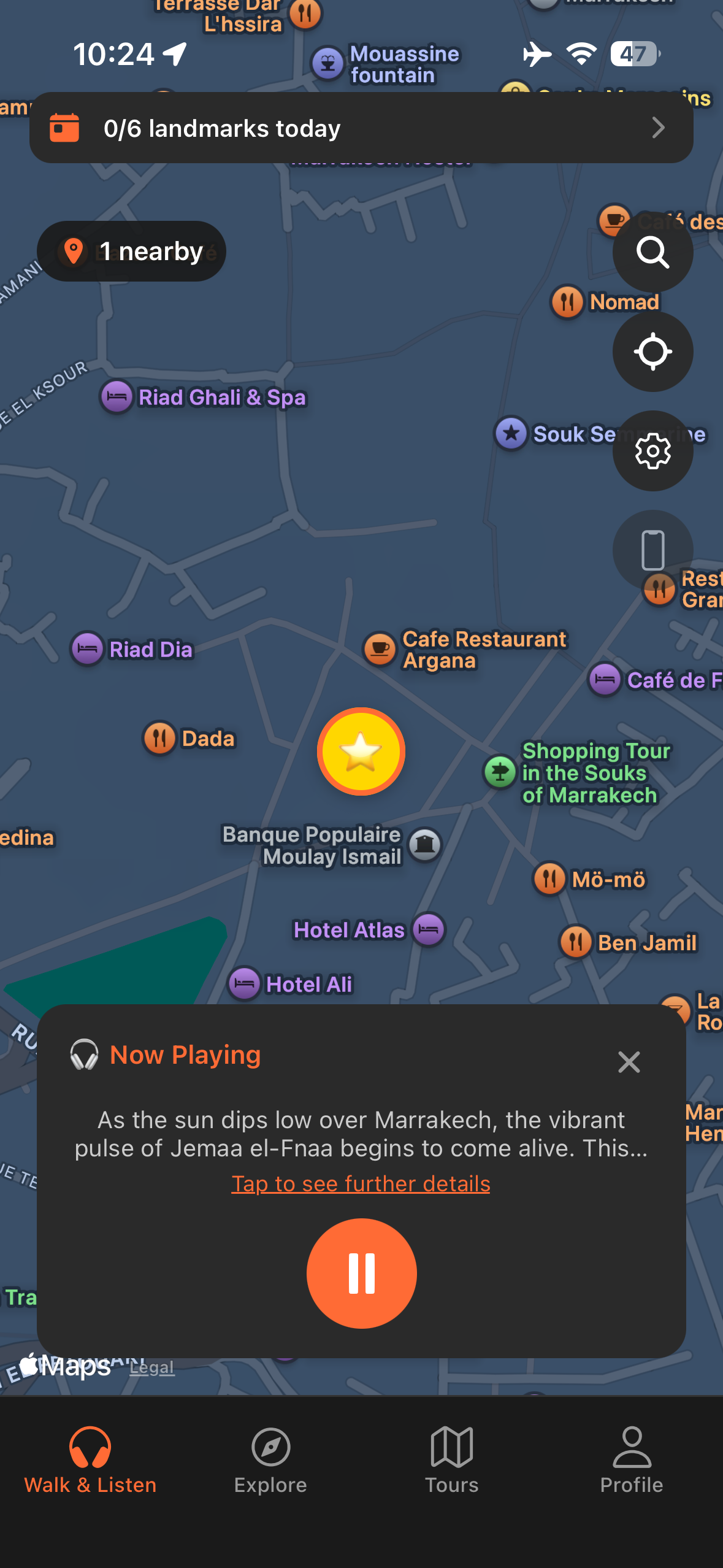
No tapping. No searching. Urban Tales detects your GPS position and plays audio automatically the moment you're close enough. Put your phone in your pocket — just walk and listen.

Urban Tales GPS map in Marrakech with audio story automatically triggered

GPS triggered. Audio starts the moment you arrive at a landmark.

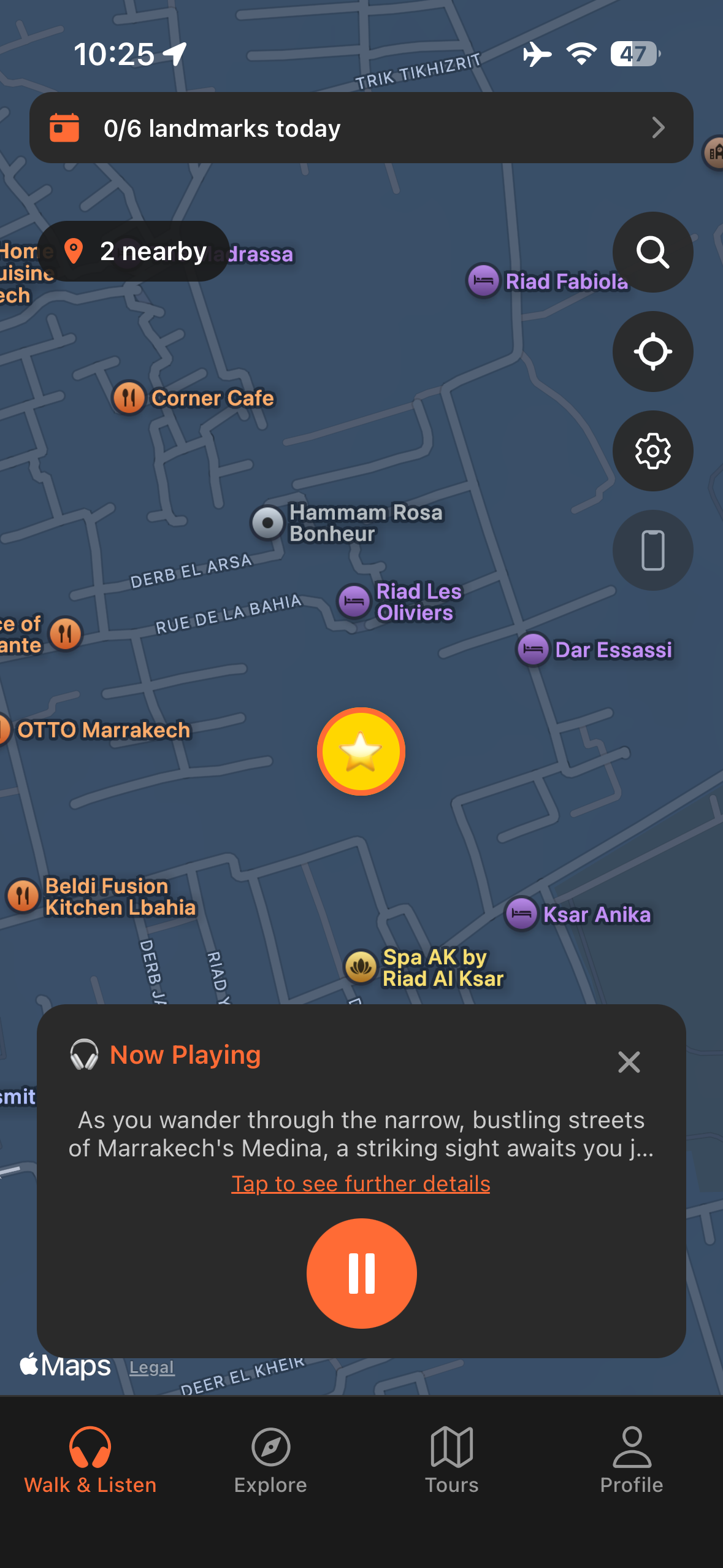
Urban Tales GPS map in Marrakech with story automatically triggered

Walk freely. Every landmark around you has a story ready.

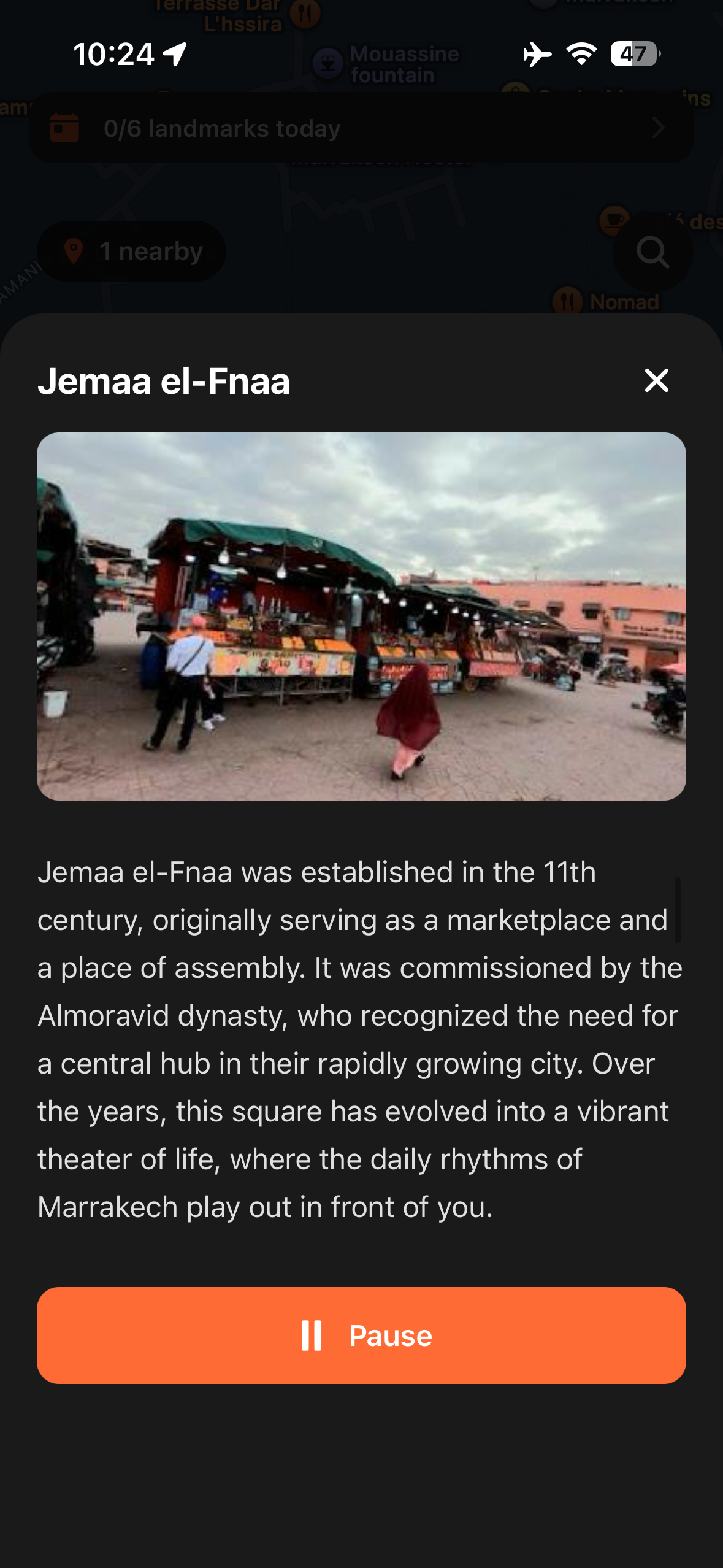
Urban Tales story panel in Marrakech with photo and narration

Rich stories. History, legends and context for every landmark.

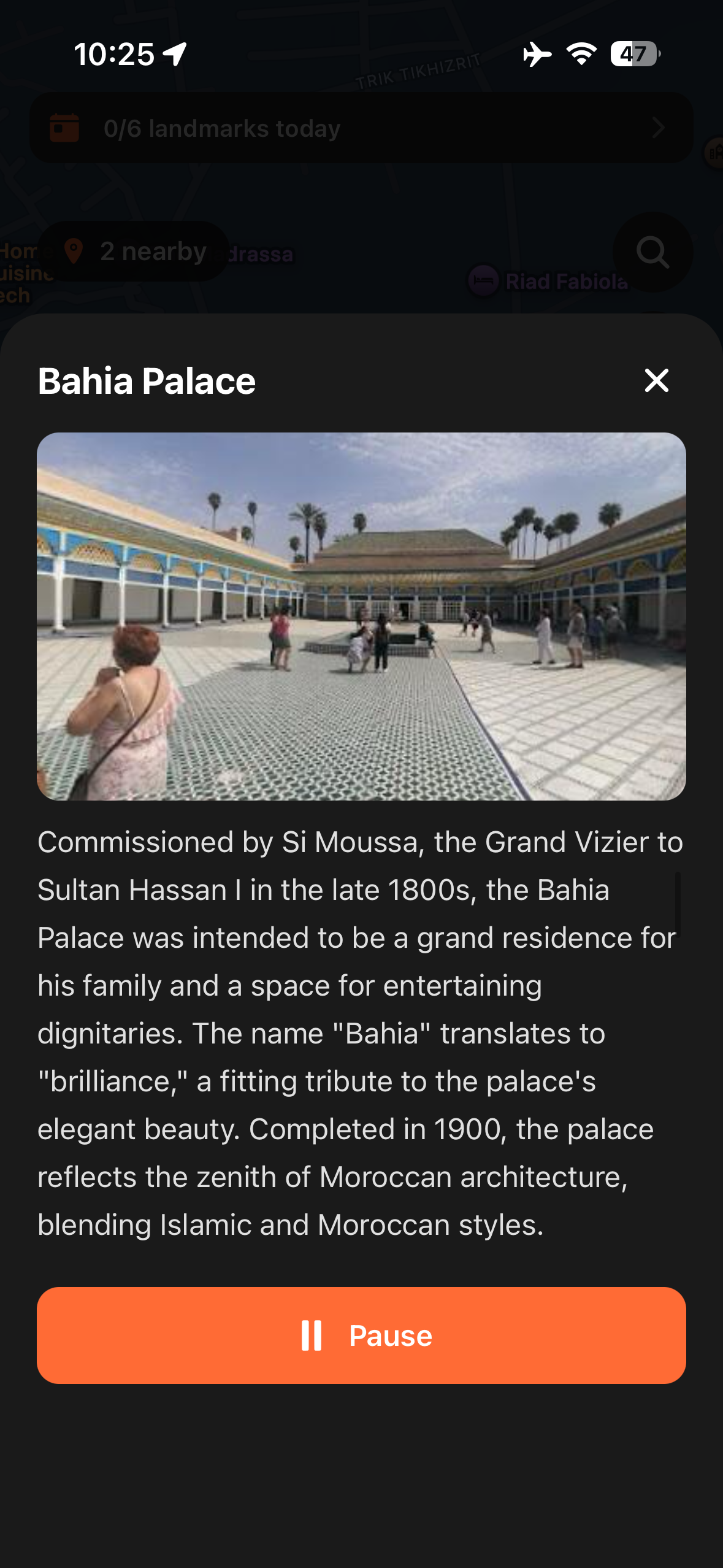
Urban Tales story panel in Marrakech with photo and narration

4 storytelling styles. Historical, Legends, Fun Facts and Cinematic.


How it works

Open the app.
Start walking.

No preparation, no pre-booked route, no group to keep up with. Urban Tales works the moment you step outside.

01

Download and open the map

The app shows landmarks around you the moment you open it. Works anywhere in Marrakech — the app covers the full city.

02

Walk toward anything that catches your eye

As you get close to a landmark, the audio starts automatically. Put your phone in your pocket and just walk and listen.

03

Build a route or explore freely

Create a half-day route, a full-day itinerary, a 7-wonders tour or a custom path. Or ignore all of that and wander — the app keeps up.


What you'll hear

The Marrakech most visitors
never actually learn.

These are the kinds of stories Urban Tales narrates as you walk. Each one triggers automatically when you're standing in the right place.

History

Jemaa el-Fnaa · Medina

The world's greatest open-air theatre was almost destroyed to build a car park in the 1980s

Jemaa el-Fnaa — the Assembly of the Dead, named for the public executions once held here — has been the living heart of Marrakech since the 11th century. By day, orange juice sellers, snake charmers and henna artists. By night, one of the largest spontaneous food markets in the world, surrounded by storytellers, musicians and acrobats. In the 1980s, the city government planned to pave it over for parking. The Spanish writer Juan Goytisolo led an international campaign that resulted in UNESCO adding oral traditions to its Intangible Cultural Heritage list specifically to protect spaces like this one.

Legend

Ben Youssef Madrasa · Medina

The most beautiful building in Marrakech was a school — and its geometry encodes the structure of the universe

The Ben Youssef Madrasa, built in the 14th century and expanded in the 16th, was once the largest Islamic school in North Africa. Its internal courtyard is covered in a continuous surface of carved cedarwood, geometric tilework and stucco arabesque — three materials, each with its own vocabulary, that together form a visual argument about the nature of God and the cosmos. The geometric patterns were not decorative. They were instructional — a meditation on the infinite, designed so students absorbing Islamic law would do so surrounded by its mathematical expression.

History

Bahia Palace · Southern Medina

The palace took 14 years to build — and was designed so that no room would be the most impressive

Bahia Palace was built in the late 19th century by Ba Ahmed, the Grand Vizier who effectively ruled Morocco while the sultan was a child. It contains 160 rooms arranged around a series of courtyards, each decorated with hand-cut zellij tilework, carved cedar and painted plaster. The design was intentional: no room was meant to be obviously superior to any other, so that rival wives and concubines could not claim precedence. When Ba Ahmed died in 1900, the sultan moved in immediately and stripped it of everything valuable within a week.

Fun fact

The Souks · Northern Medina

The souk dyers have been using the same stone vats and natural pigments for over 900 years — the smell is deliberate

The tanneries of Marrakech's leather souk are one of the most photographed sights in Morocco — pools of pigment in vivid colours, workers treading leather by hand in stone vats. The process is unchanged since the medieval era: pigeon droppings soften the leather, then natural plant dyes — poppy, indigo, saffron, mint — colour it. The vats are placed downwind of the rest of the souk because the smell is significant. Shops surrounding the tanneries provide visitors with sprigs of mint to hold under their nose. This is not a recent custom.

Cinematic

Majorelle Garden · Gueliz

A French painter spent 40 years creating a garden — then Yves Saint Laurent bought it to stop it being demolished

The Majorelle Garden was created by the French painter Jacques Majorelle, who moved to Marrakech in 1919 and spent four decades designing the garden and painting its structures in a vivid cobalt blue that he patented as "Majorelle Blue." After his death in 1962, the garden fell into disrepair. In 1980, Yves Saint Laurent and Pierre Bergé bought it to prevent its conversion into a hotel. Saint Laurent's ashes are scattered in the garden. After his death, the garden and its attached Islamic art museum were purchased by a Moroccan foundation — and the gate repainted Majorelle Blue.

Legend

Koutoubia Mosque · Medina

The most important minaret in the Islamic world was built as an act of penance — and its proportions became the template for two others

The Koutoubia Mosque's minaret, completed in 1199, is the masterpiece of Almohad architecture and one of the most influential towers ever built. Its proportions — height to width ratio of 5:1 — became the template for the Giralda in Seville and the Hassan Tower in Rabat, built shortly after. The mosque's name means "Mosque of the Booksellers," for the market that surrounded it. According to tradition, the minaret was built on the orders of the Almohad caliph Yaqub al-Mansur as penance — because the original mosque had been built facing the wrong direction, misaligned with Mecca by a few degrees.


Where to walk

Marrakech's neighborhoods,
explained through stories.

Urban Tales covers the full city. Here are the areas where the stories are thickest.

Jemaa el-Fnaa & Koutoubia

The heart of the medina — the great square that transforms completely between day and night, and the minaret whose proportions were copied in Seville and Rabat.

The Souks

The labyrinth of covered markets north of the square, organised by craft since the medieval era. Leather tanners, spice merchants, metalworkers and carpet weavers in an urban layout that hasn't changed in 900 years.

Mellah (Jewish Quarter)

The historic Jewish quarter established in the 16th century, one of the oldest in Morocco. Its synagogues, fondouks and distinctive balconied architecture tell the story of a community that shaped the city for centuries.

Bahia & Southern Medina

The Bahia Palace, the Badi Palace ruins and the Saadian Tombs — a cluster of royal monuments built and stripped by successive dynasties, each leaving a different layer of the city's political history.

Gueliz (New City)

The French-built new city outside the medina walls, where the Majorelle Garden sits behind its cobalt blue walls. The contrast between Gueliz's wide boulevards and the medina's medieval lanes tells the story of the protectorate era.

Palmeraie

The palm grove on the northern edge of Marrakech, planted according to legend when Almoravid soldiers spat out date pits as they marched. An oasis city that still has an oasis — barely visible but still there.


Storytelling styles

Choose how Marrakech
speaks to you.

The same landmark sounds completely different in each mode. Switch styles anytime during your walk.

Historical

Context, dates, politics, empires. What actually happened here and why it mattered. For travelers who want to leave Marrakech genuinely knowing things.

Legends

Myths, curses, ghosts and ancient superstitions. The stories locals told each other before the history books were written.

Fun Facts

The absurd, the surprising and the genuinely weird. Perfect for keeping energy up on a long walk or exploring with kids.

Cinematic

Hitchcock filmed The Man Who Knew Too Much here, Paul Bowles wrote about it. Marrakech through the lens of cinema and literature.


FAQ

Common questions about
Urban Tales in Marrakech.

Does Urban Tales work inside the medina's narrow alleys?

Yes. Urban Tales uses GPS to trigger stories throughout the medina — including the souks, the palaces and the smaller neighborhoods beyond the main tourist routes. The app works wherever you walk.

Is Urban Tales worth it if I have already been to Marrakech?

Especially then. The stories behind the Ben Youssef Madrasa's geometry, the palace stripped bare within a week of its owner's death, the Koutoubia built as penance — these are the layers that standard tours never reach.

How does the pricing work for Marrakech?

You can start exploring for free. A day pass unlocks the full Marrakech experience for a single day, or you can unlock the city permanently. No subscriptions required.

What languages is the Marrakech audio guide available in?

Urban Tales supports English, Spanish (LATAM), Brazilian Portuguese, French and German. The French narration for Marrakech is particularly rich — a city that was a French protectorate for 44 years and still carries that layer alongside its much older ones.

Can I use Urban Tales for a half-day or full-day visit to Marrakech?

Yes. The medina is compact but dense — a half-day covers the main square and souks; a full day lets you explore the palaces, the Ben Youssef Madrasa, the Mellah and the Majorelle Garden. Getting lost is encouraged. Urban Tales finds you wherever you end up.

Marrakech is waiting.
The stories start the moment you land.

Free to download. No tour group. No fixed schedule.

Download on theApp Store
Get it onGoogle Play

Explore more

Urban Tales works
everywhere you travel.

Explore our full collection of cities at urbantales.net/cities.html See the full list and find your next destination.

View all cities →