Mexico City, Mexico

Three thousand years
of history, layered
under your feet.

Urban Tales is a GPS audio guide app that narrates Mexico City's hidden history, legends and secrets automatically as you walk — at your own pace, with no tour group to follow.


Walk up to a landmark.
The story starts.

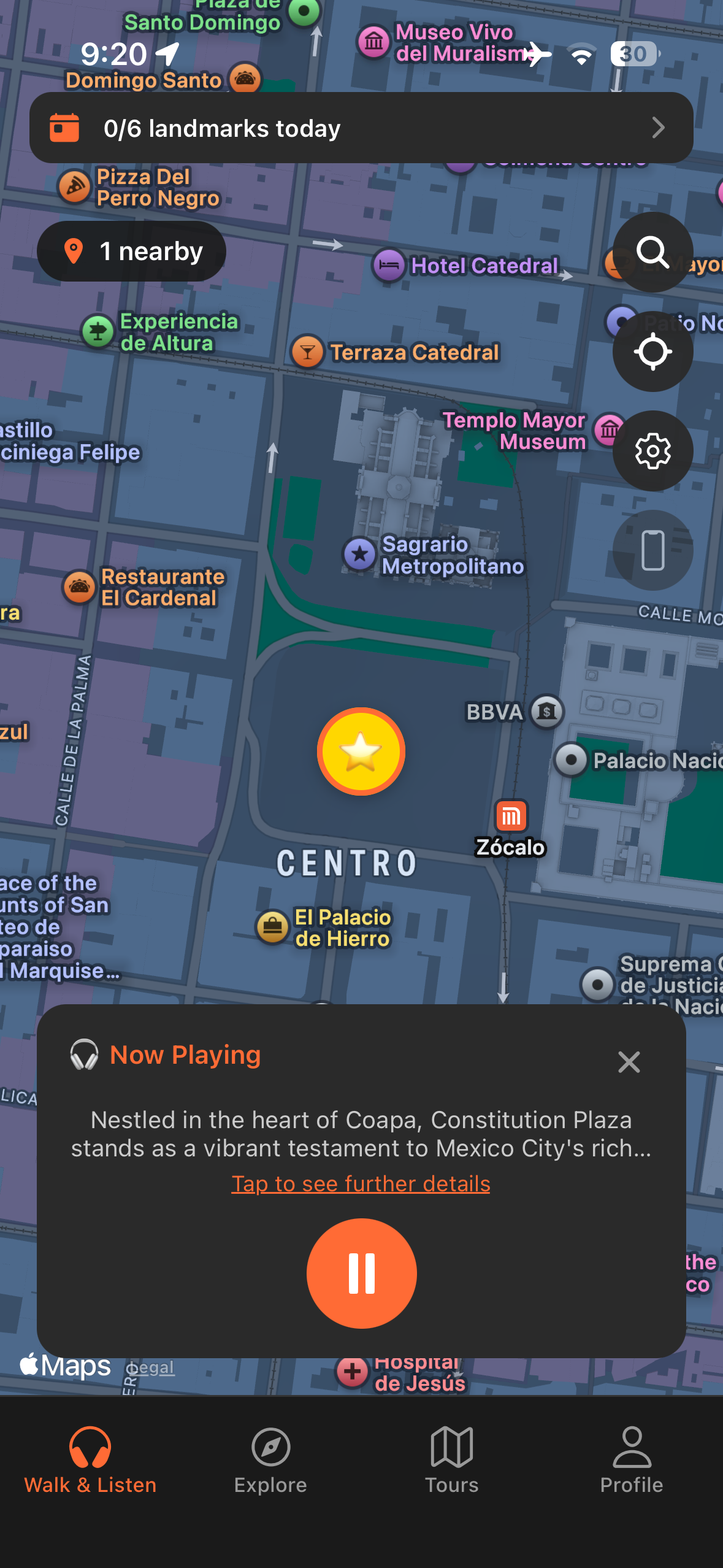
No tapping. No searching. Urban Tales detects your GPS position and plays audio automatically the moment you're close enough. Put your phone in your pocket — just walk and listen.

Urban Tales app showing GPS map near the Zócalo in Mexico City with audio story automatically triggered

GPS triggered. Audio starts the moment you arrive at a landmark.

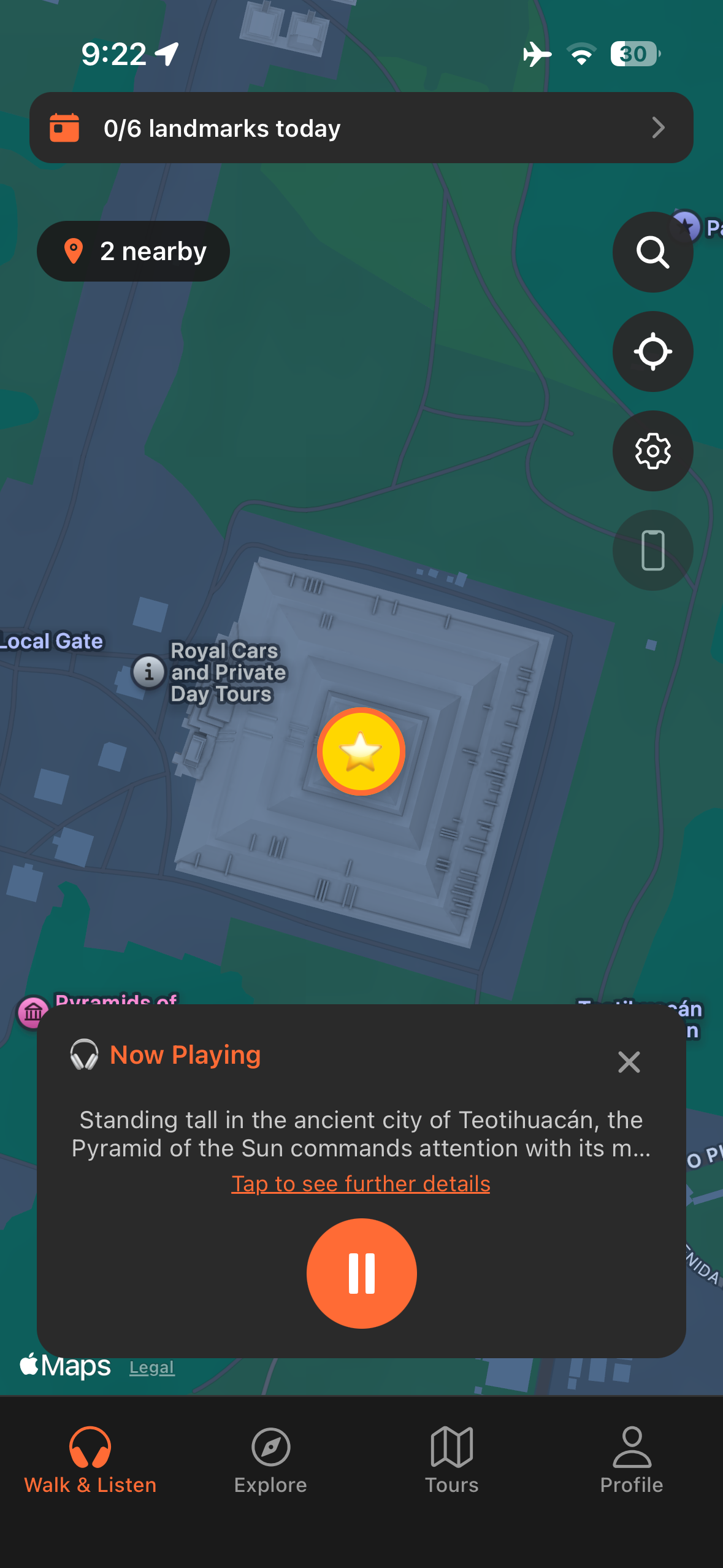
Urban Tales GPS map near the Pyramid of the Sun at Teotihuacán with story automatically triggered

Walk freely. Every landmark around you has a story ready.

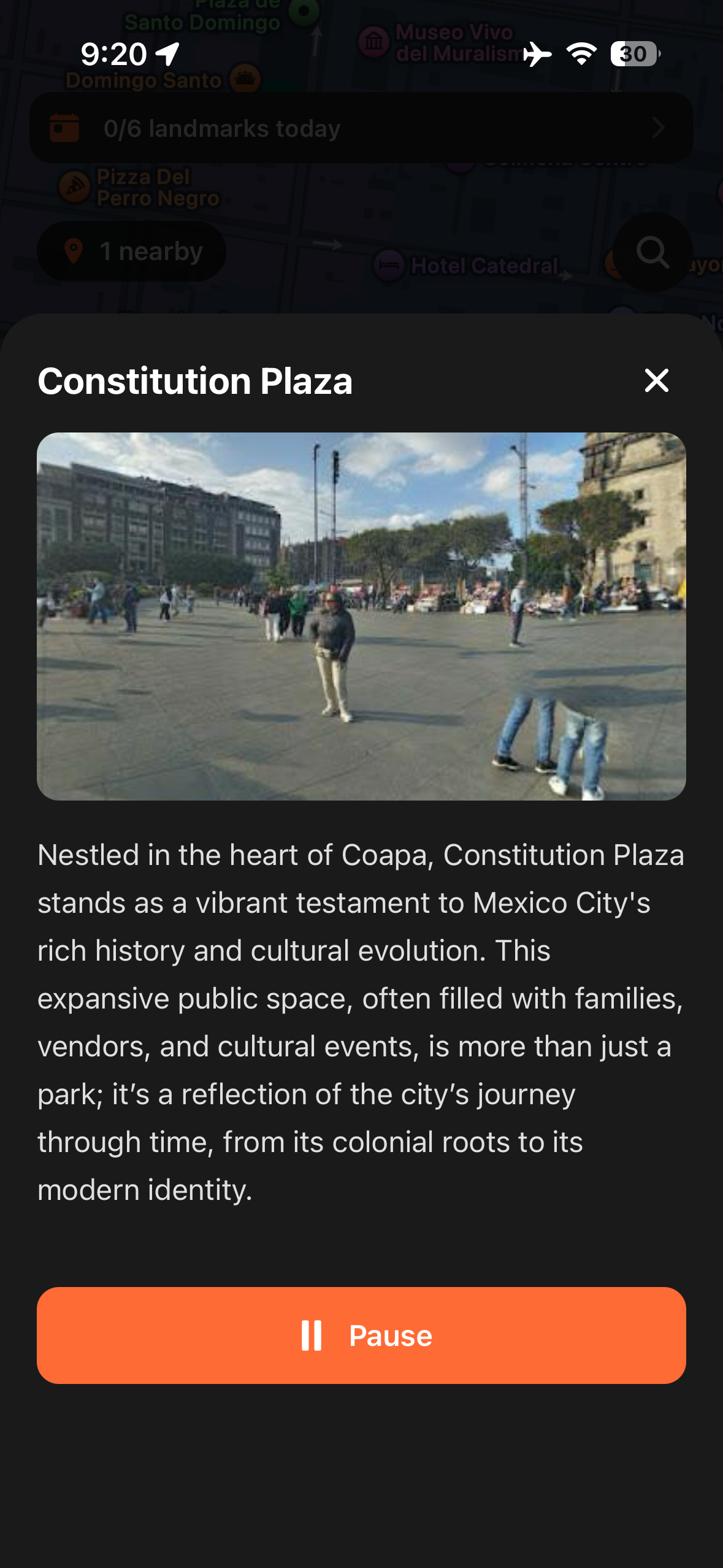
Urban Tales story panel for Constitution Plaza in Mexico City showing narration text and landmark photo

Rich stories. History, legends and context for every landmark.

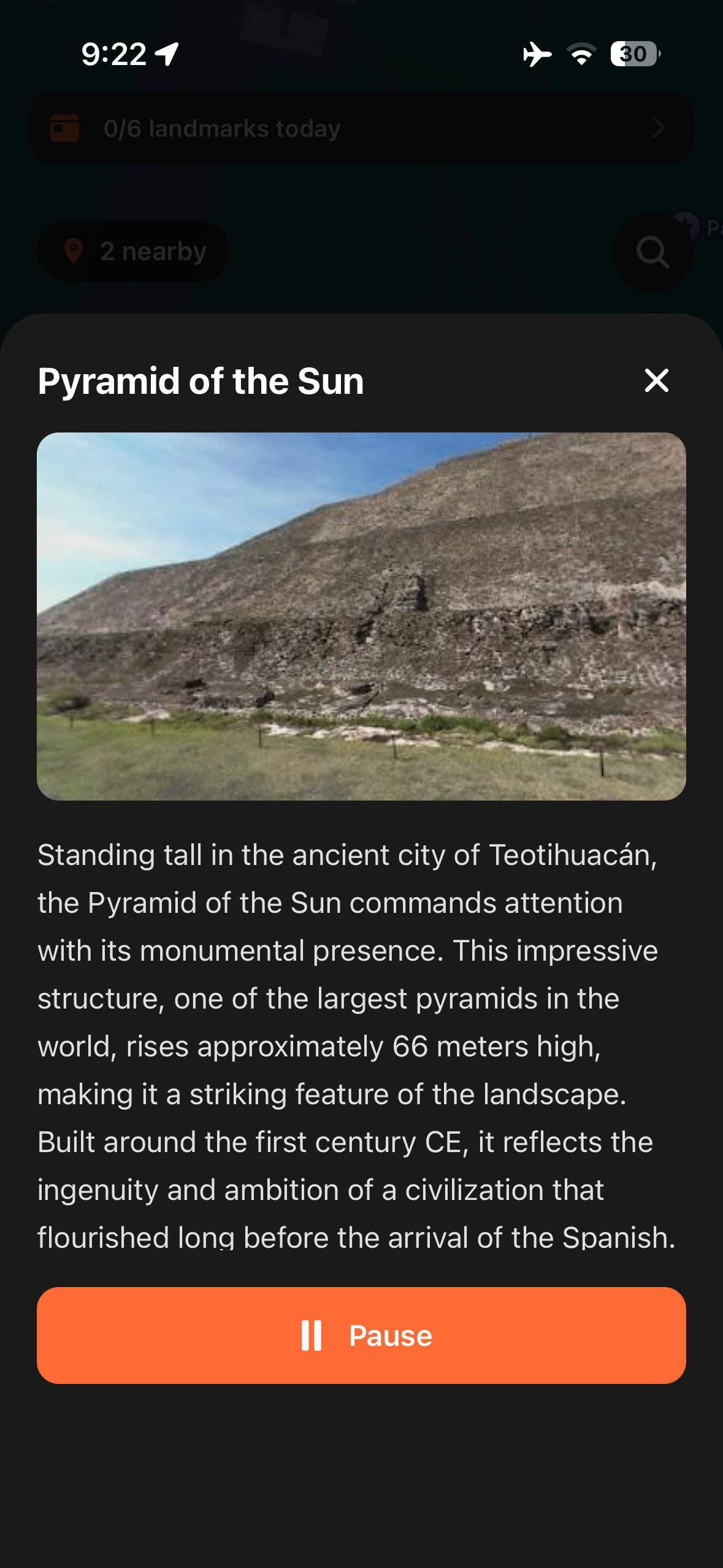
Urban Tales story panel for the Pyramid of the Sun at Teotihuacán with photo and narration text

4 storytelling styles. Historical, Legends, Fun Facts and Cinematic.


How it works

Open the app.
Start walking.

No preparation, no pre-booked route, no group to keep up with. Urban Tales works the moment you step outside.

01

Download and open the map

The app shows landmarks around you the moment you open it. Works anywhere in Mexico City — from the Zócalo to a quiet street in Xochimilco.

02

Walk toward anything that catches your eye

As you get close to a landmark, the audio starts automatically. Put your phone in your pocket and just walk and listen.

03

Build a route or explore freely

Create a half-day route, a full-day itinerary, a 7-wonders tour or a custom path. Or ignore all of that and wander — the app keeps up.


What you'll hear

The Mexico City most visitors
never actually learn.

These are the kinds of stories Urban Tales narrates as you walk. Each one triggers automatically when you're standing in the right place.

History

Zócalo · Centro Histórico

The largest plaza in Latin America was built on top of a destroyed civilization

The Zócalo — officially Plaza de la Constitución — sits directly on the ruins of Tenochtitlán, the Aztec capital that the Spanish conquistadors demolished stone by stone in 1521. The Metropolitan Cathedral was built using rubble from Aztec temples. Beneath the square, archaeologists have found layers of the original city that once held up to 200,000 inhabitants, making it one of the largest cities in the world at the time.

Legend

Templo Mayor · Centro Histórico

The Aztec's most sacred temple was hidden under a city block — and found by accident

In 1978, workers from the electric company were digging near the Zócalo when they hit something massive: a carved stone disk nearly 3.5 metres wide depicting the dismembered moon goddess Coyolxauhqui. Excavations revealed the Templo Mayor — the spiritual heart of the Aztec empire — buried under the streets of modern Mexico City. The Spanish had built directly over it. The site is now an open-air museum steps from the cathedral.

Fun fact

Mexico City · Centro

The entire city is slowly sinking — because it was built on a lake

The Aztecs built Tenochtitlán on an island in the middle of Lake Texcoco. The Spanish drained most of the lake and built their new city on the soft lakebed. Mexico City has been sinking ever since — in some areas by as much as 10 metres over the past century. The Metropolitan Cathedral visibly tilts as a result. Engineers have spent decades installing counterweights and drainage systems to slow what cannot be fully stopped.

Cinematic

Coyoacán · South Mexico City

Frida Kahlo's blue house was the center of the most dramatic love story in Mexican art history

La Casa Azul — the Blue House — is where Frida Kahlo was born, painted and died. It's also where she endured one of the most turbulent marriages in art history, to the muralist Diego Rivera, who famously had an affair with her own sister. Kahlo herself had affairs with Leon Trotsky, who lived nearby after being granted asylum in Mexico. Trotsky was later assassinated with an ice pick two kilometres away. All of this happened in the same leafy neighborhood.

History

Pyramid of the Sun · Teotihuacán

The third largest pyramid in the world was built by a civilization we still can't identify

Teotihuacán was one of the largest cities in the ancient world, home to over 100,000 people at its peak. The Pyramid of the Sun was completed around 200 AD — centuries before the Aztecs arrived. When the Aztecs discovered the site, it was already abandoned. They named it Teotihuacán — "the place where the gods were created" — because the scale was so overwhelming they assumed only gods could have built it. The civilization that actually built it remains unknown.

Legend

Chapultepec Park · Chapultepec

The hill of the grasshopper was sacred to the Aztecs — and haunted by a child emperor

Chapultepec means "hill of the grasshopper" in Nahuatl. The Aztecs considered it sacred and built a royal retreat there. The castle that sits atop it today was the site of one of Mexico's most tragic moments: the Battle of Chapultepec in 1847, where a group of military cadets — the Niños Héroes — died defending it against American troops. Legend holds that one cadet wrapped himself in the Mexican flag and jumped from the castle walls rather than surrender it.


Where to walk

Mexico City's neighborhoods,
explained through stories.

Urban Tales covers the full city. Here are the areas where the stories are thickest.

Centro Histórico

The Zócalo, Templo Mayor, Metropolitan Cathedral and Palacio Nacional — all within walking distance of each other. Three layers of civilization stacked on top of one another. The densest history in the entire city.

Coyoacán

The cobblestone village where Frida Kahlo was born, Leon Trotsky was assassinated and Diego Rivera painted. One of the few areas of the city that still feels like a town within the megalopolis.

Chapultepec

A 686-hectare urban forest containing a castle, six museums and the ruins of Aztec baths. Chapultepec Park is where Mexico City breathes — and where centuries of power struggles played out.

Colonia Roma & Condesa

Art Nouveau mansions, leafy boulevards, independent bookshops and the best restaurant scene in Latin America. Rebuilt after the 1985 earthquake, these neighborhoods became the creative heart of the modern city.

Xochimilco

The last remnant of the lake system the Aztecs built their civilization on. Colorful trajinera boats still navigate the same canals that once connected Tenochtitlán. A UNESCO World Heritage Site hiding in plain sight.

Tlatelolco & Tepito

Tlatelolco was the Aztec's great marketplace — once the largest in the world. The Plaza de las Tres Culturas here marks where the Aztec empire made its last stand. One of the most charged squares in Mexican history.


Storytelling styles

Choose how Mexico City
speaks to you.

The same landmark sounds completely different in each mode. Switch styles anytime during your walk.

Historical

Context, dates, politics, empires. What actually happened here and why it mattered. For travelers who want to leave Mexico City genuinely knowing things.

Legends

Myths, curses, ghosts and ancient superstitions. The stories Mexicans told each other before the history books were written.

Fun Facts

The absurd, the surprising and the genuinely weird. Perfect for keeping energy up on a long walk or exploring with kids.

Cinematic

Films shot here, scenes set here, directors who fell in love with this city. Mexico City through the lens of cinema.


FAQ

Common questions about
Urban Tales in Mexico City.

Does Urban Tales cover Teotihuacán as well as the city centre?

Yes. Urban Tales covers both the historic centre and Teotihuacán, the ancient pyramid complex about 50km from the city. Whether you're standing in the Zócalo or at the base of the Pyramid of the Sun, stories trigger automatically as you explore.

Is Urban Tales worth it if I've already been to Mexico City before?

Especially then. Return visitors consistently say the app revealed layers they had completely missed — the Aztec city buried under the Spanish city, the sinking foundations, the stories behind the murals. The Legends mode transforms places you thought you already knew.

How does the pricing work for Mexico City?

You can start exploring for free. A day pass unlocks the full Mexico City experience for a single day, or you can unlock the city permanently. No subscriptions required.

What languages is the Mexico City audio guide available in?

Urban Tales supports English, Spanish (LATAM), Brazilian Portuguese, French and German. The Spanish narration for Mexico City is particularly rich — the city's stories were meant to be told in this language.

Can I use Urban Tales for a half-day or full-day visit?

Yes. The app supports everything from a quick stop at the Zócalo to a full-day route covering the historic centre, Chapultepec and Coyoacán. Use the route generator to build an itinerary that fits your time — Mexico City rewards whoever slows down.

Mexico City is waiting.
The stories start the moment you land.

Free to download. No tour group. No fixed schedule.

Download on theApp Store
Get it onGoogle Play

Explore more

Urban Tales works
everywhere you travel.

Rome, Paris, Mexico City and more cities being added regularly. See the full list and find your next destination.

View all cities →