New York City, USA

Eight million people.
Eight million stories.
Start walking.

Urban Tales is a GPS audio guide app that narrates New York City's hidden history, legends and secrets automatically as you walk — at your own pace, with no tour group to follow.


Walk up to a landmark.
The story starts.

No tapping. No searching. Urban Tales detects your GPS position and plays audio automatically the moment you're close enough. Put your phone in your pocket — just walk and listen.

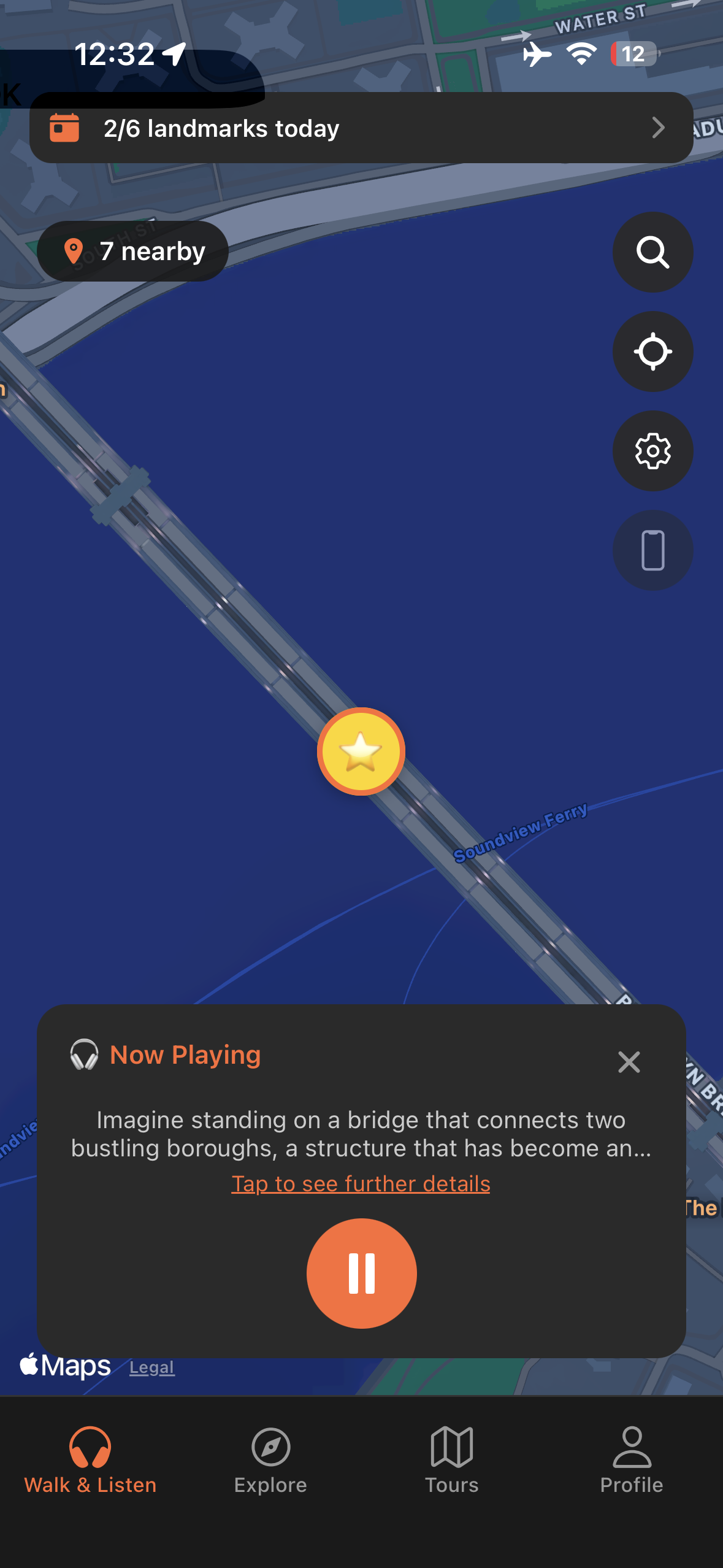
Urban Tales GPS map at the Brooklyn Bridge in New York City with audio story automatically triggered

GPS triggered. Audio starts the moment you arrive at a landmark.

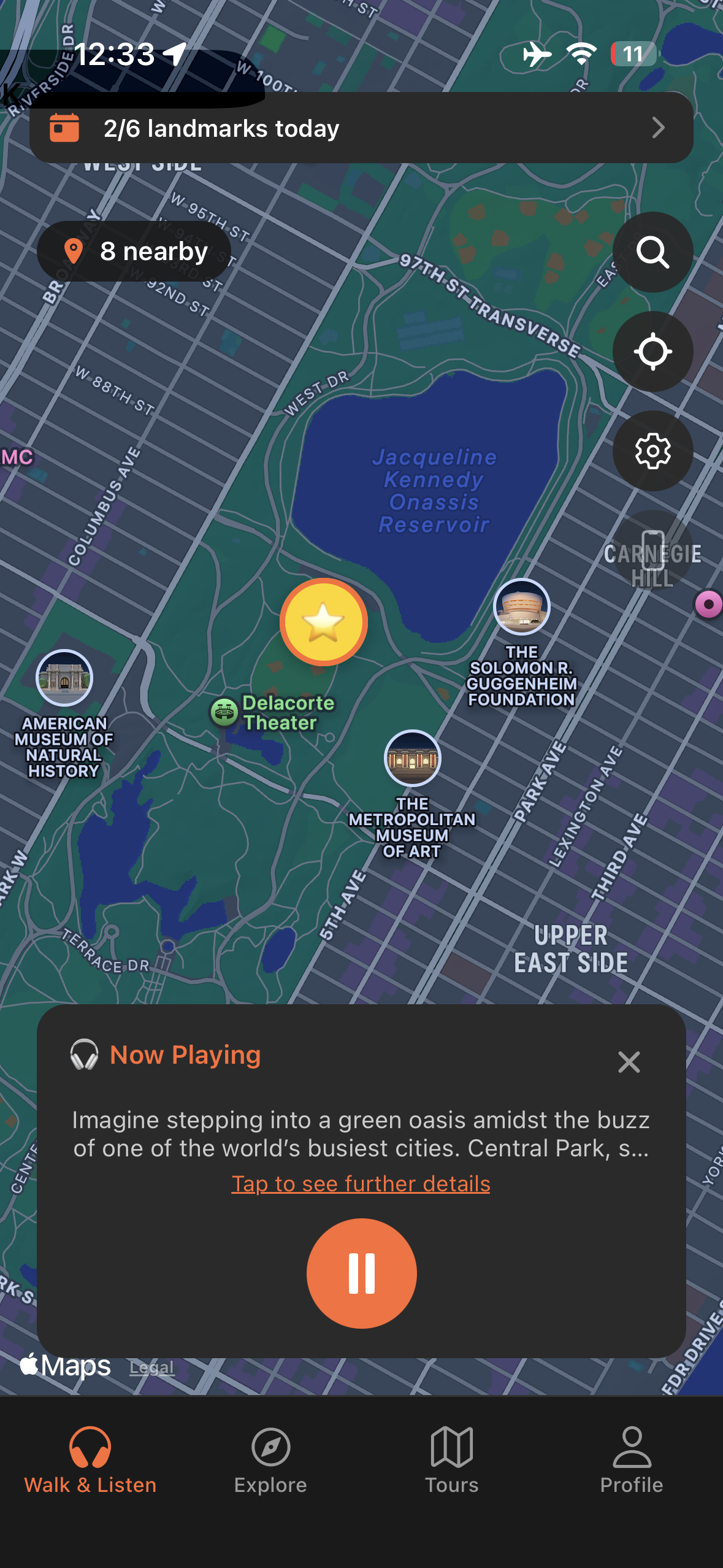
Urban Tales GPS map at Central Park in New York City with story automatically triggered

Walk freely. Every landmark around you has a story ready.

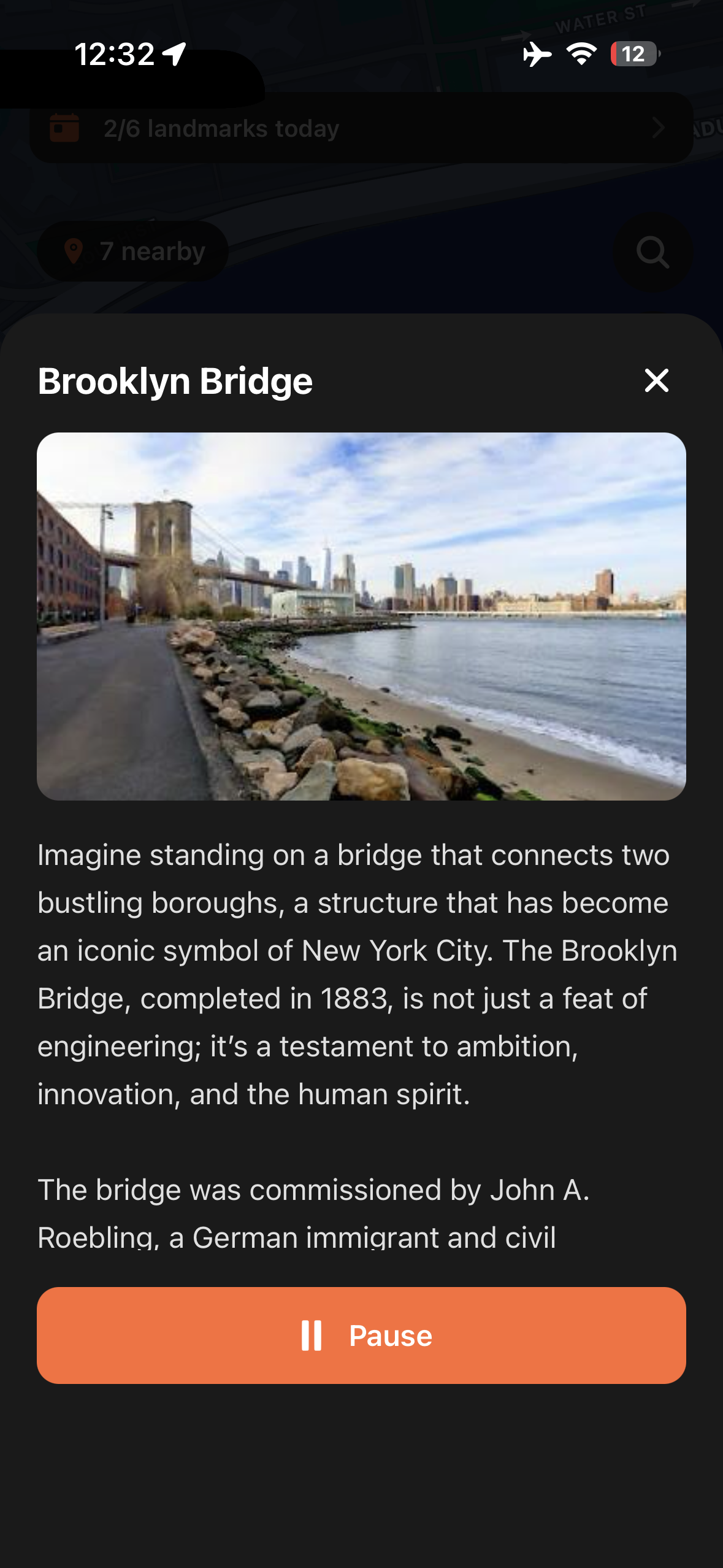
Urban Tales story panel for the Brooklyn Bridge in New York City with narration and photo

Rich stories. History, legends and context for every landmark.

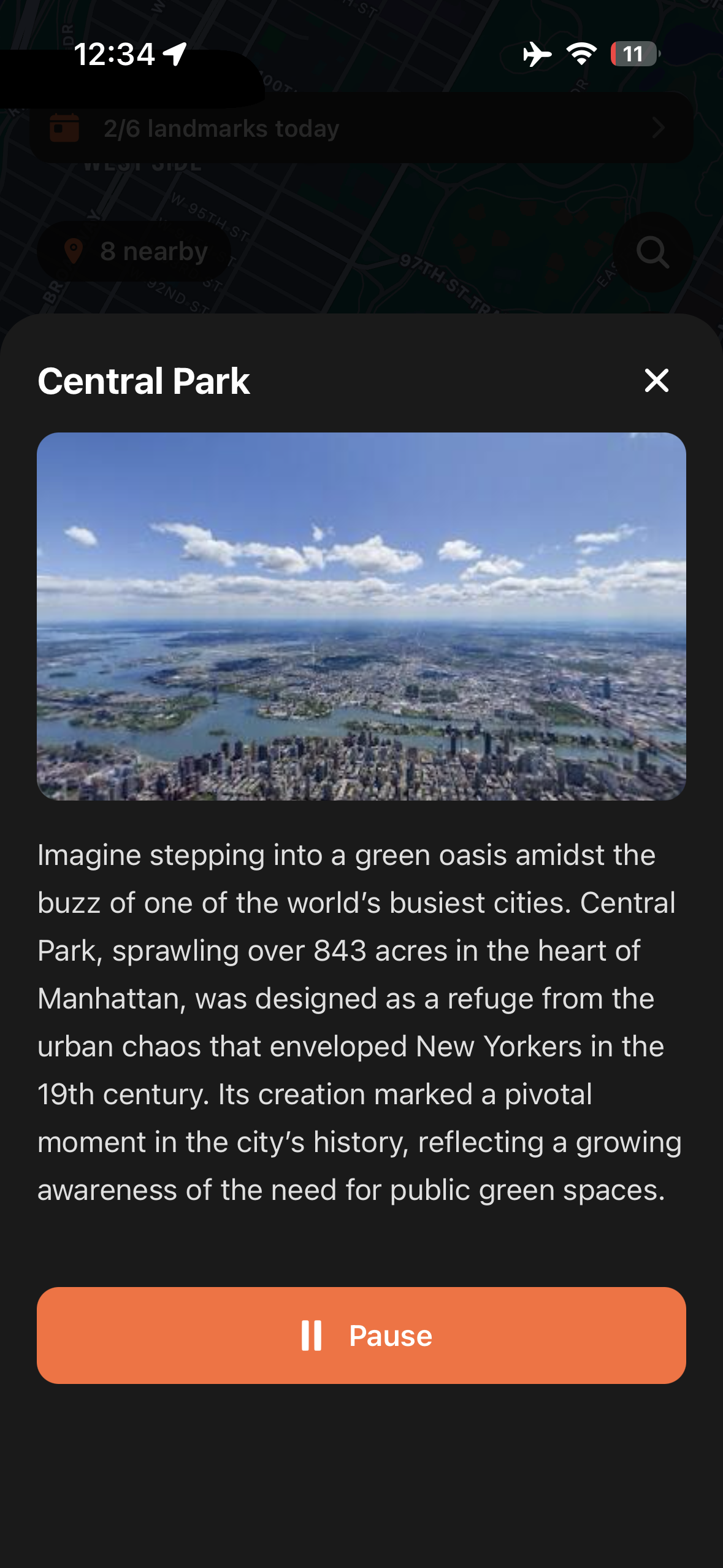
Urban Tales story panel for Central Park with aerial photo and narration text

4 storytelling styles. Historical, Legends, Fun Facts and Cinematic.


How it works

Open the app.
Start walking.

No preparation, no pre-booked route, no group to keep up with. Urban Tales works the moment you step outside.

01

Download and open the map

The app shows landmarks around you the moment you open it. Works anywhere in New York City — from the Brooklyn Bridge to a quiet street in the West Village.

02

Walk toward anything that catches your eye

As you get close to a landmark, the audio starts automatically. Put your phone in your pocket and just walk and listen.

03

Build a route or explore freely

Create a half-day route, a full-day itinerary, a 7-wonders tour or a custom path. Or ignore all of that and wander — the app keeps up.


What you'll hear

The New York most visitors
never actually learn.

These are the kinds of stories Urban Tales narrates as you walk. Each one triggers automatically when you're standing in the right place.

History

Brooklyn Bridge · Lower Manhattan

The engineer who designed it died before construction started — and his wife finished it

John Roebling designed the Brooklyn Bridge but died of tetanus after his foot was crushed during surveying in 1869. His son Washington took over, then suffered decompression sickness from working in the pressurised underwater caissons and was left partially paralysed. Washington's wife Emily spent the next 11 years learning advanced engineering and overseeing construction on his behalf. She was the first person to cross the completed bridge in 1883, carrying a rooster as a symbol of victory.

Fun fact

Grand Central Terminal · Midtown Manhattan

The whispering gallery works — and so does the secret presidential platform underneath

Stand in the archway of Grand Central's lower dining concourse and whisper into the wall — someone on the opposite side of the arch 15 metres away will hear every word, while nobody in between hears anything. Beneath the terminal, Track 61 is a sealed platform where Franklin D. Roosevelt's private armoured train car could arrive without anyone knowing. The President, who kept his polio private, used it to travel discreetly to the Waldorf Astoria above.

History

Central Park · Upper Manhattan

1,600 people were forcibly removed to build the park — and their neighborhood was erased from the maps

Central Park was designed as a refuge for New Yorkers in 1858. But the land was not empty. A thriving community called Seneca Village — home to over 250 free Black residents, three churches and two schools — occupied the site. Every resident was evicted under eminent domain, their buildings demolished and their community literally written off the maps. The park's own designers barely acknowledged their existence. Archaeologists began excavating the site for the first time in 2011.

Legend

The High Line · Chelsea

A disused railway line was saved from demolition by two people who had never built anything before

By the late 1990s, the abandoned High Line freight railway was scheduled for demolition. Two Chelsea residents — a writer and a fashion designer — formed a conservancy to save it, despite having no experience in urban planning or real estate development. They spent a decade fighting the city, inspired partly by a wild garden that had grown spontaneously across the tracks. The High Line opened in 2009 and transformed the surrounding neighborhood so dramatically that it became a case study in urban planning worldwide.

Cinematic

Lower East Side · Manhattan

The most documented immigrant neighborhood in American history — where a million stories arrived by ship

Between 1880 and 1924, the Lower East Side was the most densely populated place on Earth. Over a million Jewish immigrants from Eastern Europe lived in tenements designed for a fraction of that number. The neighborhood produced Irving Berlin, George Gershwin and a generation of artists who shaped American culture. The Tenement Museum on Orchard Street preserves the apartments exactly as they were left — wallpaper, furniture, personal objects — when families moved out.

History

City Hall Park · Lower Manhattan

New York's original city hall has a secret: there's a ghost subway station underneath it

The City Hall station of the New York City subway opened in 1904 as the jewel of the original IRT line — vaulted Guastavino tile ceilings, brass chandeliers, skylights. It closed in 1945 because its curved platform was too short for modern trains. Rather than demolish it, the MTA simply sealed it off. The station still exists intact underground, and the No. 6 train passes through it every day on its turnaround loop — if you stay on past Brooklyn Bridge station, you can briefly glimpse it through the window.


Where to walk

New York's neighborhoods,
explained through stories.

Urban Tales covers the full city. Here are the areas where the stories are thickest.

Lower Manhattan & Financial District

Where New York began — Dutch colonial trading post, revolutionary battleground, the site of Washington's inauguration and the original home of American capitalism. The oldest streets in the city are here.

Lower East Side & Chinatown

The neighborhood that absorbed more immigrants than anywhere else on Earth. Layer after layer of communities — Jewish, Italian, Chinese, Dominican — each leaving their mark on the same streets.

Greenwich Village & West Village

The birthplace of the American bohemian tradition. The beat poets, the folk revival, the Stonewall uprising, and decades of artists who came here because the rents were cheap and the city looked away.

Midtown & Central Park

The grid that defines New York. Grand Central, the Chrysler Building, the Empire State, and Central Park — the green rectangle that 843 acres of displaced community paid for with their homes.

Harlem & Upper Manhattan

The cultural capital of Black America. The Harlem Renaissance, jazz, the Apollo Theater — and a neighborhood that has survived urban renewal, disinvestment and gentrification while maintaining an identity unlike anywhere else in the city.

Brooklyn Heights & DUMBO

The neighborhood where George Washington retreated after the Battle of Brooklyn in 1776 — the Continental Army's first defeat. Now home to the best view of Manhattan, the Brooklyn Bridge and some of the oldest brownstones in New York.


Storytelling styles

Choose how New York
speaks to you.

The same landmark sounds completely different in each mode. Switch styles anytime during your walk.

Historical

Context, dates, politics, empires. What actually happened here and why it mattered. For travelers who want to leave New York genuinely knowing things.

Legends

Myths, curses, ghosts and ancient superstitions. The stories New Yorkers told each other before the history books were written.

Fun Facts

The absurd, the surprising and the genuinely weird. Perfect for keeping energy up on a long walk or exploring with kids.

Cinematic

Films shot here, scenes set here — Scorsese, Woody Allen, Spike Lee. New York through the lens of cinema.


FAQ

Common questions about
Urban Tales in New York City.

Does Urban Tales cover all five boroughs of New York City?

Yes. Urban Tales covers landmarks across Manhattan, Brooklyn, Queens, the Bronx and Staten Island. The app works wherever you are — from the Brooklyn Bridge to the Bronx's Grand Concourse.

Is Urban Tales worth it if I've already been to New York before?

Especially then. New York rewards deeper exploration more than almost any city. The stories behind Central Park, the Brooklyn Bridge and Grand Central are almost entirely unknown even to frequent visitors. Every neighborhood has histories that the official tourist trail completely skips.

How does the pricing work for New York City?

You can start exploring for free. A day pass unlocks the full New York experience for a single day, or you can unlock the city permanently. No subscriptions required.

What languages is the New York City audio guide available in?

Urban Tales supports English, Spanish (LATAM), Brazilian Portuguese, French and German. Select your language when you first open the app.

Can I use Urban Tales for a half-day or full-day visit to New York?

Yes. The app supports everything from a 2-hour Brooklyn Bridge walk to a full-day Manhattan route. Use the tour generator to plan around your time, or explore freely — New York rewards wandering more than almost any city.

New York is waiting.
The stories start the moment you land.

Free to download. No tour group. No fixed schedule.

Download on theApp Store
Get it onGoogle Play

Explore more

Urban Tales works
everywhere you travel.

Barcelona, London, New York and many more cities available. See the full list and find your next destination.

View all cities →