Paris, France

Paris reveals itself
to those who
walk and listen.

Urban Tales is a GPS audio guide app that narrates Paris's hidden history, legends and secrets automatically as you walk — at your own pace, with no tour group to follow.


Walk up to a landmark.
The story starts.

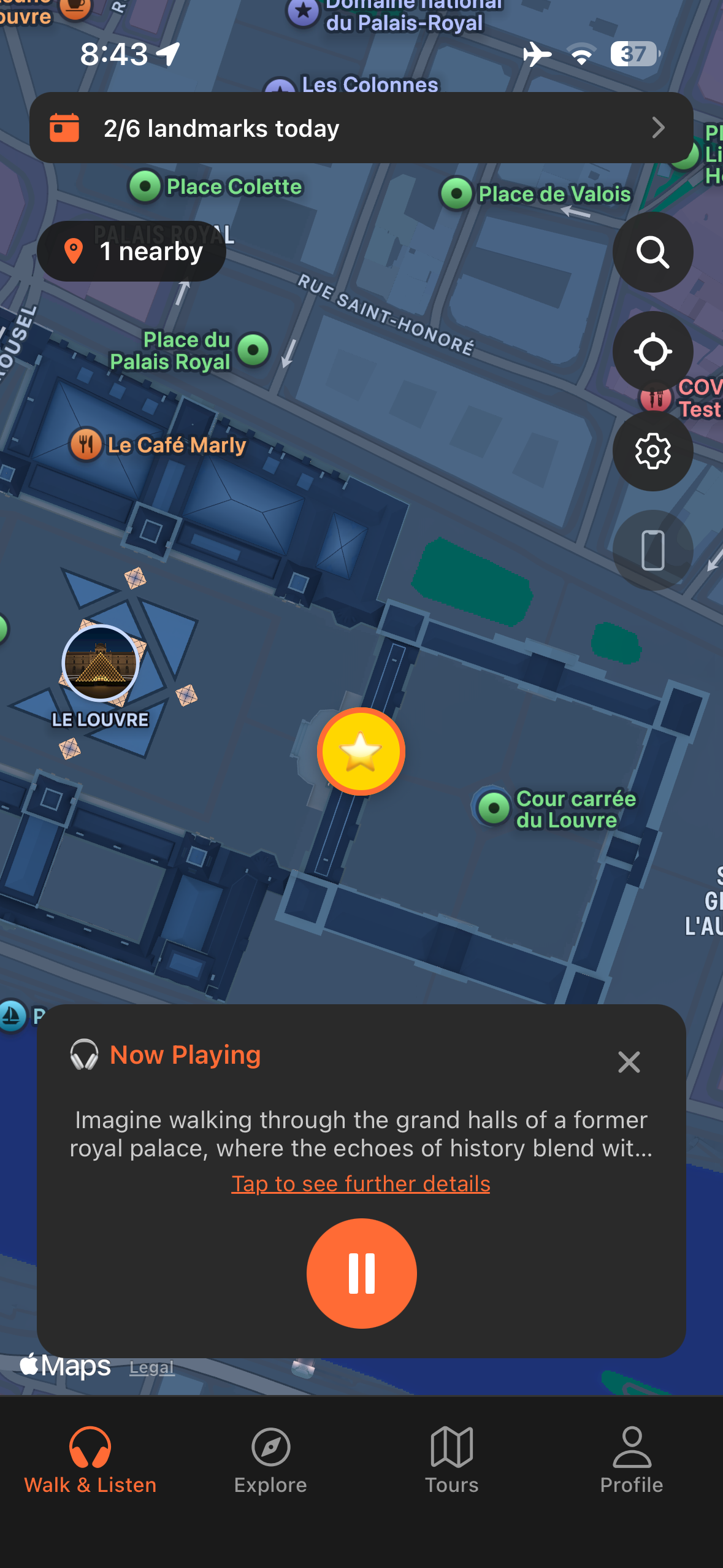
No tapping. No searching. Urban Tales detects your GPS position and plays audio automatically the moment you're close enough. Put your phone in your pocket — just walk and listen.

Urban Tales app showing GPS map near the Louvre in Paris with audio story automatically triggered

GPS triggered. Audio starts the moment you arrive at a landmark.

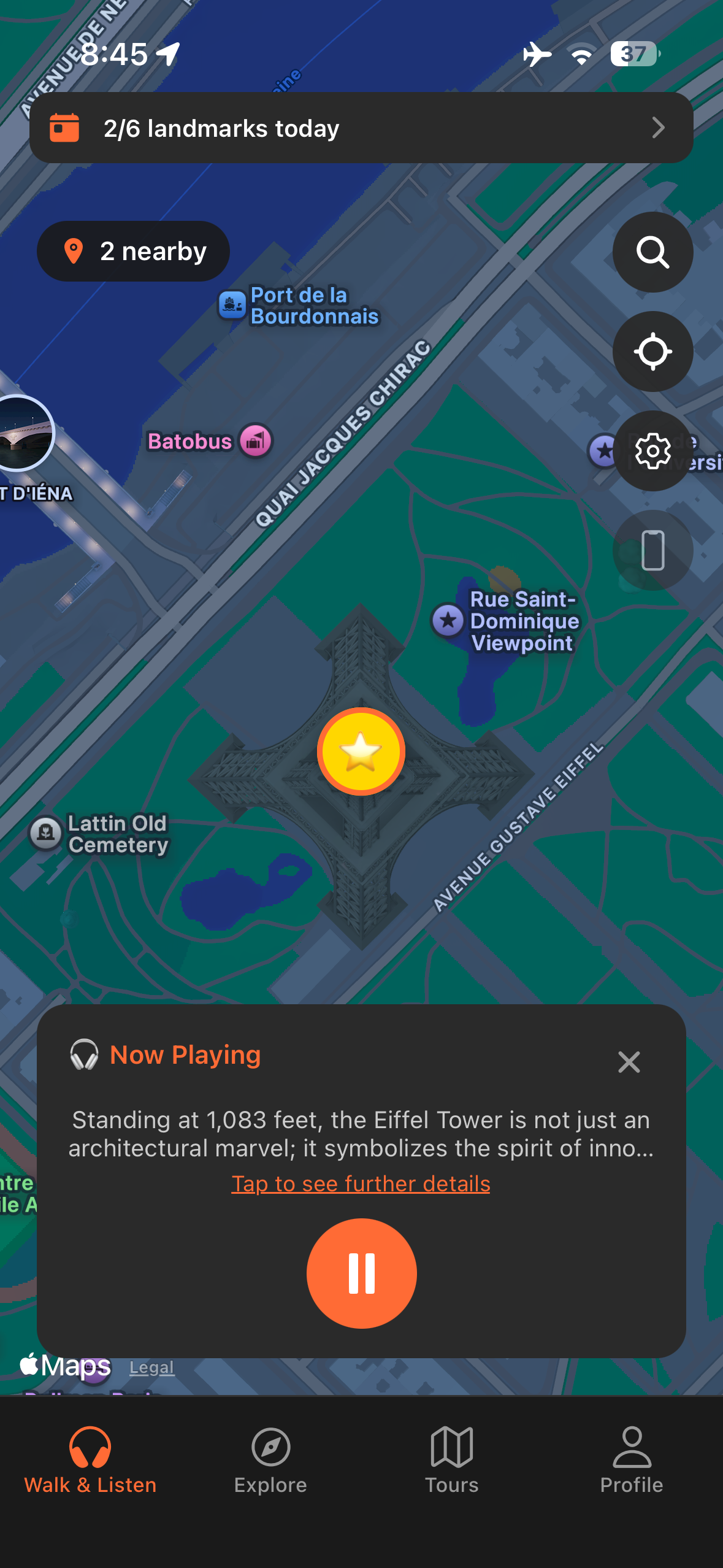
Urban Tales GPS map near the Eiffel Tower in Paris with story automatically triggered

Walk freely. Every landmark around you has a story ready.

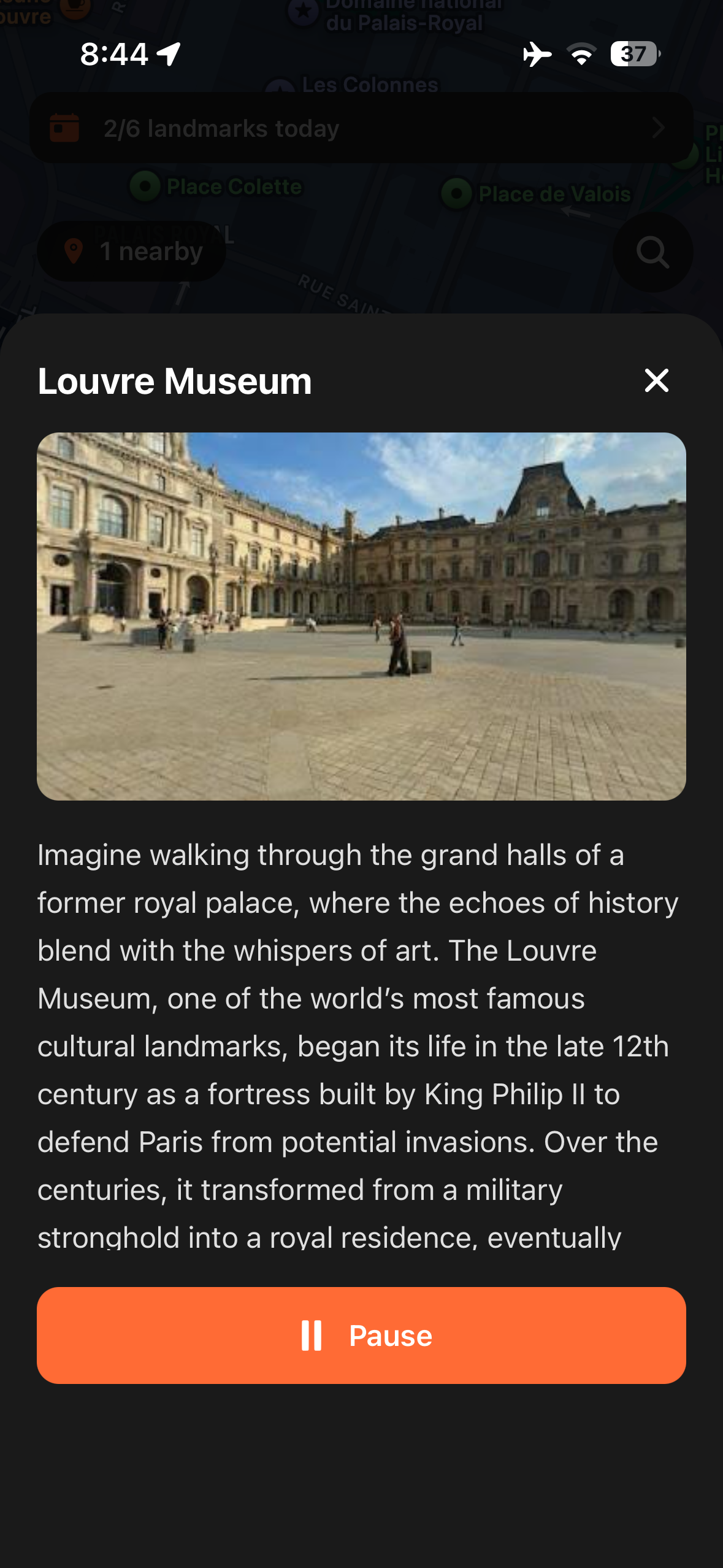
Urban Tales story panel for the Louvre Museum in Paris showing narration text and landmark photo

Rich stories. History, legends and context for every landmark.

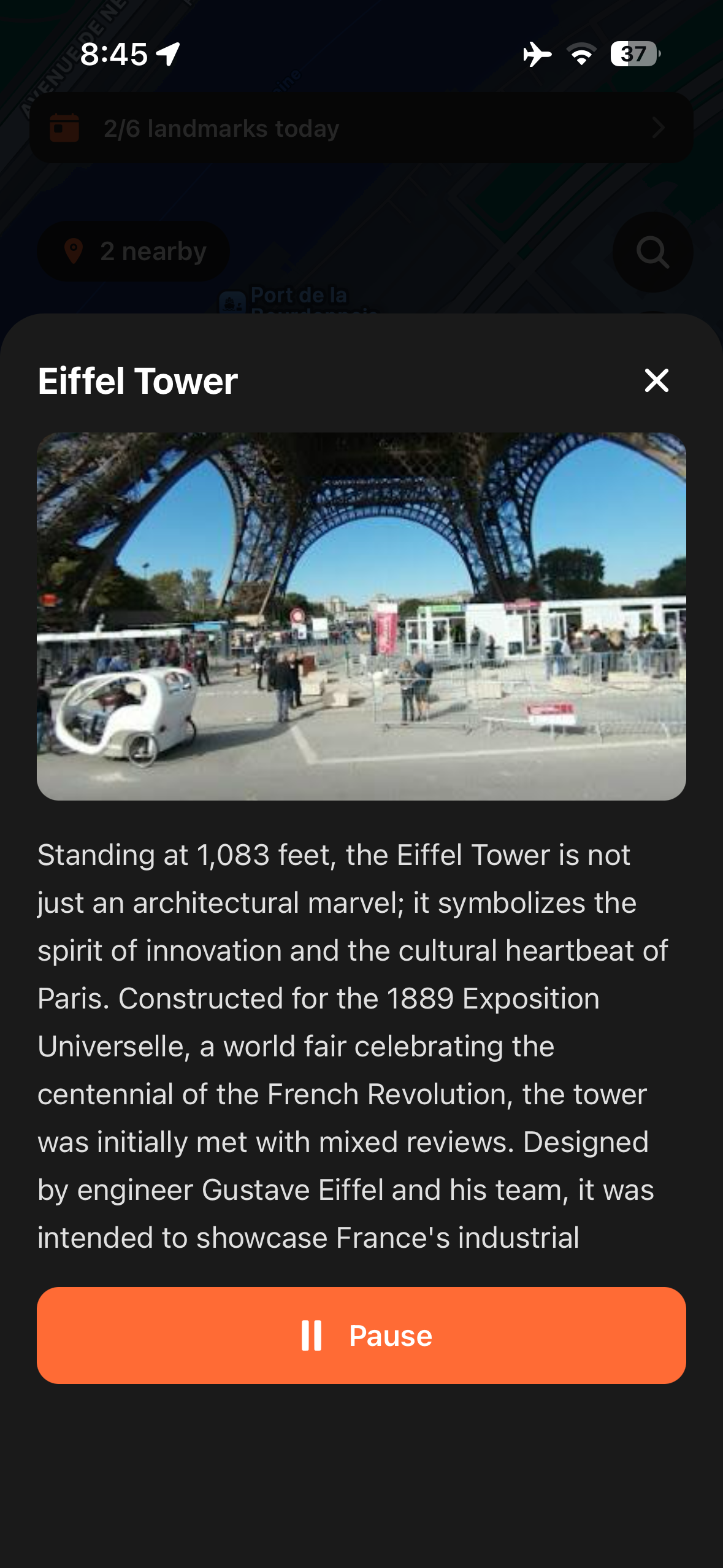
Urban Tales story panel for the Eiffel Tower in Paris with photo and narration text

4 storytelling styles. Historical, Legends, Fun Facts and Cinematic.


How it works

Open the app.
Start walking.

No preparation, no pre-booked route, no group to keep up with. Urban Tales works the moment you step outside.

01

Download and open the map

The app shows landmarks around you the moment you open it. Works anywhere in Paris — from the Eiffel Tower to a quiet street in Belleville.

02

Walk toward anything that catches your eye

As you get close to a landmark, the audio starts automatically. Put your phone in your pocket and just walk and listen.

03

Build a route or explore freely

Create a half-day route, a full-day itinerary, a 7-wonders tour or a custom path. Or ignore all of that and wander — the app keeps up.


What you'll hear

The Paris most visitors
never actually learn.

These are the kinds of stories Urban Tales narrates as you walk. Each one triggers automatically when you're standing in the right place.

Legend

Notre-Dame Cathedral · Île de la Cité

The ironwork on the doors was so perfect, the craftsman was accused of a deal with the devil

When Notre-Dame was unveiled, its iron door hinges were so intricate and flawless that medieval Parisians could not believe they were the work of a human craftsman. Rumors spread that the blacksmith Biscornet had sold his soul to complete them. The hinges could reportedly only be opened after being blessed with holy water. Modern metalworkers still cannot fully explain how the work was achieved with 12th-century tools.

History

Eiffel Tower · Champ de Mars

Paris hated it — and almost tore it down

When Gustave Eiffel's tower was completed in 1889 for the World's Fair, Parisian artists and intellectuals signed a petition calling it a blot on the city skyline. Writers, painters and architects lined up to condemn it in the press. It was only saved from demolition because it doubled as a functional radio antenna. The man who had it dismantled before its scheduled destruction? A military commander who used it to intercept enemy signals in World War I.

Legend

Maison de Nicolas Flamel · 51 Rue de Montmorency

Paris's oldest house belonged to an alleged alchemist who may never have died

Built in 1407, the oldest surviving house in Paris was home to Nicolas Flamel — a bookseller and scribe rumored to have discovered the Philosopher's Stone. According to legend, Flamel cracked a mysterious manuscript, decoded the secret of transmuting metals into gold, and achieved immortality. His tomb was reportedly found empty. The building is now a restaurant. Harry Potter fans will recognise his name immediately.

History

The Louvre · 1st Arrondissement

The world's greatest museum started as a fortress — and hid its art underground during wartime

The Louvre began in the late 12th century as a military fortress built to defend Paris from English raids. It became a royal palace, then a revolutionary public museum in 1793. When World War II broke out, museum staff secretly transported thousands of masterpieces — including the Mona Lisa — to châteaux across rural France to protect them from Nazi seizure. The empty frames were left hanging on the walls.

Fun fact

The Catacombs · 14th Arrondissement

Six million people are buried beneath the city's streets — and you can walk among them

In the late 18th century, Paris's overflowing cemeteries were creating a public health crisis. The solution: move the bones underground into the abandoned limestone quarries that had been carved out to build the city above. Today, about 300 kilometres of tunnels run beneath Paris. The official ossuary holds the remains of roughly six million people, arranged in decorative patterns by workers who considered it a form of art.

Cinematic

Montmartre · 18th Arrondissement

Picasso, Van Gogh and Renoir all lived here — when it was still a village outside Paris

Montmartre wasn't absorbed into Paris until 1860. Before that it was a rural hilltop village with windmills, vineyards and cheap rents that attracted struggling artists. Van Gogh lived with his brother Theo on Rue Lepic. Picasso painted Les Demoiselles d'Avignon in the cramped studios of the Bateau-Lavoir. A working vineyard — Clos Montmartre — still exists on the hillside and produces wine sold at auction every October.


Where to walk

Paris's neighborhoods,
explained through stories.

Urban Tales covers the full city. Here are the areas where the stories are thickest.

Île de la Cité

The original Paris. Notre-Dame, the Conciergerie where Marie Antoinette awaited execution, and the Sainte-Chapelle with its 15 Gothic stained-glass windows. The oldest stories in the city are here.

Le Marais

Medieval streets, Renaissance mansions and Paris's historic Jewish quarter. The Marais escaped Haussmann's 19th-century demolitions, so it's one of the few areas where old Paris still looks old.

Montmartre

A hilltop village absorbed into Paris only in 1860. Windmills, a working vineyard, artists' studios and the Sacré-Cœur. The neighborhood where the bohemian myth of Paris was actually born.

Saint-Germain & Latin Quarter

The intellectual heart of Paris for centuries. Hemingway, Sartre, Simone de Beauvoir and James Joyce all worked in its cafés. The Sorbonne has stood here since the 13th century.

Champs-Élysées & Trocadéro

The Eiffel Tower, the Arc de Triomphe and a perfectly aligned axis that Napoleon engineered to project imperial power across the entire city. Monumental Paris at its most deliberate.

Père Lachaise & Belleville

The world's most visited cemetery, where Oscar Wilde, Chopin, Édith Piaf and Jim Morrison are buried. Belleville next door is the authentic, multi-cultural Paris that tourists rarely find.


Storytelling styles

Choose how Paris
speaks to you.

The same landmark sounds completely different in each mode. Switch styles anytime during your walk.

Historical

Context, dates, politics, empires. What actually happened here and why it mattered. For travelers who want to leave Paris genuinely knowing things.

Legends

Myths, curses, ghosts and ancient superstitions. The stories Parisians told each other before the history books were written.

Fun Facts

The absurd, the surprising and the genuinely weird. Perfect for keeping energy up on a long walk or exploring with kids.

Cinematic

Films shot here, scenes set here, directors who fell in love with these streets. Paris through the lens of cinema.


FAQ

Common questions about
Urban Tales in Paris.

Does Urban Tales work near the Eiffel Tower and the Louvre?

Yes. Urban Tales covers both iconic landmarks with full stories, as well as the surrounding areas — the Champ de Mars, Trocadéro, Tuileries Garden, and the Louvre's outdoor courtyards where two millennia of French history converge.

Is Urban Tales worth it if I've already been to Paris before?

Especially then. Return visitors consistently say the app revealed a Paris they didn't know existed — the legends of Notre-Dame, the alchemist's house in the Marais, the wartime secrets hidden beneath the city. The Legends mode is particularly transformative for places you thought you already understood.

How does the pricing work for Paris?

You can start exploring for free. A day pass unlocks the full Paris experience for a single day, or you can unlock the city permanently. No subscriptions required.

What languages is the Paris audio guide available in?

Urban Tales supports English, Spanish (LATAM), Brazilian Portuguese, French and German. Select your language when you first open the app — and yes, the French narration for Paris is something special.

Can I use Urban Tales for a half-day or full-day visit to Paris?

Yes. The app supports quick stops, half-day explorations, full-day routes and custom tours. Use the route generator to plan an itinerary around your available time — Paris rewards both the rushed visitor and the one with nowhere to be.

Paris is waiting.
The stories start the moment you land.

Free to download. No tour group. No fixed schedule.

Download on theApp Store
Get it onGoogle Play

Explore more

Urban Tales works
everywhere you travel.

Rome, Paris, Mexico City and more cities being added regularly. See the full list and find your next destination.

View all cities →