Prague, Czech Republic

Medieval towers.
Baroque churches.
Kafka lived here.

Urban Tales is a GPS audio guide app that narrates Prague's hidden history, legends and secrets automatically as you walk — at your own pace, with no tour group to follow.


Walk up to a landmark.
The story starts.

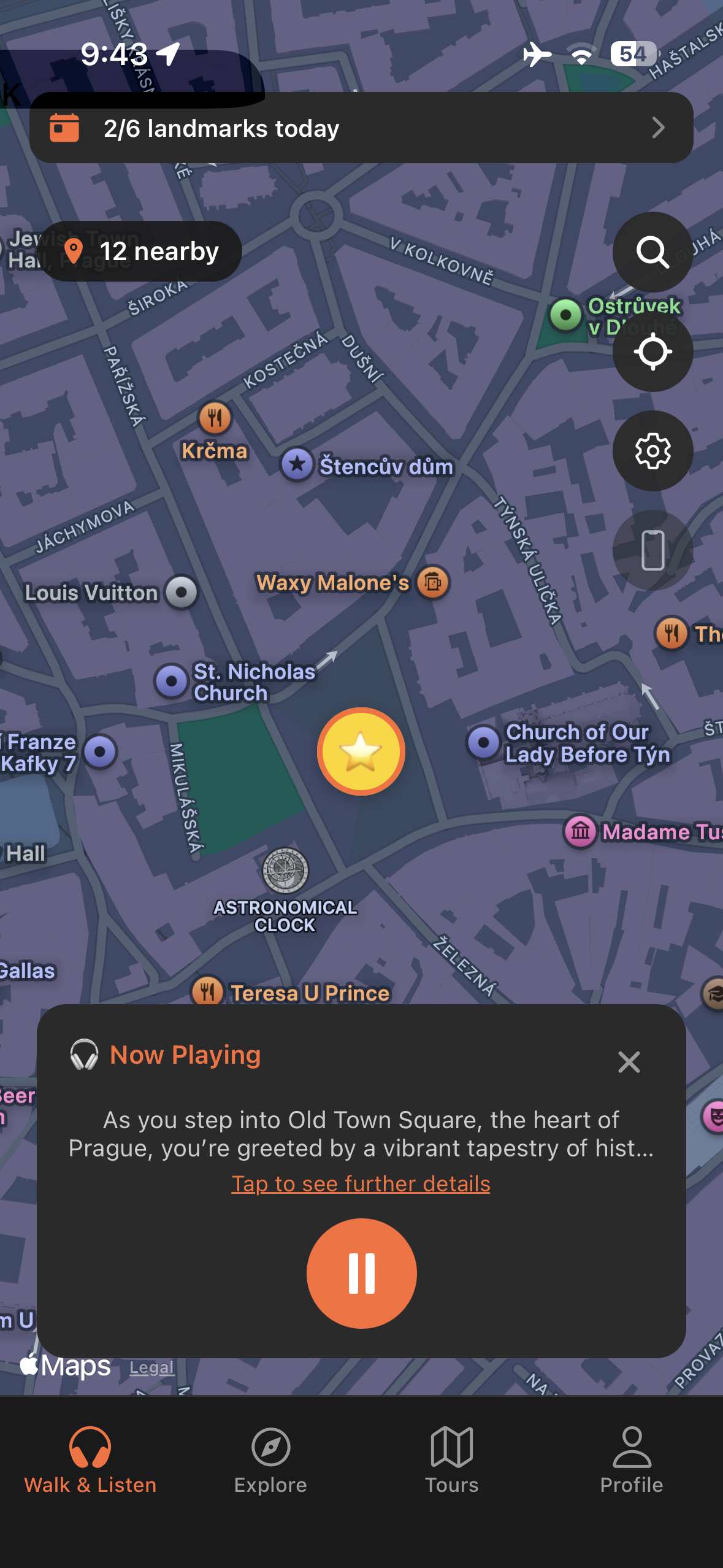
No tapping. No searching. Urban Tales detects your GPS position and plays audio automatically the moment you're close enough. Put your phone in your pocket — just walk and listen.

Urban Tales GPS map in Prague with audio story automatically triggered

GPS triggered. Audio starts the moment you arrive at a landmark.

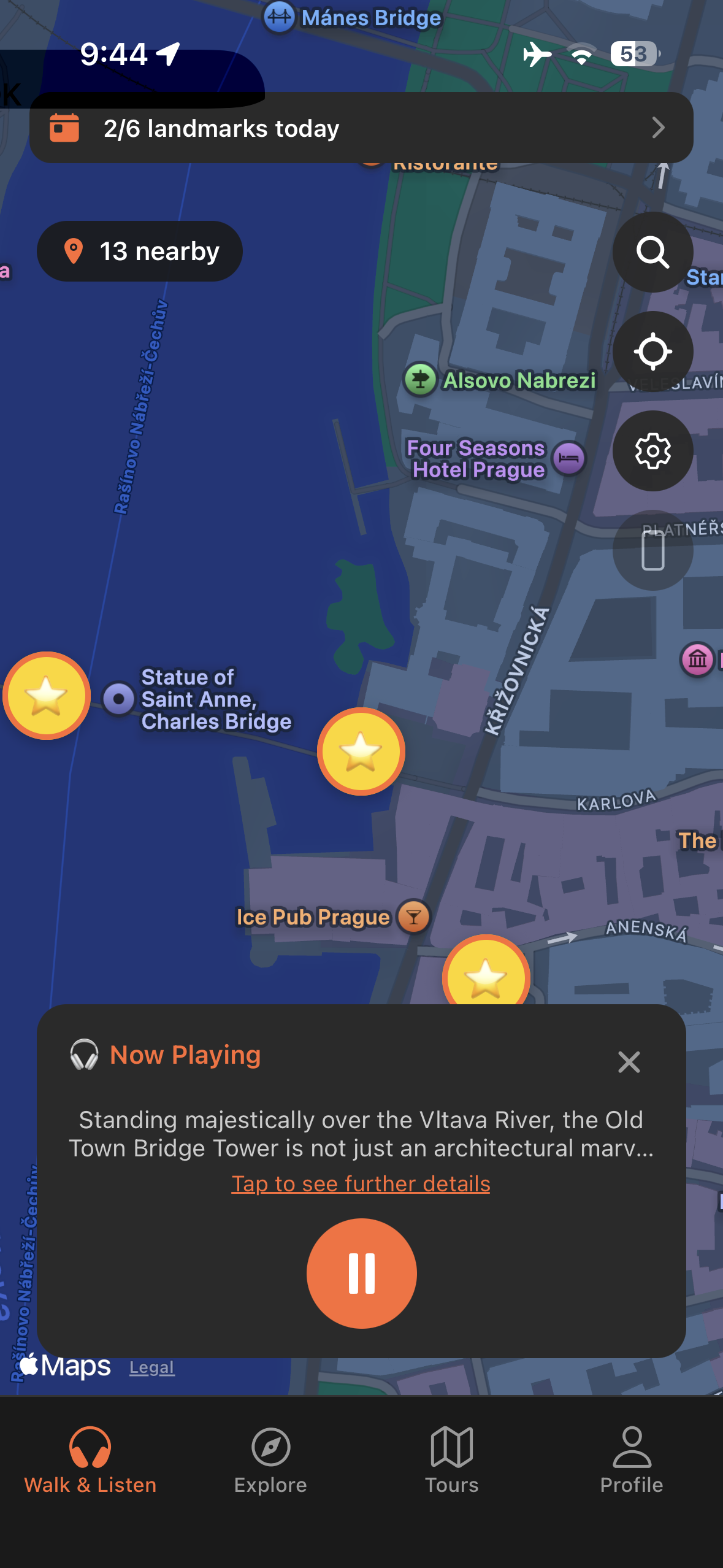
Urban Tales GPS map in Prague with story automatically triggered

Walk freely. Every landmark around you has a story ready.

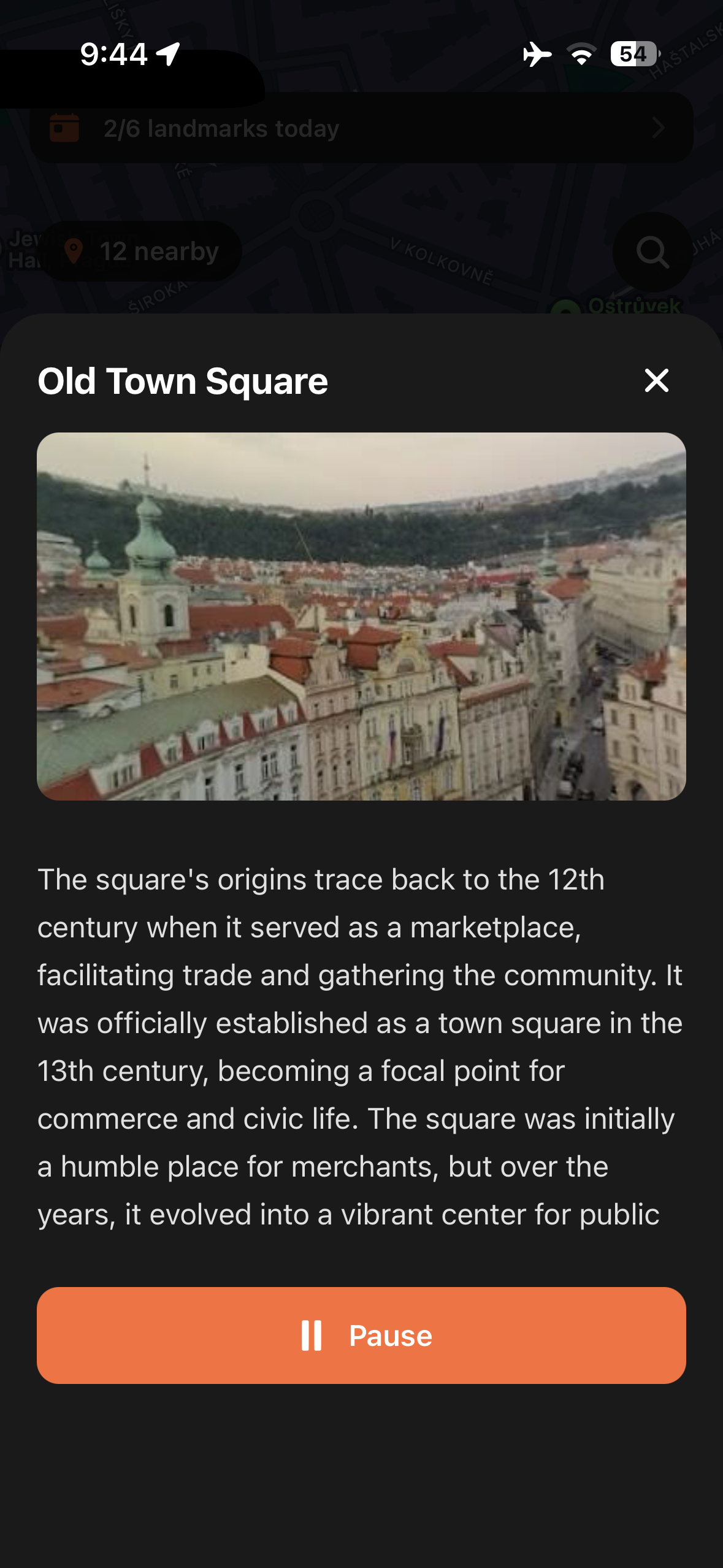
Urban Tales story panel in Prague with photo and narration

Rich stories. History, legends and context for every landmark.

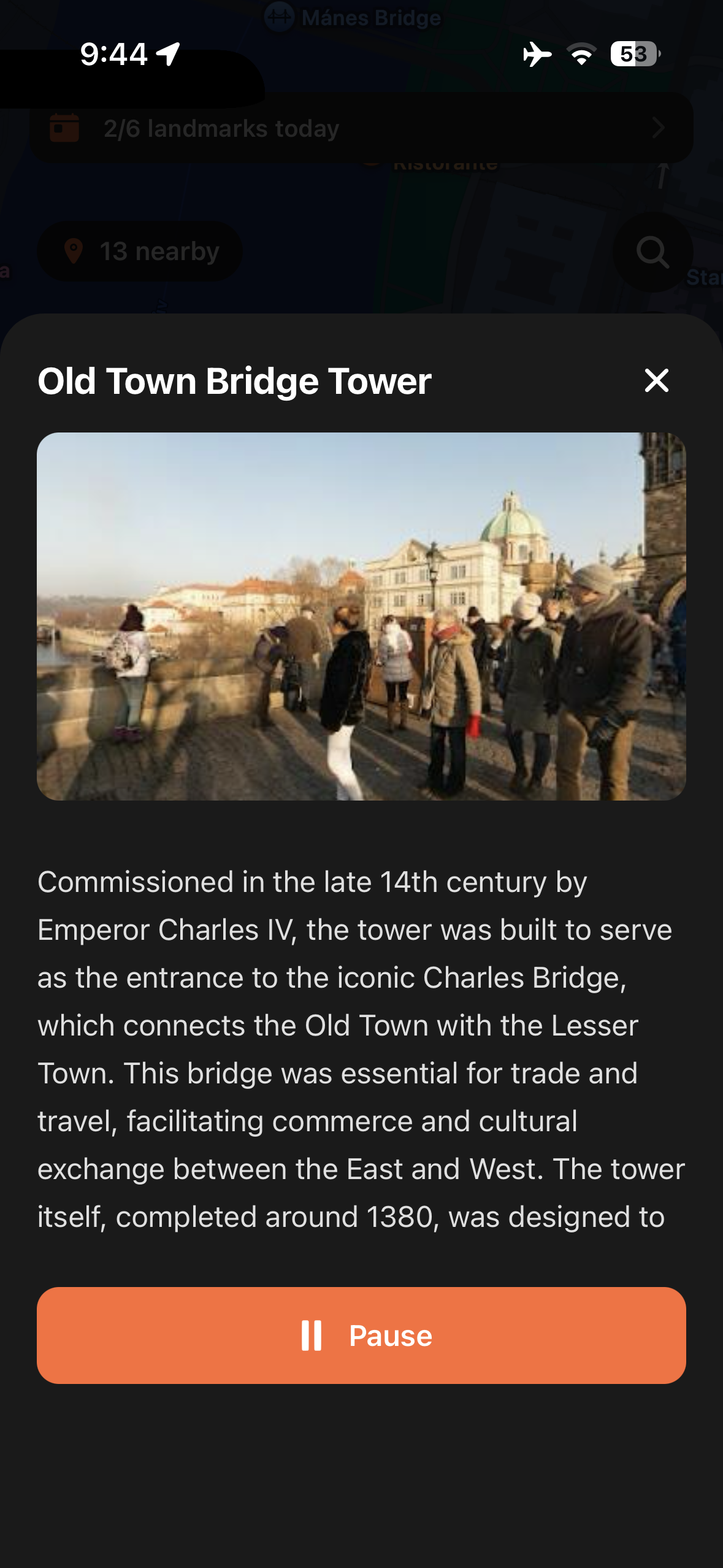
Urban Tales story panel in Prague with photo and narration

4 storytelling styles. Historical, Legends, Fun Facts and Cinematic.


How it works

Open the app.
Start walking.

No preparation, no pre-booked route, no group to keep up with. Urban Tales works the moment you step outside.

01

Download and open the map

The app shows landmarks around you the moment you open it. Works anywhere in Prague — the app covers the full city.

02

Walk toward anything that catches your eye

As you get close to a landmark, the audio starts automatically. Put your phone in your pocket and just walk and listen.

03

Build a route or explore freely

Create a half-day route, a full-day itinerary, a 7-wonders tour or a custom path. Or ignore all of that and wander — the app keeps up.


What you'll hear

The Prague most visitors
never actually learn.

These are the kinds of stories Urban Tales narrates as you walk. Each one triggers automatically when you're standing in the right place.

History

Old Town Square · Staré Město

The Astronomical Clock still works after 600 years — and the man who built it was supposedly blinded to prevent him building another

The Prague Orloj, installed in 1410, is the oldest functioning astronomical clock in the world. Every hour, the Twelve Apostles parade past its windows. A legend holds that the clockmaker Master Hanuš was blinded by the city council after its completion, to prevent him creating a rival clock elsewhere. His revenge, the legend says, was to reach into the mechanism and stop it — and for over a century it could not be repaired. The story is almost certainly invented, but Prague has never stopped telling it.

Legend

Charles Bridge · Vltava River

The bridge was built using egg yolks mixed into the mortar — and villages from across Bohemia sent cartloads to help

Charles Bridge, commissioned by Emperor Charles IV in 1357, was constructed using a mortar recipe that supposedly included egg yolks to strengthen it. According to legend, towns across Bohemia were ordered to send eggs for the construction. One village, confused by the order, sent hard-boiled eggs. The bridge has stood for over 650 years. Whether the eggs helped is debated by engineers, but the story is told as fact in Prague. The bridge's foundation stone was laid at exactly 5:31 AM on July 9, 1357 — a numerologically significant sequence: 1-3-5-7-9-7-5-3-1.

History

Prague Castle · Hradčany

The largest castle complex in the world has a window famous for throwing people out of it

Prague Castle covers over 70,000 square metres — the largest ancient castle complex in the world. But its most famous feature is a particular window. In 1618, Protestant nobles threw three Catholic officials out of the castle window in what became known as the Defenestration of Prague — triggering the Thirty Years War. This was actually the second defenestration: the first occurred in 1419, during the Hussite Wars. Prague is the only city in the world where "defenestration" is a recurring historical event with a number attached to each occurrence.

Fun fact

Josefov · Jewish Quarter

Prague's Jewish Quarter contains the world's oldest Jewish cemetery — with graves stacked up to 12 layers deep

The Old Jewish Cemetery in Josefov was in use from the 15th century until 1787. Because the Jewish community was forbidden from burying their dead outside its walls, and the cemetery could not expand, bodies were buried in layers — up to 12 deep in some areas. Over 100,000 people are estimated to be buried there. Around 12,000 tombstones are visible above ground, many tilted at odd angles from centuries of pressure beneath. It is one of the most significant Jewish heritage sites in the world.

Cinematic

Nové Město · New Town

Kafka was born here, hated the city, never left, and turned its bureaucratic nightmare into literature

Franz Kafka was born in Prague in 1883 and spent almost his entire life in the city, despite writing in his diaries that he wanted to escape it. He worked as an insurance clerk and wrote at night. He found Prague's labyrinthine bureaucracy, its multiple languages and its suffocating social hierarchies so oppressive that they became the central metaphor of everything he wrote. He asked his friend Max Brod to burn all his manuscripts after his death. Brod did not. The Trial, The Castle and The Metamorphosis would not exist if he had listened.

Legend

Old Jewish Quarter · Josefov

The Golem of Prague was a clay man brought to life to protect the Jewish community — and may still be hidden in the attic of the Old-New Synagogue

Rabbi Judah Loew ben Bezalel, the Maharal of Prague, is said to have created a Golem — a figure made of clay from the banks of the Vltava, animated by inscribing the Hebrew word "emet" (truth) on its forehead. The Golem protected Prague's Jewish Quarter from antisemitic attacks. When the Rabbi erased the first letter, the word became "met" (death) and the Golem was deactivated. Its remains, the legend says, were hidden in the attic of the Old-New Synagogue, where they still rest. The attic has never been opened to the public.


Where to walk

Prague's neighborhoods,
explained through stories.

Urban Tales covers the full city. Here are the areas where the stories are thickest.

Staré Město (Old Town)

The medieval core of Prague — the Astronomical Clock, the Old Town Square, the university founded in 1348 and the streets that have barely changed since the 14th century.

Josefov (Jewish Quarter)

One of the most significant Jewish heritage sites in Europe. The Old Jewish Cemetery, the Old-New Synagogue and the legend of the Golem — all within a few minutes' walk of each other.

Hradčany & Prague Castle

The castle district that dominates Prague from the hillside above the river. The largest castle complex in the world, with St. Vitus Cathedral, the Golden Lane and two famous defenestrations.

Malá Strana (Lesser Town)

The Baroque neighbourhood beneath the castle, where embassies now occupy the palaces of 17th-century nobles. The foot of Charles Bridge, the Kafka Museum and some of Prague's quietest streets.

Nové Město (New Town)

Wenceslas Square — the site of the 1968 Soviet invasion protests and the 1989 Velvet Revolution. "New" means founded in 1348 by Emperor Charles IV. Prague's concept of time is elastic.

Vinohrady & Žižkov

The neighborhoods where Prague actually lives. Art Nouveau apartment buildings, the third-tallest television tower in Europe (with crawling babies on it), and local bars that tourists rarely find.


Storytelling styles

Choose how Prague
speaks to you.

The same landmark sounds completely different in each mode. Switch styles anytime during your walk.

Historical

Context, dates, politics, empires. What actually happened here and why it mattered. For travelers who want to leave Prague genuinely knowing things.

Legends

Myths, curses, ghosts and ancient superstitions. The stories locals told each other before the history books were written.

Fun Facts

The absurd, the surprising and the genuinely weird. Perfect for keeping energy up on a long walk or exploring with kids.

Cinematic

Kafka wrote here, Kundera described it, Amadeus was filmed here. Prague through the lens of literature and cinema.


FAQ

Common questions about
Urban Tales in Prague.

Does Urban Tales cover Prague Castle and Charles Bridge?

Yes. Urban Tales covers both Prague Castle and Charles Bridge, with stories triggered as you walk across the bridge and through the castle district. Entry to certain areas within Prague Castle requires a separate ticket.

Is Urban Tales worth it if I have already been to Prague?

Especially then. Prague rewards deeper exploration more than almost any European city. The Legends mode — the clockmaker's blinding, the Golem in the synagogue attic, the egg yolk mortar of Charles Bridge — transforms a city that most visitors only scratch the surface of.

How does the pricing work for Prague?

You can start exploring for free. A day pass unlocks the full Prague experience for a single day, or you can unlock the city permanently. No subscriptions required.

What languages is the Prague audio guide available in?

Urban Tales supports English, Spanish (LATAM), Brazilian Portuguese, French and German. Select your language when you first open the app.

Can I use Urban Tales for a half-day or full-day visit to Prague?

Yes. Prague's historic centre is extremely walkable and compact. A half-day covers the main route from Old Town Square across Charles Bridge to the castle; a full day lets you explore the Jewish Quarter, Malá Strana and the neighborhoods beyond the tourist trail.

Prague is waiting.
The stories start the moment you land.

Free to download. No tour group. No fixed schedule.

Download on theApp Store
Get it onGoogle Play

Explore more

Urban Tales works
everywhere you travel.

Explore our full collection of cities at urbantales.net/cities.html See the full list and find your next destination.

View all cities →