Tokyo, Japan

Ancient temples.
Neon streets.
One city, every era.

Urban Tales is a GPS audio guide app that narrates Tokyo's hidden history, legends and secrets automatically as you walk — at your own pace, with no tour group to follow.


Walk up to a landmark.
The story starts.

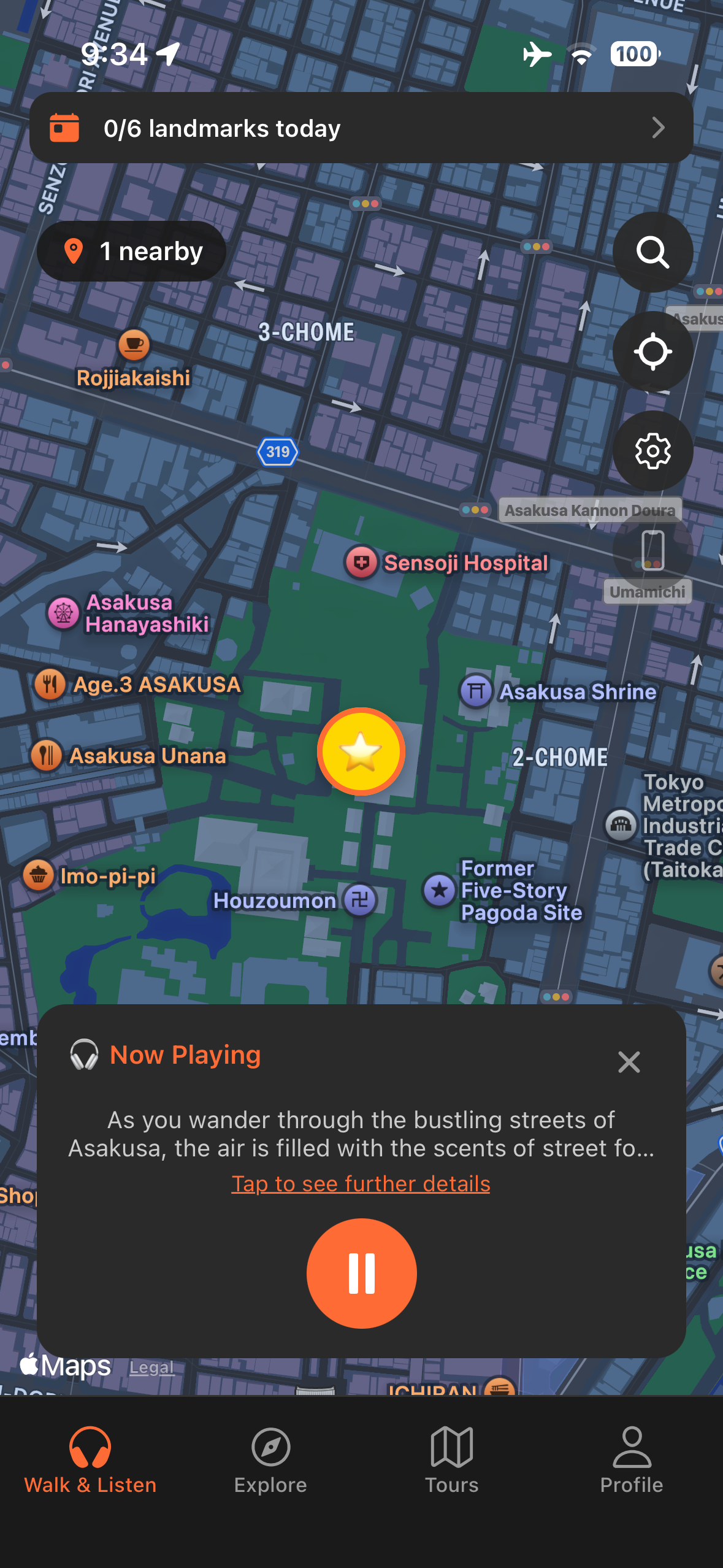
No tapping. No searching. Urban Tales detects your GPS position and plays audio automatically the moment you're close enough. Put your phone in your pocket — just walk and listen.

Urban Tales GPS map at Senso-ji temple in Tokyo's Asakusa with audio story automatically triggered

GPS triggered. Audio starts the moment you arrive at a landmark.

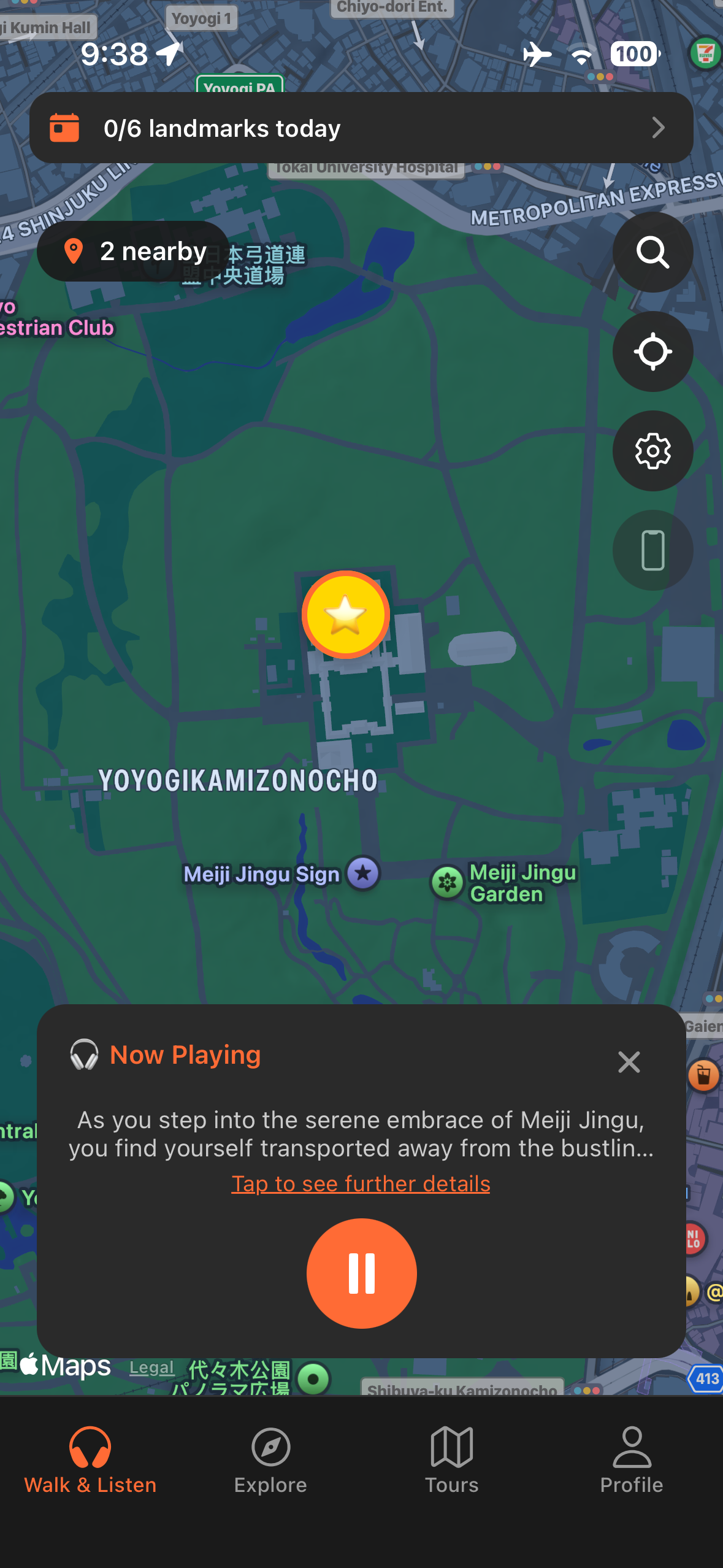
Urban Tales GPS map at Meiji Jingu shrine in Tokyo with story automatically triggered

Walk freely. Every landmark around you has a story ready.

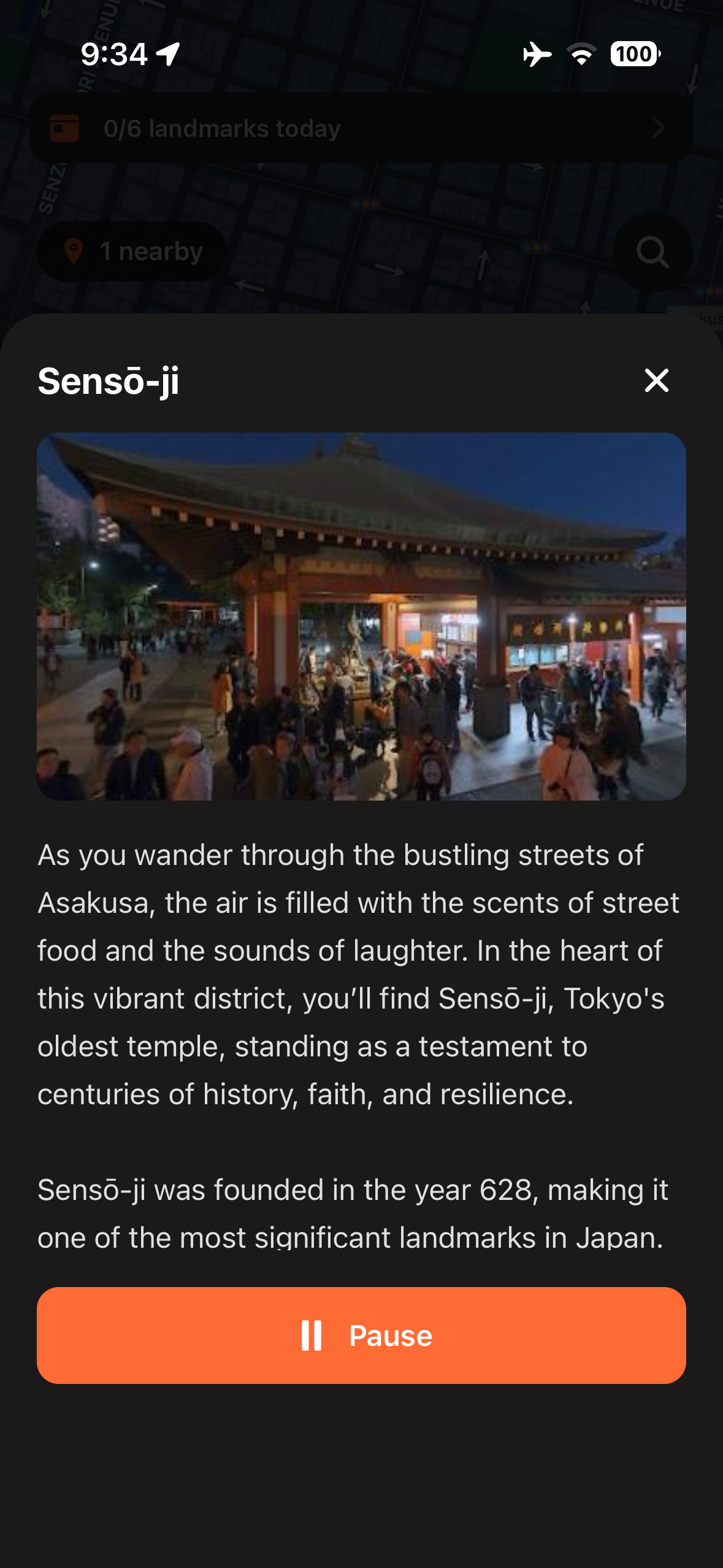
Urban Tales story panel for Senso-ji temple in Tokyo with narration text and photo at night

Rich stories. History, legends and context for every landmark.

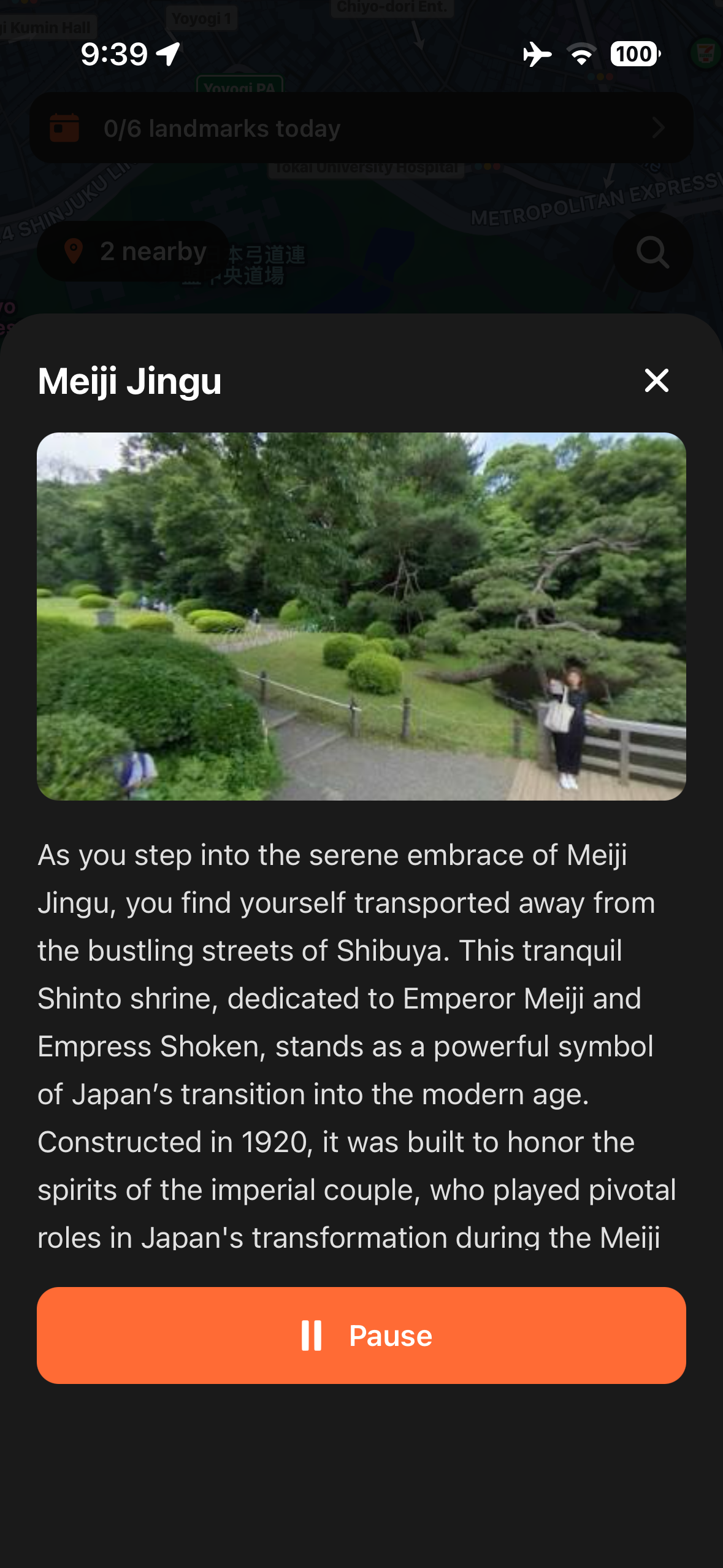
Urban Tales story panel for Meiji Jingu shrine in Tokyo with garden photo and narration

4 storytelling styles. Historical, Legends, Fun Facts and Cinematic.


How it works

Open the app.
Start walking.

No preparation, no pre-booked route, no group to keep up with. Urban Tales works the moment you step outside.

01

Download and open the map

The app shows landmarks around you the moment you open it. Works anywhere in Tokyo — from Senso-ji temple to a quiet street in Yanaka.

02

Walk toward anything that catches your eye

As you get close to a landmark, the audio starts automatically. Put your phone in your pocket and just walk and listen.

03

Build a route or explore freely

Create a half-day route, a full-day itinerary, a 7-wonders tour or a custom path. Or ignore all of that and wander — the app keeps up.


What you'll hear

The Tokyo most visitors
never actually learn.

These are the kinds of stories Urban Tales narrates as you walk. Each one triggers automatically when you're standing in the right place.

History

Senso-ji Temple · Asakusa

Tokyo's oldest temple was founded by two fishermen who pulled a goddess from the river

In 628 AD, two brothers fishing in the Sumida River pulled up a small golden statue in their net. They threw it back, but it kept returning. A local elder recognised it as Kannon, the Buddhist goddess of mercy, and a temple was built to enshrine her. The statue has never been displayed publicly since — it remains hidden behind closed doors in the inner sanctuary. Senso-ji was destroyed by American bombing in 1945 and rebuilt by the people of Tokyo as an act of collective healing.

History

Meiji Jingu · Shibuya

The entire forest surrounding the shrine was planted by hand — 100,000 volunteers in one day

Meiji Jingu was built in 1920 to honour Emperor Meiji and Empress Shoken, who oversaw Japan's transformation from feudal isolation to modern nation. The 700 acres of forested grounds did not exist naturally — they were created by 100,000 volunteers who planted 120,000 trees donated from across Japan in a single day. The forest was designed to be self-sustaining, requiring no human maintenance. A century later it functions exactly as planned, a dense woodland in the heart of Tokyo.

Legend

Gotokuji Temple · Setagaya

The maneki-neko lucky cat was born here — and the temple is filled with thousands of them

The beckoning cat figurine seen in shops and restaurants across the world reportedly originated at this small temple in western Tokyo. Legend holds that a feudal lord was sheltering under a tree during a storm when a cat from the temple beckoned him inside. Moments later, lightning struck the tree. The grateful lord became the temple's patron. Visitors still leave small cat figurines as offerings — thousands of them line the shelves, all with one paw raised.

Fun fact

Shibuya Crossing · Shibuya

Up to 3,000 people cross simultaneously — and it was designed to be deliberately chaotic

Shibuya Crossing is the busiest pedestrian intersection in the world. When the lights change, traffic stops in every direction and pedestrians cross from all angles at once — diagonally included. The scramble crossing was introduced deliberately to handle volume, not despite the chaos but because of it. Around 2–3 million people pass through Shibuya station every day. The crossing has appeared in more films, music videos and advertisements than almost any other urban space on Earth.

Cinematic

Golden Gai · Shinjuku

200 tiny bars in a warren of alleys that survived demolition, the yakuza and urban redevelopment

Golden Gai is a cluster of six narrow alleyways containing around 200 bars, most seating fewer than eight people. It was built after World War II as an illegal black market district. By the 1980s, developers tried to demolish it — bar owners physically barricaded the streets. The yakuza reportedly owned several bars as fronts. Today it's one of Tokyo's most atmospheric neighborhoods: writers, filmmakers, sumo wrestlers and tourists drinking side by side in rooms the size of a wardrobe.

History

Yanaka · Taito

The one neighborhood that survived the earthquake, the firebombing and urban redevelopment

The 1923 Great Kanto Earthquake destroyed much of Tokyo. The 1945 firebombing destroyed most of what remained. Then postwar development erased much of the rest. Yanaka survived all three. Its wooden temples, narrow lanes and traditional shophouses remain almost unchanged from the Meiji era. The neighborhood cemetery contains the grave of the last Tokugawa shogun. Walking through Yanaka feels like stepping into a Tokyo that the rest of the city has forgotten existed.


Where to walk

Tokyo's neighborhoods,
explained through stories.

Urban Tales covers the full city. Here are the areas where the stories are thickest.

Asakusa

Tokyo's most traditional neighborhood. Senso-ji temple, rickshaws, craft shops and the last area of the city that looks like the Edo-period capital it once was. The oldest Tokyo in the city.

Shibuya & Harajuku

The crossing, the fashion streets, Meiji Jingu hidden behind a torii gate. The contrast between the world's busiest intersection and a 700-acre sacred forest ten minutes' walk away is one of Tokyo's defining experiences.

Shinjuku

Tokyo's most contradictory neighborhood. The city's biggest red-light district sits beside its most serene garden. Golden Gai's 200 tiny bars are three minutes from a glass skyscraper containing the Metropolitan Government Building.

Yanaka & Ueno

The Tokyo that survived. Yanaka's wooden lanes and traditional shophouses sit beside Ueno Park, the site of the last battle of the Boshin War in 1868 and now home to a cluster of world-class museums.

Akihabara

Electric Town — the global capital of anime, manga and electronics culture. What's less known is that it was originally Tokyo's postwar black market for American military surplus, which is how it became an electronics district.

Shimokitazawa

The neighborhood that resisted a highway for 50 years. Artists, musicians and students kept developers at bay for decades — today it's Tokyo's most beloved indie neighborhood, built around secondhand clothing, live music and coffee.


Storytelling styles

Choose how Tokyo
speaks to you.

The same landmark sounds completely different in each mode. Switch styles anytime during your walk.

Historical

Context, dates, politics, empires. What actually happened here and why it mattered. For travelers who want to leave Tokyo genuinely knowing things.

Legends

Myths, curses, ghosts and ancient superstitions. The stories Tokyoites told each other before the history books were written.

Fun Facts

The absurd, the surprising and the genuinely weird. Perfect for keeping energy up on a long walk or exploring with kids.

Cinematic

Films shot here, anime set here, directors who fell in love with Tokyo's strange beauty. The city through the lens of cinema.


FAQ

Common questions about
Urban Tales in Tokyo.

Does Urban Tales work at temples and shrines in Tokyo?

Yes. Urban Tales covers Tokyo's major temples and shrines including Senso-ji, Meiji Jingu and Yasukuni, with stories triggered as you approach each site. The app covers the grounds and surrounding areas — entry to inner sanctuaries follows each site's own rules.

Is Urban Tales worth it if I've already been to Tokyo before?

Especially then. Tokyo's surface is extraordinary — but the layers beneath it are what make the city endlessly fascinating. The Legends mode covers stories most visitors never hear: the hidden statue at Senso-ji, the origin of the lucky cat, the neighborhood that survived everything.

How does the pricing work for Tokyo?

You can start exploring for free. A day pass unlocks the full Tokyo experience for a single day, or you can unlock the city permanently. No subscriptions required.

What languages is the Tokyo audio guide available in?

Urban Tales supports English, Spanish (LATAM), Brazilian Portuguese, French and German. Select your language when you first open the app.

Can I use Urban Tales for a half-day or full-day visit to Tokyo?

Yes. Tokyo is vast but its best neighborhoods are walkable once you're in them. The tour generator can build a route for your available time — or explore freely and let the app surface stories as you discover landmarks on your own.

Tokyo is waiting.
The stories start the moment you land.

Free to download. No tour group. No fixed schedule.

Download on theApp Store
Get it onGoogle Play

Explore more

Urban Tales works
everywhere you travel.

Tokyo, Florence, Barcelona, London, New York and many more cities available. See the full list and find your next destination.

View all cities →