Why it's so lopsided
The temple stands on sloping ground and had to fit around older sacred spots, so it has different floor levels and porches of different sizes. It's the least symmetrical major temple of classical Greece.
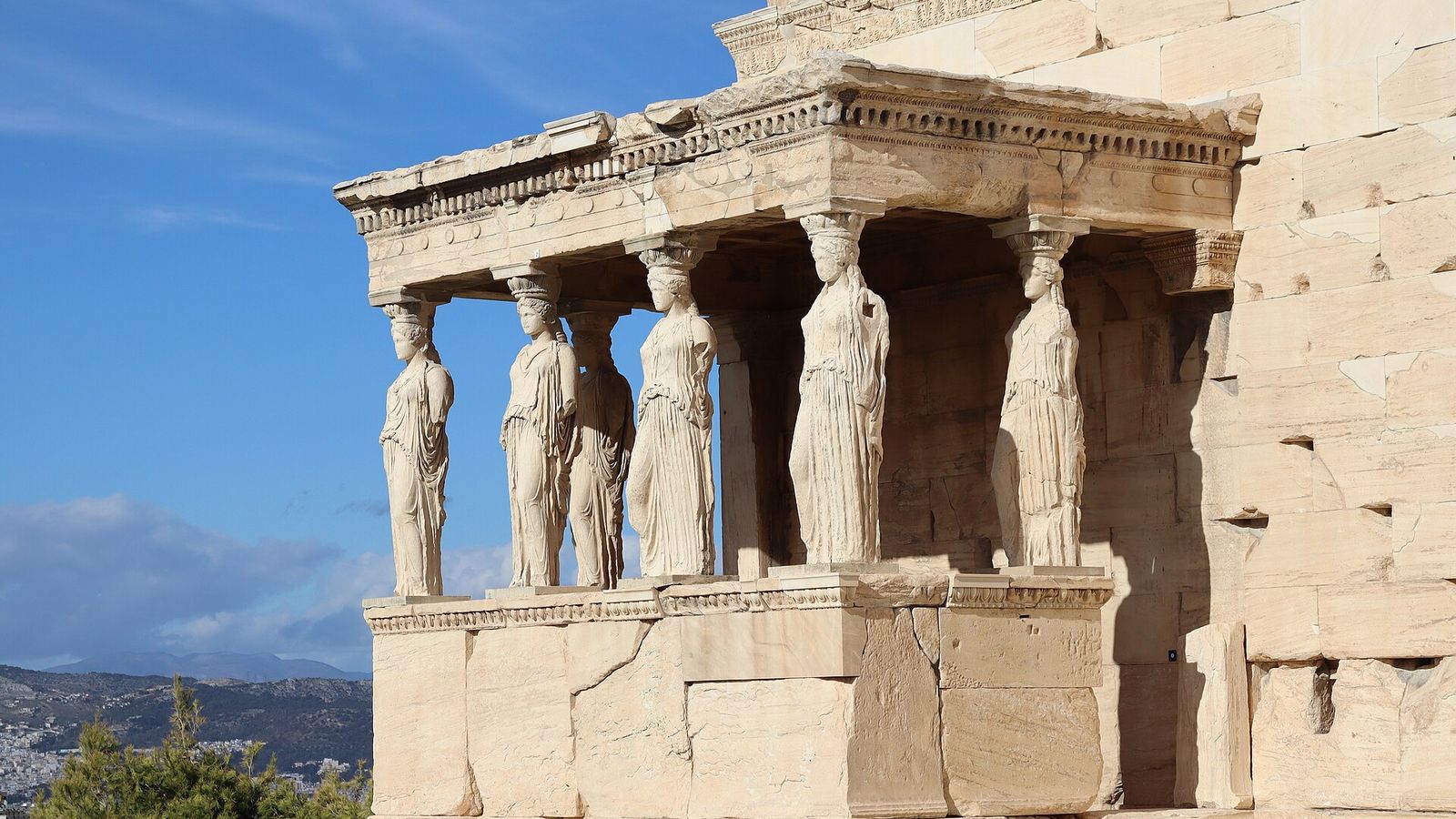
Built around 421–406 BC, the Erechtheion is the Acropolis temple that breaks the rules: several floor levels, porches of different sizes and six stone women instead of columns. Here's what you're looking at, and what to listen for as you walk past it.
The temple stands on sloping ground and had to fit around older sacred spots, so it has different floor levels and porches of different sizes. It's the least symmetrical major temple of classical Greece.
Legend says Athena and Poseidon competed here to be the city's patron. Poseidon struck the rock with his trident; Athena gave an olive tree, and the Athenians chose the olive. An olive tree still grows beside the temple.
The six women on the porch are replicas. Five originals are in the Acropolis Museum below the hill; the sixth is in the British Museum in London.
An Ionic temple on the Acropolis, built around 421–406 BC, that housed the ancient wooden statue of Athena Polias and several of Athens' oldest shrines.
No. The figures on the temple are copies. Five originals are in the Acropolis Museum and one is in the British Museum.
It was built on uneven ground and around older sacred sites, so it has several levels and porches of different sizes.