Eight winds, eight faces
Each side faces one of the eight main compass points and carries a carved wind god. Boreas, the north wind, blows a conch shell; Notos, the south wind, empties a jar of rain.
Around 50 BC, the astronomer Andronikos of Cyrrhus built an eight-sided marble tower in Athens' market that told the time by sun and by water. Here's what you're looking at, and what to listen for in the Roman Agora.
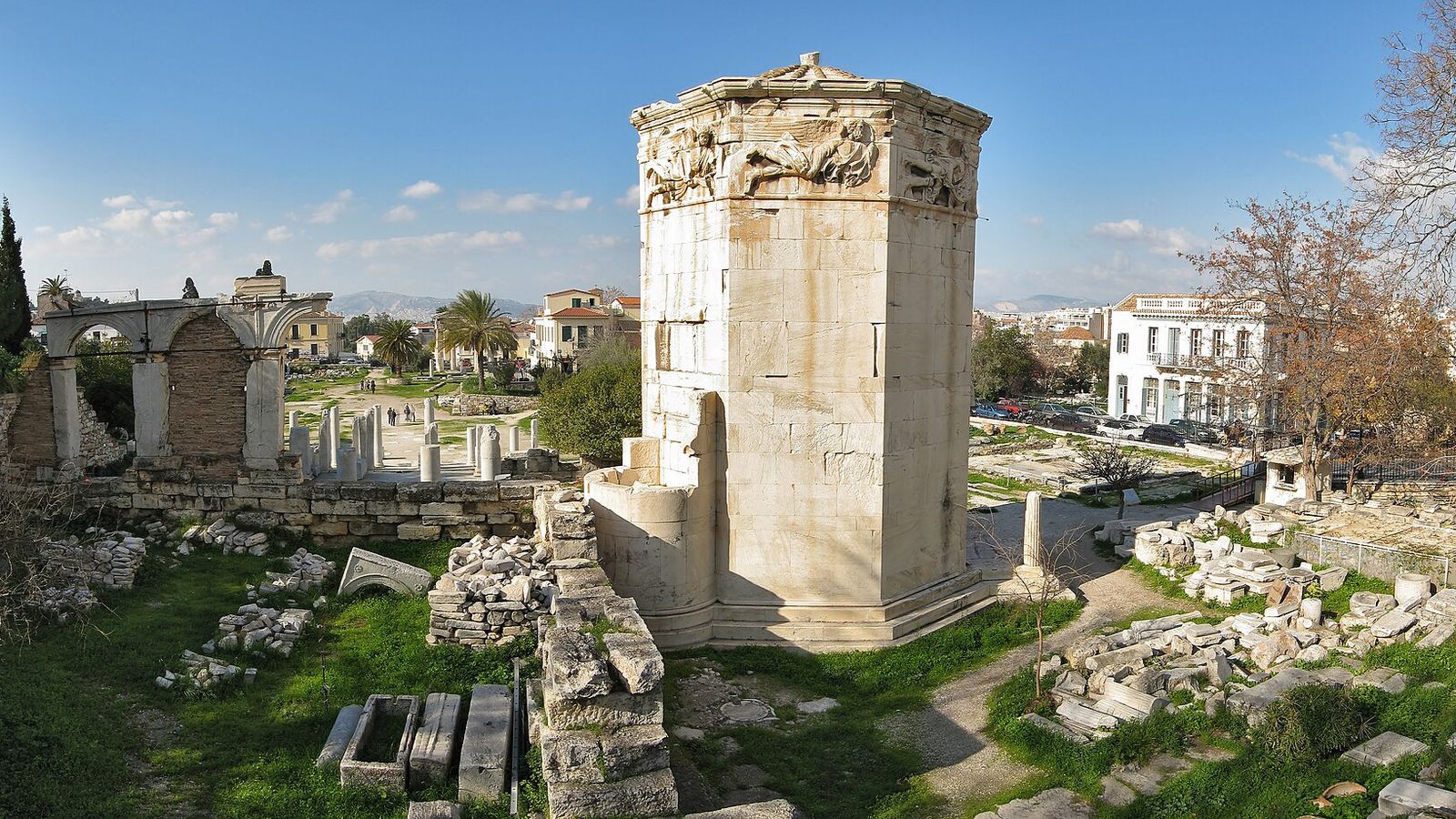
Each side faces one of the eight main compass points and carries a carved wind god. Boreas, the north wind, blows a conch shell; Notos, the south wind, empties a jar of rain.
Sundials on the outside told the time on sunny days. Inside, a water clock fed by the Klepsydra spring on the Acropolis worked at night and under clouds, and a bronze Triton on the roof turned with the wind.
In late antiquity it was used by a Christian church, and in the 18th century, under Ottoman rule, it became a tekke, a lodge for Dervishes. It is the only clock tower to survive from classical antiquity.
It was a public timepiece and weather station: sundials outside, a water clock inside and a weathervane on top.
Around 50 BC, designed by the astronomer Andronikos of Cyrrhus.
In the Roman Agora of Athens, between Monastiraki and Plaka.