Madrid, Spain

A royal palace,
a Nile temple,
and the stories
in between.

Urban Tales is a GPS audio guide app that narrates Madrid's hidden history, legends and secrets automatically as you walk — at your own pace, with no tour group to follow.


Walk up to a landmark.
The story starts.

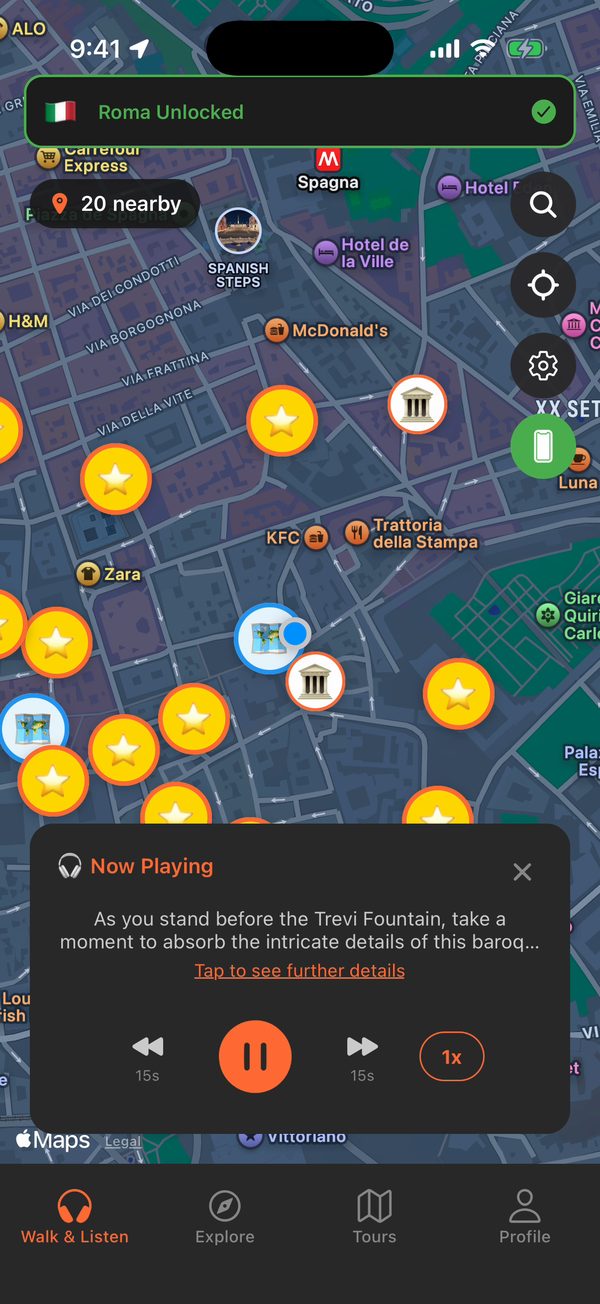
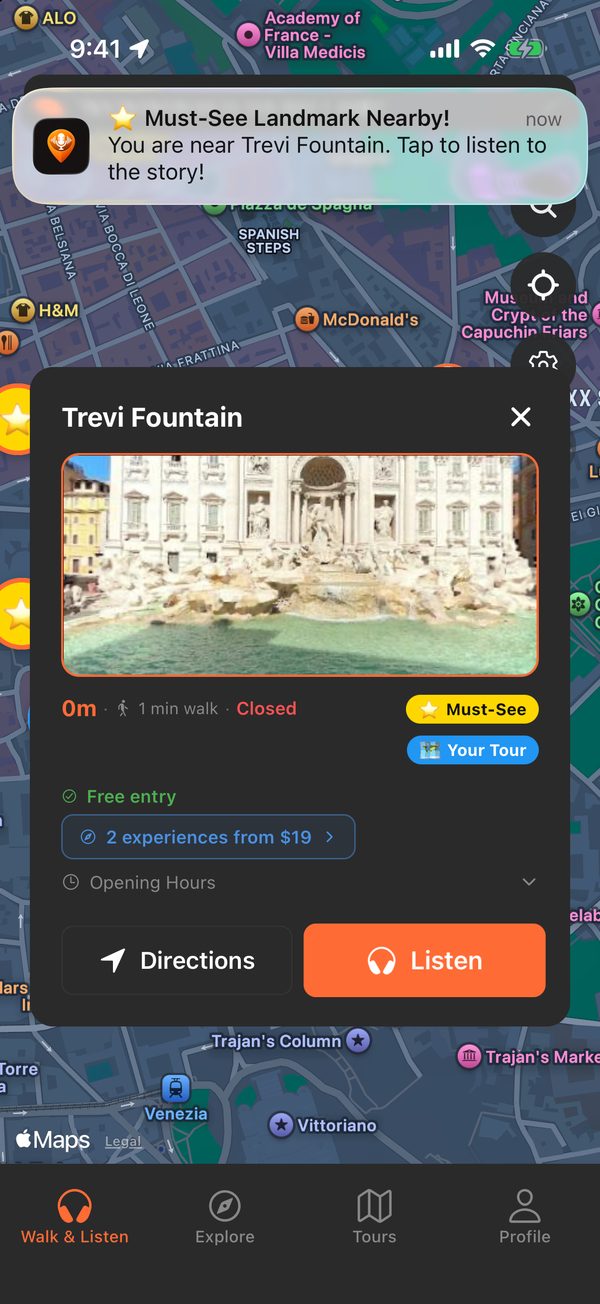
No tapping. No searching. Urban Tales detects your GPS position and plays audio automatically the moment you're close enough. Put your phone in your pocket — just walk and listen. (Screens shown: the app in Rome.)

Urban Tales in Rome: map of nearby landmarks with a story playing

GPS triggered. Audio starts the moment you arrive at a landmark.

Urban Tales in Rome: notification that a must-see landmark is nearby

Walk freely. Every landmark around you has a story ready.

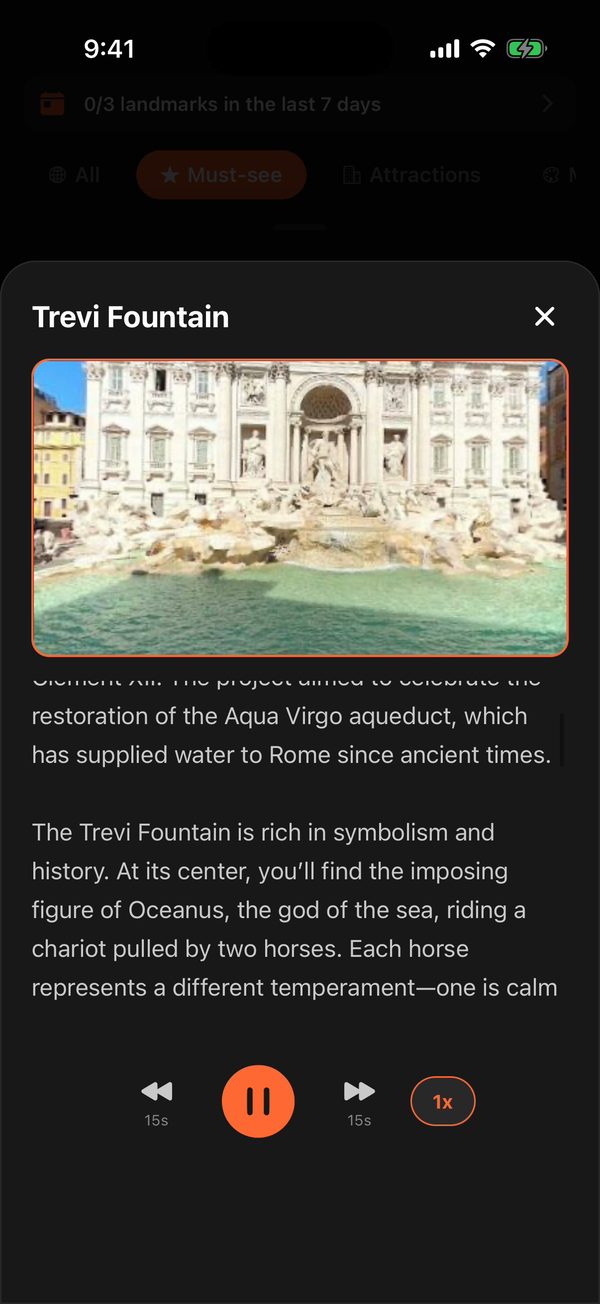
Urban Tales in Rome: the Trevi Fountain story with photo and narration text

Rich stories. History, legends and context for every landmark.

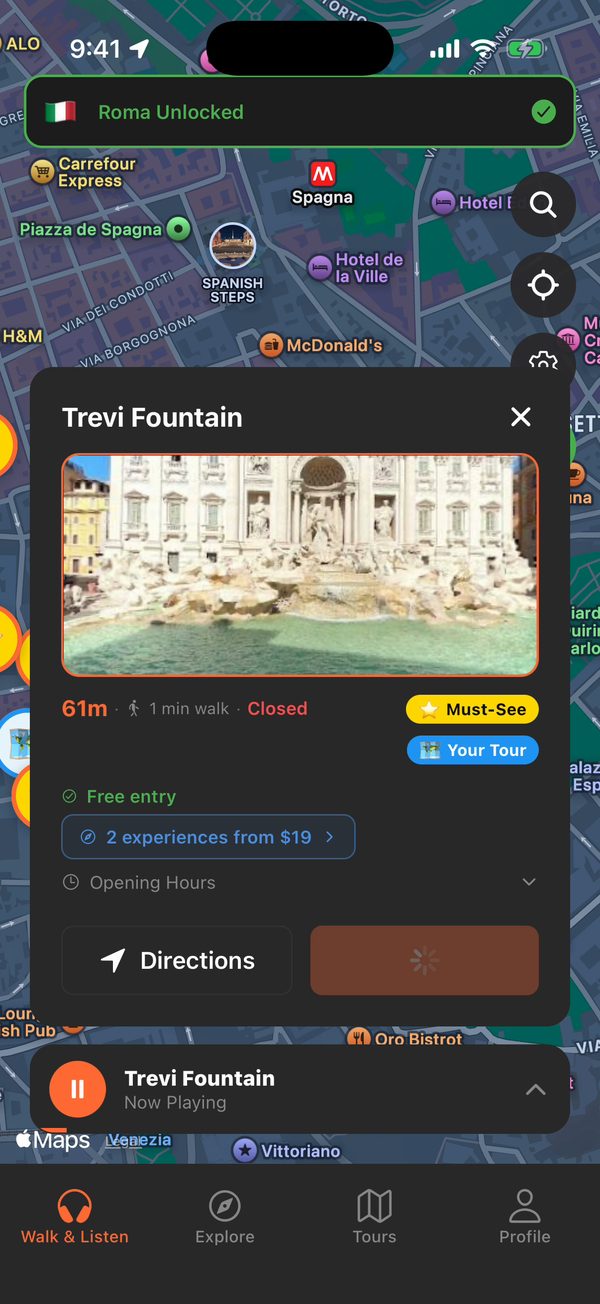
Urban Tales in Rome: the Trevi Fountain card with Listen and Directions

4 storytelling styles. Historical, Legends, Fun Facts and Cinematic.


How it works

Open the app.
Start walking.

No preparation, no pre-booked route, no group to keep up with. Urban Tales works the moment you step outside.

01

Download and open the map

The app shows landmarks around you the moment you open it. Works anywhere in Madrid — from the Royal Palace to a quiet street in La Latina.

02

Walk toward anything that catches your eye

As you get close to a landmark, the audio starts automatically. Put your phone in your pocket and just walk and listen.

03

Build a route or explore freely

Create a half-day route, a full-day itinerary, a 7-wonders tour or a custom path. Or ignore all of that and wander — the app keeps up.


What you'll hear

The Madrid most visitors
never actually learn.

These are the kinds of stories Urban Tales narrates as you walk. Each one triggers automatically when you're standing in the right place.

History

Royal Palace · Madrid de los Austrias

The largest royal palace in Europe exists because the old one burned down on Christmas Eve

The Royal Alcázar, a fortress first built by the Emir of Córdoba in the 9th century, burned down on Christmas Eve 1734. Spain's new Bourbon kings replaced it with a palace of 3,418 rooms, built almost entirely of stone between 1738 and 1755. Charles III was the first king to live in it.

Fun fact

Temple of Debod · Parque del Oeste

A 2,200-year-old Egyptian temple stands on a Madrid hilltop, and it was a thank-you gift

When the Aswan High Dam threatened to flood the temples of Nubia, Spain helped UNESCO save them. In 1968 Egypt gave Spain the Temple of Debod, which was taken apart, shipped and rebuilt stone by stone. It opened in 1972, facing east to west as it did on the Nile.

History

Plaza Mayor · Centro

The city's grand square burned three times, and the one you see is the rebuild

Finished in 1619 on the site of an old market, the Plaza Mayor hosted markets, bullfights and royal ceremonies. After the worst of its three fires, in 1790, architect Juan de Villanueva lowered the buildings from five storeys to three and opened the arches at the corners.

Fun fact

Puerta del Sol · Centro

All of Spain starts the New Year eating twelve grapes to this clock

The clock on the Real Casa de Correos, given in 1866, rings in the New Year on national TV, and Spaniards eat one grape for each of the twelve chimes. A plaque on the pavement outside marks Kilometre Zero, the point Spain's main roads are measured from.

History

Palacio de Cristal · Retiro Park

A President of Spain was elected inside a greenhouse

The iron-and-glass Palacio de Cristal was built in 1887 to house tropical plants from the Philippines. In 1936 the assembly that elected Manuel Azaña President of the Second Republic met here, because the parliament building was too small.

Legend

Almudena Cathedral · Madrid de los Austrias

A Virgin hidden in the town wall, and a cathedral that took 110 years

By tradition, Madrid's patron image was hidden in the town wall during the Muslim conquest and found again centuries later; her name comes from the Arabic al-mudayna, the citadel. The cathedral dedicated to her was begun in 1883 and consecrated only in 1993, by Pope John Paul II.


Where to walk

Madrid's neighborhoods,
explained through stories.

Urban Tales covers the full city. Here are the areas where the stories are thickest.

Madrid de los Austrias

The oldest part of the city, around the Plaza Mayor and the Royal Palace: the streets of the Habsburg capital, the Almudena Cathedral and the Mercado de San Miguel.

La Latina

Narrow streets, the Sunday Rastro flea market and the tapas bars of Cava Baja, in one of the oldest neighborhoods of Madrid.

Barrio de las Letras

The writers' quarter, where Lope de Vega lived and Cervantes is buried, with lines of their work set into the pavement.

Paseo del Prado & Retiro

The Prado, the Reina Sofía and the Thyssen museums along one avenue, next to the Retiro Park and its Palacio de Cristal. A UNESCO World Heritage Site since 2021.

Malasaña

The heart of the 1980s Movida madrileña, the cultural explosion after the end of the dictatorship, and still the city's most bohemian neighborhood.

Gran Vía

Madrid's great avenue, cut through the old city from 1910, with early skyscrapers, theatres and the Edificio Metrópolis at its start.


Storytelling styles

Choose how Madrid
speaks to you.

The same landmark sounds completely different in each mode. Switch styles anytime during your walk.

Historical

Context, dates, politics, empires. What actually happened here and why it mattered. For travelers who want to leave Madrid genuinely knowing things.

Legends

Myths, curses, ghosts and ancient superstitions. The stories Madrileños told each other before the history books were written.

Fun Facts

The absurd, the surprising and the genuinely weird. Perfect for keeping energy up on a long walk or exploring with kids.

Cinematic

Films shot here and scenes set here: Almodóvar has filmed Madrid for four decades. Madrid through the lens of cinema.


Madrid's landmarks,
one story at a time.


FAQ

Common questions about
Urban Tales in Madrid.

Does Urban Tales cover the Royal Palace and the Prado?

Yes. Stories play as you reach the Royal Palace, the Prado, the Plaza Mayor and the other landmarks around you. The app tells the story outside; tickets for the interiors are separate.

Is Urban Tales worth it if I've already been to Madrid?

Especially then. The Legends and Fun Facts modes turn places you already know, like the Puerta del Sol or the Plaza Mayor, into new stories.

How does the pricing work for Madrid?

You can start exploring for free. A Day Pass unlocks every city for a day, or you can unlock Madrid permanently. No subscription required.

What languages is the Madrid audio guide available in?

English, Spanish, Brazilian Portuguese, French and German. Select your language when you first open the app.

Can I use Urban Tales for a half-day or full-day visit to Madrid?

Yes. Use the tour generator for a half-day, full-day or 7 Wonders route, or just walk and let the stories find you.

Madrid is waiting.
The stories start the moment you land.

Free to download. No tour group. No fixed schedule.

Download on theApp Store
Get it onGoogle Play

Explore more

Urban Tales works
everywhere you travel.

These are our deepest, most-researched city guides — but Urban Tales generates fresh stories for any city or town on Earth, the moment you get there.

View all cities → How we compare to other audio guide apps →